

Channel Capacity Limits: Shannon and Nyquist Worked Examples and Exam Traps
Learn when to use the Nyquist and Shannon limits, how to compare them, and how to reverse both formulas through checked numerical examples.
KnowledgeGate Team
Exam prep & CS education
Updated 17 Nov 20266 min read
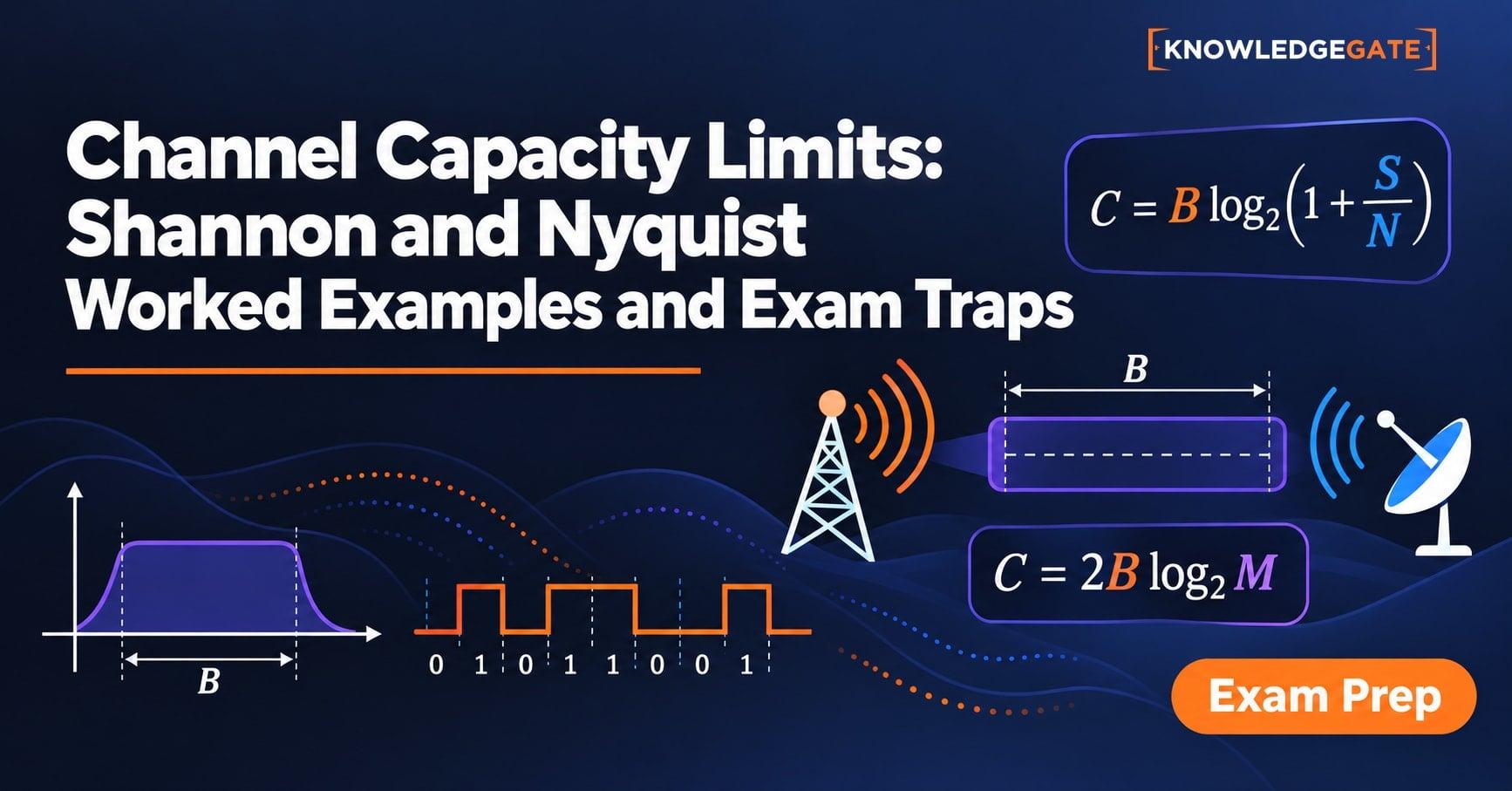
Many learners remember both channel capacity formulas but still lose marks when decibels, signal levels, or both limits appear together. The mistake is usually choosing a formula from memory before sorting bandwidth in hertz, symbol rate in baud, data rate in bit/s, and SNR as a linear power ratio. For wider study, this topic sits under Computer Networks within CS fundamentals. A 3 kHz channel has separate Nyquist and Shannon limits, and its combined limit is the smaller applicable ceiling. For a 6 Mb/s target, the formulas give the required signal alphabet and SNR.
The Data Communication in Computer Networks guide places the same 3 kHz/30 dB and 1 MHz/6 Mb/s baselines alongside multiplexing and switching. The deeper distinction is the active constraint: comparing both ceilings reveals the bottleneck-switch alphabet, while reversing them yields the required alphabet and SNR.
Channel capacity limits: what Nyquist and Shannon actually bound
Channel capacity is a theoretical upper bound on reliable information rate under a stated model. It is not a speed that every real modem automatically achieves. Keep four quantities separate: bandwidth B is measured in hertz, symbol rate in baud, capacity C in bit/s, and M is the number of distinct signal levels.
Limit | Channel model | Inputs | What it bounds |
|---|---|---|---|
Nyquist | Ideal, noiseless, bandwidth-limited |
| Bit rate allowed by bandwidth and the signal alphabet |
Shannon | Noisy channel |
| Reliable information rate allowed by bandwidth and noise |
The formulas describe different constraints. Never add their answers. If you want a structured route through core subjects including Computer Networks, Computer Science Fundamentals for Placements by Sanchit Sir is an optional resource.
Nyquist capacity limit: convert signal levels into bit rate
For an ideal noiseless channel, bandwidth B permits at most 2B symbols per second. If each symbol can take one of M levels, it carries log2(M) bits. Combining those two facts gives:
C_N = 2B log2(M) bit/s
For B = 3 kHz = 3000 Hz and M = 8:
Maximum symbol rate
= 2 x 3000 = 6000baud.Bits per symbol
= log2(8) = 3bits.Nyquist ceiling
= 6000 x 3 = 18,000 bit/s = 18 kb/s.
Notice that M = 8 levels, while log2(M) = 3 bits per symbol. They are not interchangeable.
Now reverse-check a requested 24 kb/s on the same noiseless channel:
24,000 = 6000 log2(M)
So log2(M) = 4, which gives M = 2^4 = 16 levels. Raising the rate from 18 to 24 kb/s requires twice as many levels here. In general, however, doubling a target rate does not mean merely doubling M, because the rate depends on log2(M).
Shannon capacity limit: convert decibels before using the logarithm
For a noisy channel, Shannon's formula is:
C_S = B log2(1 + S/N) bit/s
The S/N value must be a linear power ratio. For an SNR of 30 dB, convert first:
S/N = 10^(30/10) = 10^3 = 1000
Do not substitute 30 directly into Shannon's formula. A ratio of 1000 means that signal power is 1000 times noise power. The ratio is dimensionless. Bandwidth remains 3000 Hz throughout, while the logarithmic term represents the ideal information carried per hertz. For the same channel:
C_S = 3000 log2(1 + 1000)
= 3000 log2(1001)
= 29,901.68 bit/s
Rounded sensibly, the Shannon ceiling is about 29.9 kb/s. The calculation keeps the +1, uses a base-2 logarithm, and ends in bit/s. Under Shannon's model, suitable coding can approach this reliable-communication ceiling. The formula does not choose a modulation alphabet, and it does not guarantee that a practical system will operate at exactly 29.9 kb/s.
Shannon and Nyquist together: identify the active bottleneck
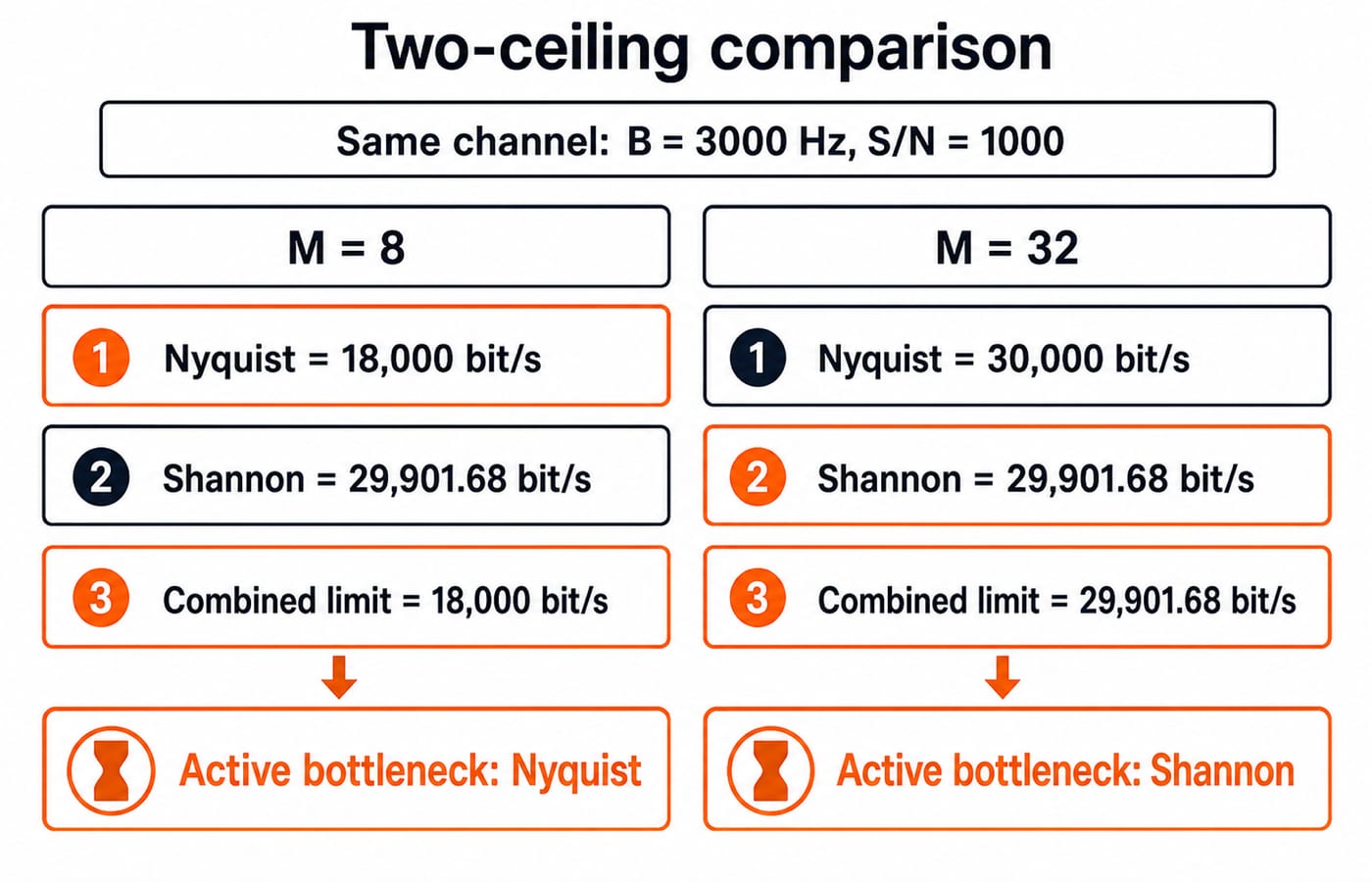
Suppose the complete question gives B = 3000 Hz, S/N = 1000, and M = 8. Compute both ceilings and compare them:
Nyquist:
2 x 3000 x log2(8) = 18,000 bit/s.Shannon:
3000 x log2(1001) = 29,901.68 bit/s.Combined textbook bound:
min(18,000, 29,901.68) = 18,000 bit/s.
The 8-level signal alphabet is the tighter constraint. The two limits are not added.
What is the smallest power-of-two alphabet that stops Nyquist from being tighter? Require:
2B log2(M) >= B log2(1001)
Cancelling B and rearranging gives M >= sqrt(1001) = 31.638.... The next valid power of two is therefore M = 32. Check it: 2 x 3000 x log2(32) = 30,000 bit/s. Nyquist now lies slightly above Shannon, so the combined limit is about 29.9 kb/s.
This threshold asks when the alphabet ceiling first reaches the noise ceiling. Taking min(Nyquist, Shannon) is the standard exam-model comparison. Increasing M alone does not overcome noise or guarantee a chosen error probability.
Inverse channel capacity problem: design for a 6 Mb/s target
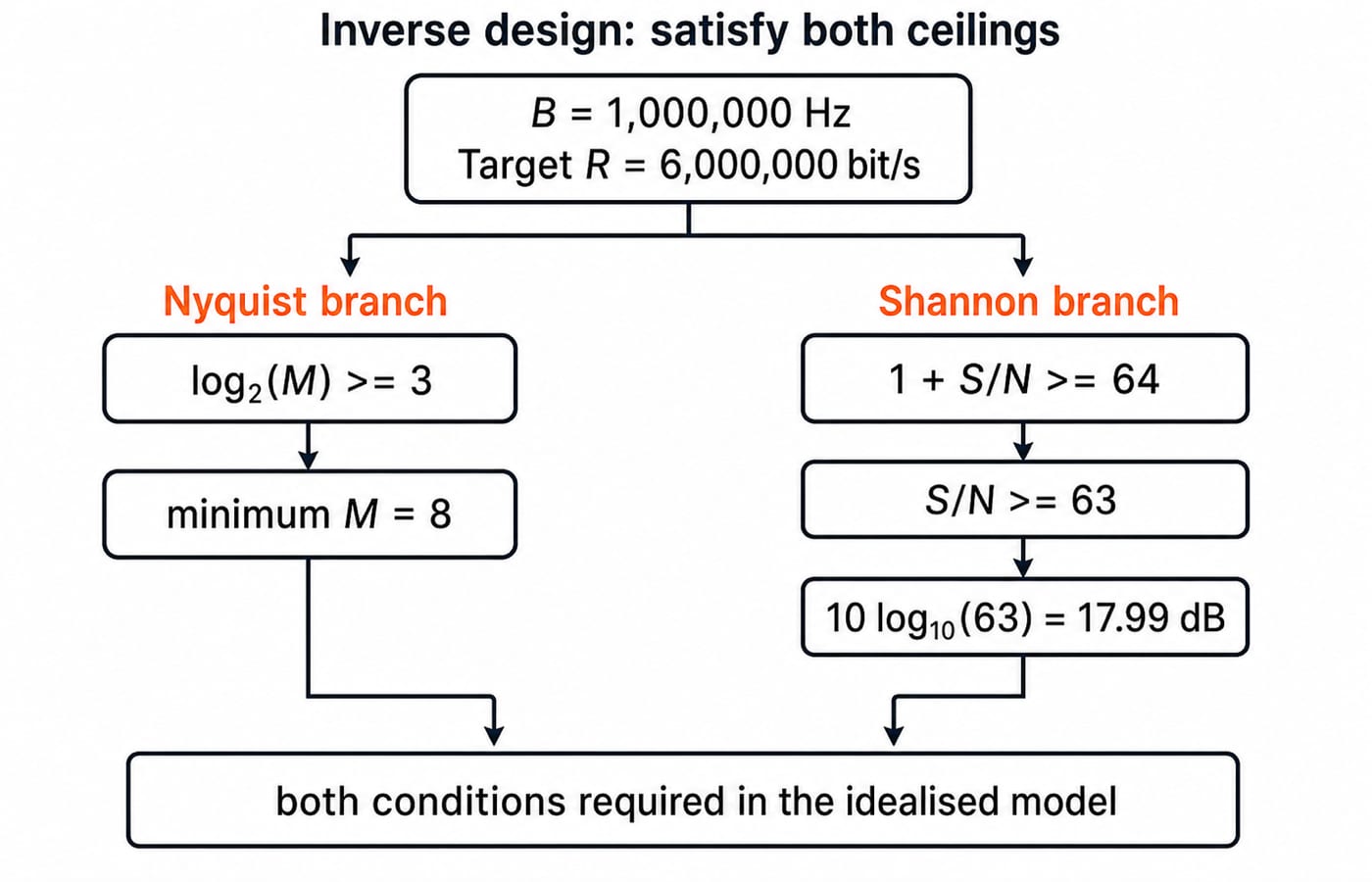
Now reverse both formulas. A channel has B = 1 MHz = 1,000,000 Hz and must support R = 6 Mb/s = 6,000,000 bit/s. Find the minimum power-of-two signal alphabet under Nyquist and the minimum SNR under Shannon.
For the Nyquist branch:
6,000,000 <= 2 x 1,000,000 x log2(M)
Therefore log2(M) >= 3, so the minimum alphabet is M = 2^3 = 8 levels. Verification: 2 x 1,000,000 x 3 = 6,000,000 bit/s.
For the Shannon branch, divide by the bandwidth:
6 = log2(1 + S/N)
Thus 1 + S/N = 2^6 = 64, so S/N = 63. Convert this minimum linear ratio to decibels:
SNR_dB = 10 log10(63) = 17.993... dB, or about 18.0 dB.
These are boundary values, not comfortable operating margins. In the idealised model, the target requires both M >= 8 and S/N >= 63. Any practical design margin lies outside the problem unless it is supplied.
Channel capacity exam traps: units, logs, and false shortcuts
The most common trap is putting 30 directly into Shannon when the value is 30 dB. Convert first to S/N = 1000. Otherwise you collapse the noise term and badly understate the ceiling of about 29.9 kb/s. Each shortcut has a corresponding correction.
Trap | Fix |
|---|---|
| Convert it to |
| Use |
Shannon's | Keep |
| Use |
| Convert it to |
| Multiply by 3: |
The two limits are added | Take the smaller applicable ceiling |
Treat bandwidth as the width of the band, not its upper edge. As a final sanity check, increasing M raises only Nyquist, increasing SNR raises only Shannon, and increasing B raises both.
Channel capacity questions: a five-step exam method
A GATE-style stem may give the bandwidth with either M or SNR and ask for the ceiling. A harder one gives both and asks which of the two limits governs, the smaller one, never their sum. It may also work backwards from a target rate to the minimum signal levels or the minimum SNR. Apply this method to direct, missing-M, missing-SNR, dB-conversion, and active-bottleneck variants:
Normalise bandwidth to hertz and rate to bit/s.
Convert any dB value to a linear power ratio.
Use Nyquist when
Mis given or requested.Use Shannon when SNR is given or requested.
When both constraints are supplied, compute both and take the smaller bound.
Write the unit beside every intermediate result, so a mistaken conversion is visible before it reaches your final answer.
You need not assume any current paper pattern. For another multi-step networking calculation, practise with TCP Congestion Control for GATE, then reinforce careful unit handling through IP Addressing and Subnetting Explained.
Channel capacity limits: the short version and next step
Nyquist maps bandwidth and signal levels to a noiseless ceiling. Shannon maps bandwidth and SNR to a noisy-channel ceiling. When both are specified, the smaller bound controls in the standard textbook model.
For the shared 3 kHz, 30 dB, 8-level channel, that bound is 18 kb/s. Moving to 32 levels exposes the roughly 29.9 kb/s Shannon ceiling. Keep the four units separate and the choice becomes mechanical. For a broader preparation roadmap after these calculations, GATE Guidance by Sanchit Sir is an optional next step.
Keep learning

Channel Capacity Limits MCQs: 12 Solved PYQs on Nyquist, Shannon and Throughput
Solve 12 published-bank channel capacity PYQs covering formula selection, substitutions and unit traps. Each answer includes a concise worked explanation.
Updated 29 Oct 20267 min read94 viewsComputer Networks MCQs

Cloud Computing: Concepts, Service Models, Evolution and a Worked Capacity Plan
Learn what makes a service a cloud, how its two classification axes differ, and how elasticity changes compute and storage capacity.
Updated 30 Oct 20266 min readComputer Networks

final Keyword in Java: Constants, Inheritance Limits and Restrictions
Learn what Java's final keyword fixes in each declaration position, then trace assignment, array mutation, method inheritance, arithmetic, and compiler errors.
Updated 16 Nov 20266 min readJava
Linear Bounded Automata: Tape Limits, a Worked LBA Trace and Exam Traps
See exactly what an LBA bounds, where it sits in the language hierarchy, and how a six-cell marking machine accepts aabbcc while rejecting three near misses.
Updated 30 Oct 20266 min read79 viewsTheory of Computation