CDAC C-CAT Syllabus Decoded: Sections A, B and C and Which Course Needs Which
C-CAT is not the same section combination for every diploma. Decode Sections A, B and C, map each to its subjects, and plan only after checking your target course.
KnowledgeGate Team
Exam prep & CS education
Updated 23 Aug 20265 min read
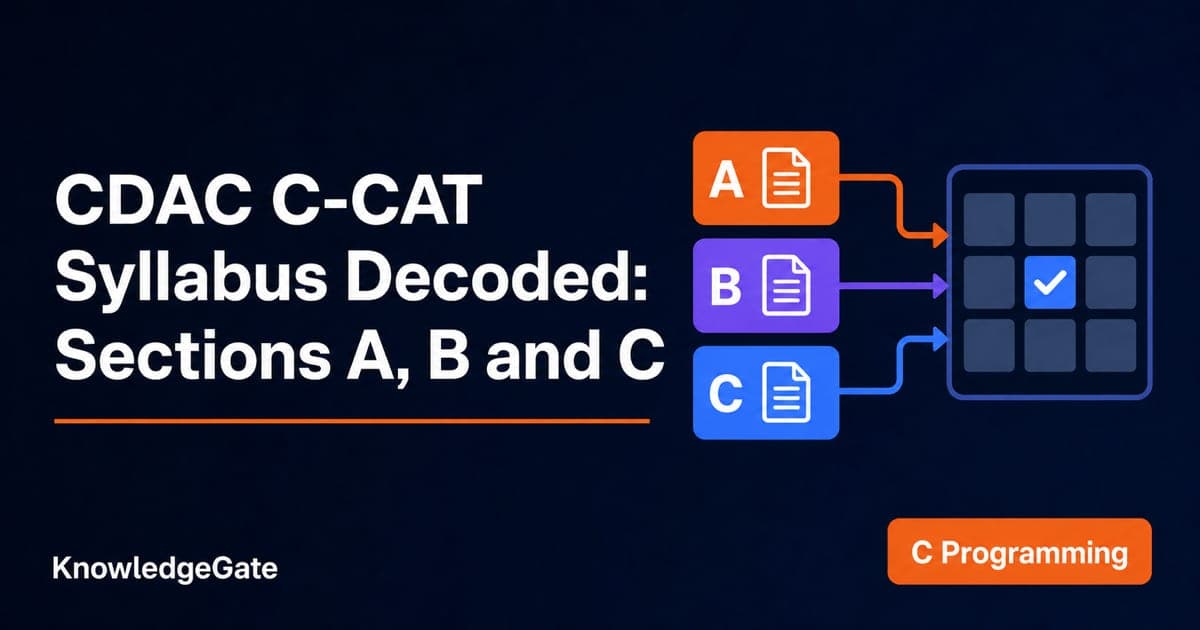
C-CAT is not one identical paper route for every C-DAC postgraduate programme. Different programmes require different combinations of Sections A, B and C. If you skip that check, you may spend weeks on a section your target does not need or neglect one it does.
Start with the course, identify its required section combination, then build the study plan. Each section tests a distinct group of subjects.
C-CAT Sections A, B and C at a glance
The three sections move from general aptitude to CS foundations and then a focused computer-hardware block:
Section | Main areas | Preparation character |
|---|---|---|
Section A | English, quantitative aptitude, reasoning, computer fundamentals and concepts of programming | Placement-style aptitude and fundamentals |
Section B | C programming, data structures, OOP with C++, Operating Systems and Networking, basics of Big Data and AI | Programming, systems and core problem solving |
Section C | Computer Architecture, Digital Electronics and Microprocessors | Focused hardware fundamentals |
Sections A, B and C divide aptitude, CS foundations and hardware topics. The current C-DAC admission page also defines the per-section question format, duration, marking scheme and course-to-paper combinations. Confirm these cycle-specific details on the official C-DAC C-CAT admission page before applying.
Section A: aptitude, English and reasoning
Section A is the common baseline across many C-CAT routes. Its syllabus combines quantitative aptitude, English, reasoning, computer fundamentals and concepts of programming.
The questions may resemble placement-test work, but that does not make the section automatic. It tests several different habits:
Quantitative aptitude: choosing an efficient method, controlling arithmetic and working under time pressure
English: reading precisely, recognising usage and separating close options
Logical reasoning: translating conditions into a clean arrangement before solving
Computer fundamentals and programming concepts: connecting core computer terminology with basic programming ideas
Prepare Section A in short, frequent sessions. Alternate the main focus between quantitative aptitude and English or reasoning, but use mixed timed sets every few days. A topic-wise score is more useful than one overall percentage because it tells you what to revise next.
For a comparison, TCS NQT Exam Structure, Explained Section by Section shows how aptitude preparation is organised under a different test's rules.
Section B: the CS core
Section B is where C programming, data structures, object-oriented concepts using C++, Operating Systems and Networking, and the basics of Big Data and AI meet. Developer-oriented routes lean heavily on this foundation.
For C, do not stop at syntax. Be able to trace:
Operators, precedence and expression values
Arrays, strings and pointer movement
Functions, parameters and recursion
Structures, storage and memory behaviour
Short output questions with undefined or implementation-dependent traps clearly separated
For data structures, connect the representation to the operation. Know what changes during linked-list insertion, why a stack supports a particular access order, how queue indices move, and what a tree traversal actually visits.
OOP preparation should also be operational. Explain why encapsulation helps, distinguish overriding from overloading, and follow a small inheritance or polymorphism example. Definitions are the starting point, not the finish.
For Operating Systems and Networking, connect concepts to short scenarios: trace process and memory behaviour, then reason through layers, addressing and data flow. For Big Data and AI basics, learn the foundational terminology and the purpose of the main ideas instead of treating them as an advanced specialist syllabus.
The C++ Programming Course: Concepts, MCQs & Coding maps directly to the programming work needed for this section. Pair concept study with output tracing and topic-wise questions from the beginning.
Section C: the focused hardware block
Section C is a compact hardware block. Its three official subject areas are Computer Architecture, Digital Electronics and Microprocessors.
Prepare them as a connected sequence:
In Digital Electronics, practise number systems, Boolean logic, gates, and combinational and sequential circuits.
In Computer Architecture, connect data representation with processor organisation, memory and input-output behaviour.
In Microprocessors, understand the processor architecture, instruction execution, programming model and basic interfacing.
If Section C is part of your target route, study one hardware subject in sustained blocks and finish each block with mixed questions. Use the official C-DAC reference list to keep the depth aligned with C-CAT.
Which sections your C-DAC course needs
Use the course requirement to decide the study load, not the other way around. For the August 2026 batch listed on C-DAC's current admission page, the mapping is:
Category II, Sections A and B: Advanced Computing (PGCP-AC), Big Data Analytics (PGCP-BDA), Artificial Intelligence (PGCP-AI), IT Infrastructure, Systems & Security (PGCP-ITISS), Mobile Computing (PGCP-MC), Advanced Secure Software Development (PGCP-ASSD), HPC System Administration (PGCP-HPCSA), FinTech & Blockchain Development (PGCP-FBD), Cyber Security & Forensics (PGCP-CSF), and Robotics & Allied Technologies (PGCP-RAT).
Category III, Sections A, B and C: Embedded Systems Design (PGCP-ESD) and VLSI Design (PGCP-VLSI).
C-DAC replaced the older PG Diploma labels with PG Certificate Programme names for this cycle, so do not rely on an old acronym chart. Recheck the current admission page if you are preparing for a later cycle.
Follow this planning sequence:
List the programmes you would genuinely join.
Find each programme's required section combination on the current admission page.
Note whether the relevant merit list uses A+B or A+B+C.
Build a common study base for overlapping sections.
Add Section C time only where a target requires it, but then prepare it properly.
Taking an extra section does not improve your position for a course whose merit list excludes that section. Section C is a narrow hardware block, but prepare all three of its subjects if an Embedded Systems Design or VLSI Design route is your target.
Our practice resources cover much of Sections A and B, including over 900 C-programming questions and 1,500+ data-structures items, thousands across Operating Systems and Computer Networks, plus 8,000+ quantitative-aptitude and 6,000+ English items. For Section C, separately plan complete coverage of Computer Architecture, Digital Electronics and Microprocessors from the current official syllabus and reference list.
Use CS Fundamentals for Exams & Placements to organise the overlap between programming, operating systems, networks and hardware.
The short version and next step
Section A covers aptitude, English, reasoning and basics. Section B covers programming, Operating Systems and Networking, and Big Data and AI basics. Section C covers Computer Architecture, Digital Electronics and Microprocessors. Identify the exact combination for your chosen programme before deciding where your hours go.
Then follow CDAC C-CAT 2026: Complete Preparation as the primary route through the required sections. Keep the current C-DAC brochure beside your plan, mark A+B or A+B+C at the top, and study that combination deeply instead of preparing for an imaginary universal paper.
Keep learning
Common Editing Ctrl Keys Explained: Copy, Cut, Paste, Undo and Redo with Worked Examples
Learn what each common Ctrl key does, then trace the document, clipboard, cursor and edit history through precise examples without confusing Copy, Cut or Undo.
Updated 11 Oct 20266 min readTeaching Recruitment (Computer Science)
Browsers and Search Engines MCQs: 9 Solved Questions with Explanations
Solve nine published browser and search engine questions, check each answer, and rebuild the browser, cache, crawler and indexing distinctions that exam distractors blur.
Updated 6 Oct 20267 min readTeaching Recruitment (Computer Science)
IT Act, 2000 Explained: Key Sections, Digital Signatures and Worked Exam Examples
Build an exam-ready map of the IT Act, then apply it to an exact digital-signature walkthrough and a section 43, 66, 66C and 66D caselet.
Updated 2 Oct 20266 min readTeaching Recruitment (Computer Science)
Emerging Trends Introduction MCQs: 12 Solved Questions with Explanations
Solve 12 Emerging Trends Introduction questions with clear answer logic, exam-year labels and a compact trap check for focused revision.
Updated 27 Sep 20268 min readTeaching Recruitment (Computer Science)