CAT Mock Analysis: Diagnose Time, Accuracy and Question Choice
Turn one mock into a practical review sheet. Separate execution, selection and reach problems, then test one measurable rule per section.
KnowledgeGate Team
Exam prep & CS education
Updated 22 Aug 20265 min read

An overall mock score cannot show whether marks leaked through bad attempts, avoidable skips, or questions you never reached. Run three passes and finish with one measurable experiment per section. The worked numbers here come from one 66-question practice mock, so the method transfers even though the figures will not.
1. Build the Evidence Sheet Before Reading Any Solution
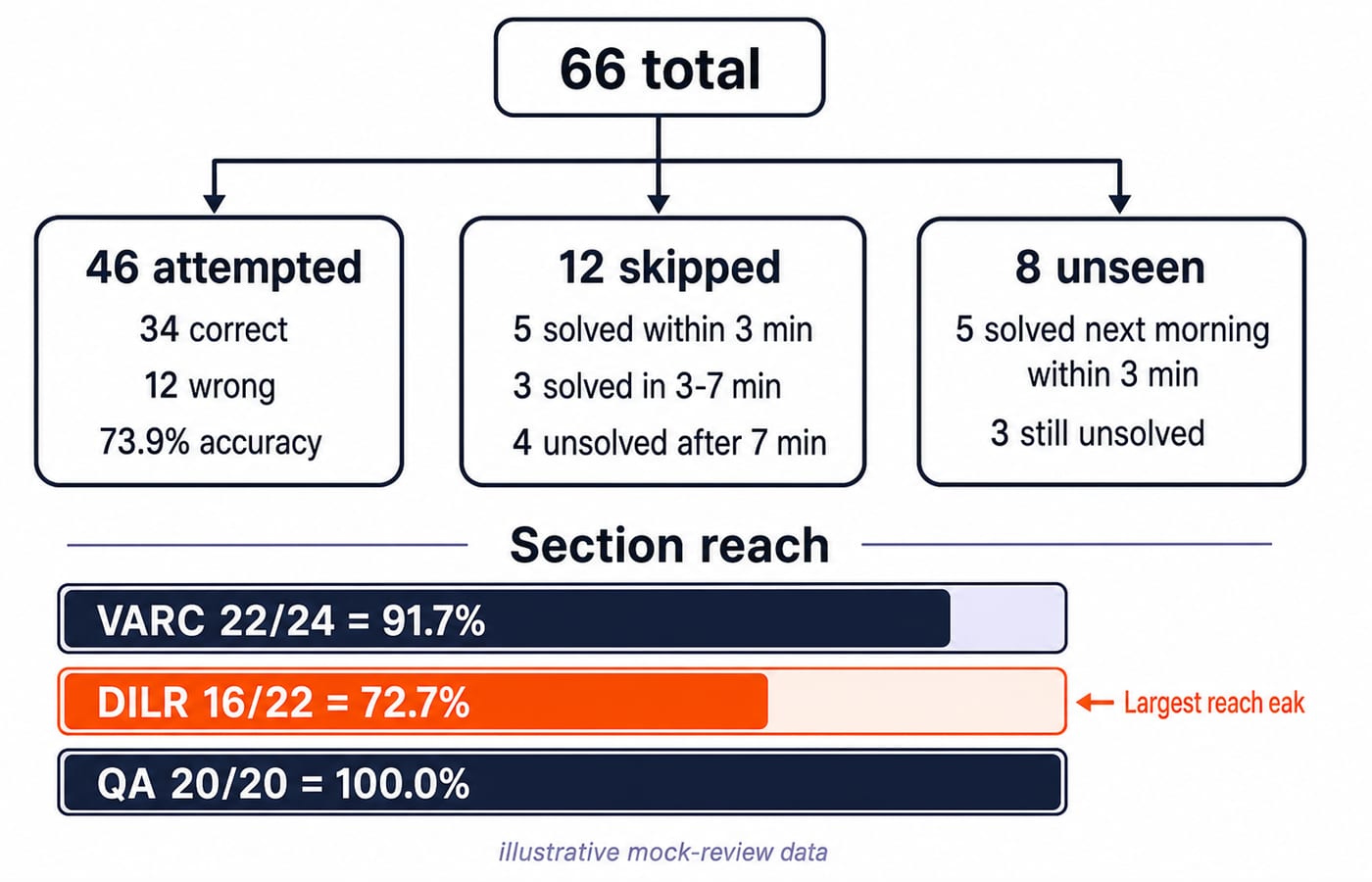
Start at question level. Attempted means an answer was submitted, skipped means the question was seen but left, and unseen means it was never opened or read. The buckets are mutually exclusive.
For a set-based item, record both set selection and each question's outcome. A poor choice can otherwise hide inside four errors.
Use these columns exactly: section, question or set ID, attempted/skipped/unseen, time spent, confidence before submission, correct/incorrect, error cause, untimed re-solve result, and next action. Fill the first six from the mock interface or your rough-work memory before reading explanations.
Section | Total | Attempted | Correct | Wrong | Skipped | Unseen |
|---|---|---|---|---|---|---|
VARC | 24 | 18 | 14 | 4 | 4 | 2 |
DILR | 22 | 12 | 8 | 4 | 4 | 6 |
QA | 20 | 16 | 12 | 4 | 4 | 0 |
Total | 66 | 46 | 34 | 12 | 12 | 8 |
Every row balances: total equals attempted plus skipped plus unseen, and attempts equal correct plus wrong.
2. Pass One: Diagnose the 46 Attempted Questions
Calculate attempt accuracy before diagnosing individual errors:
Overall:
34 / 46 x 100 = 73.9%VARC:
14 / 18 x 100 = 77.8%DILR:
8 / 12 x 100 = 66.7%QA:
12 / 16 x 100 = 75.0%
More attempts do not automatically mean a healthier section. Selection and execution are separate.
The confidence split is 26 confident-correct, 8 uncertain-correct, 3 confident-wrong and 9 uncertain-wrong. Audit the 3 for concept, reading or calculation errors, and the 9 for selection and exit-rule errors. A wrong answer is not automatically a knowledge gap.
A QA item gives A:B = 3:5 and B:C = 10:7. After 4 minutes 10 seconds, the candidate confidently writes A:C = 3:7. The shared term B was not matched.
Scale
A:B = 3:5by 2 to getA:B = 6:10.Combine
A:B = 6:10withB:C = 10:7.Therefore,
A:C = 6:7.
The untimed re-solve takes 55 seconds. Label it a setup error, then write the shared term before combining ratios.
3. Pass Two: Separate Avoidable Skips From Sensible Skips
Re-solve the 12 skipped questions without solutions, using a stopwatch. Here, 5 are correct within 3 minutes each, 3 take 3 to 7 minutes, and 4 remain unsolved after 7 minutes. The first 5 are avoidable skips; the other 7 are sensible timed skips or current gaps. Judge by evidence, not regret.
Suppose the candidate skipped x + 1/x = 5, asking for x^2 + 1/x^2.
Square both sides:
(x + 1/x)^2 = 25.Expand:
x^2 + 2 + 1/x^2 = 25.Subtract 2:
x^2 + 1/x^2 = 25 - 2 = 23.
The re-solve takes 1 minute 40 seconds. Record recognition failure, not weak algebra. Add a first-scan visual cue for recognition failure, schedule a concept drill for an unsolved item, and keep the skip rule when solving takes 3 to 7 minutes. Give each skip one action.
4. Pass Three: Find Why Eight Questions Were Never Reached
Reached means attempted plus skipped. The rates are:
Overall:
(46 + 12) / 66 = 58 / 66 = 87.9%VARC:
(18 + 4) / 24 = 22 / 24 = 91.7%DILR:
(12 + 4) / 22 = 16 / 22 = 72.7%QA:
(16 + 4) / 20 = 20 / 20 = 100.0%
DILR has the largest reach leak, beyond its low attempt accuracy. The candidate spends 12 minutes on the first chosen set, gets two contradictory deductions, abandons it with zero correct answers, and never views 6 questions. A 5-minute VARC reread leaves 2 unseen.
Only then run a counterfactual. Next morning, 5 of the 8 unseen questions are solved correctly within 3 minutes each; 3 remain unsolved. That suggests 5 reach failures and 3 current ability gaps. Do not add the five to an imaginary score or percentile. Fresh work is not the mock.
5. Turn Findings Into Three Experiments for the Next Mock
Change one rule per section so the result remains interpretable.
Section | Finding | Rule for the next mock | Success measure |
|---|---|---|---|
VARC | 2 unseen after a 5-minute reread | After 90 seconds without eliminating an option, flag and move | Reach at least 23 of 24, with attempt accuracy at or above 75% |
DILR | 12 minutes lost on a failed set, 6 unseen | Spend the first 4 minutes ranking sets. Leave at the 8-minute checkpoint if fewer than 3 deductions are verified | At most 3 unseen and no abandoned set above 8 minutes |
QA | 3 of 4 skips solved within 3 minutes on review | Mark visually familiar algebra and arithmetic structures during the first scan | Attempt at least 17, with accuracy at or above 75% |
Treat the three rules as this candidate's, then derive your own from your own sheet. Rising reach with accuracy below its guardrail counts as a failed experiment, not progress. If reach improves without accuracy loss, keep the rule for one more mock. Ranking DILR sets inside four minutes is the hardest of the three to execute, so build that rule on the four-step filter for CAT DILR set selection instead of inventing a scan of your own.
The same three-pass sheet works outside CAT. The UGC NET mock test strategy and SSC CGL mock test strategy show how the stop rules change when the paper changes.
6. Use a 4.5-Hour Review Cycle Between Weekly Mocks
Outside the mock, spend 75 minutes tagging all 66 questions, then 60 minutes re-solving skipped and unseen items, 30 minutes comparing explanations, two 45-minute cause-based drills, and 15 minutes writing the next rules.
75 + 60 + 30 + 45 + 45 + 15 = 270 minutes = 4.5 hours.
Schedule Sunday mock and tagging, Monday re-solve and explanations, Wednesday and Friday drills, Saturday experiment card, then the next Sunday mock. If Wednesday is missed, replace both drills with one 60-minute Friday block: 30 minutes for the weakest cause and 30 for the second weakest. Do not double the next day or add another mock before completing review.
7. The Short Version and the Next Action
Log attempted, skipped and unseen; diagnose execution, selection and reach separately; re-solve before solutions; choose one measurable rule per section; test it in the next mock. Seek a better decision process, not a flattering post-hoc score.
Use the CAT Preparation Course for structured preparation, or browse the PG Entrance Exams category for the broader hub.
Check the current CAT format, sectional timing, marking scheme and registration dates on the official CAT website before you fix any target of your own.
Keep learning

CAT for Non-Engineers: Build a Quant Foundation Before Chasing Shortcuts
Use this 12-week quant plan to find your real gaps, rebuild core relationships, revisit errors and add timed mixed practice only when the foundation is ready.
Updated 20 Aug 20266 min readMBA Entrance (CAT)

CAT Preparation for Working Professionals: A Sustainable 10-Hour Week
Build a repeatable CAT week around a full-time job, then use completed work and error patterns to decide what the next 600 minutes should contain.
Updated 18 Aug 20266 min readMBA Entrance (CAT)
CAT Quant for Non-Engineers: A 16-Week Foundation Plan Without Shortcuts
Rebuild CAT quant in dependency order: a 24-question diagnostic, a 16-week 160-hour map, an exact 10-hour week, an accuracy gate and a missed-day rule.
Updated 16 Aug 20265 min readMBA Entrance (CAT)

CAT DILR Set Selection: Score and Rank Sets in the First Pass
Use a written scorecard to compare DILR sets, break close calls with evidence, and leave a poor start before it consumes the rest of your mock.
Updated 14 Aug 20266 min readMBA Entrance (CAT)