Calculus for Competitive Exams: Limits, Derivatives and Integrals Solved
Learn to recognise the structure behind calculus questions, then solve limits, derivatives, optimisation problems and integrals with reliable checks.
KnowledgeGate Team
Exam prep & CS education
Updated 22 Sep 20266 min read
Calculus becomes slow when a question hides the method behind 0/0, a composite function, a word problem or an unfamiliar-looking integral. Limits, continuity, derivatives, optimisation and integration form one connected chain, supported by exact solved values and checks rather than a formula dump. If you need the wider preparation map, begin with Aptitude for Placements: Quant, Reasoning and Verbal
See calculus as one connected chain, not five formula lists
A function maps an allowed input to an output. A limit asks what is approached, continuity compares that limit with the actual value, a derivative gives instantaneous rate or tangent slope, and an integral accumulates change or signed area. First note the domain, interval, units and whether angles are in radians.
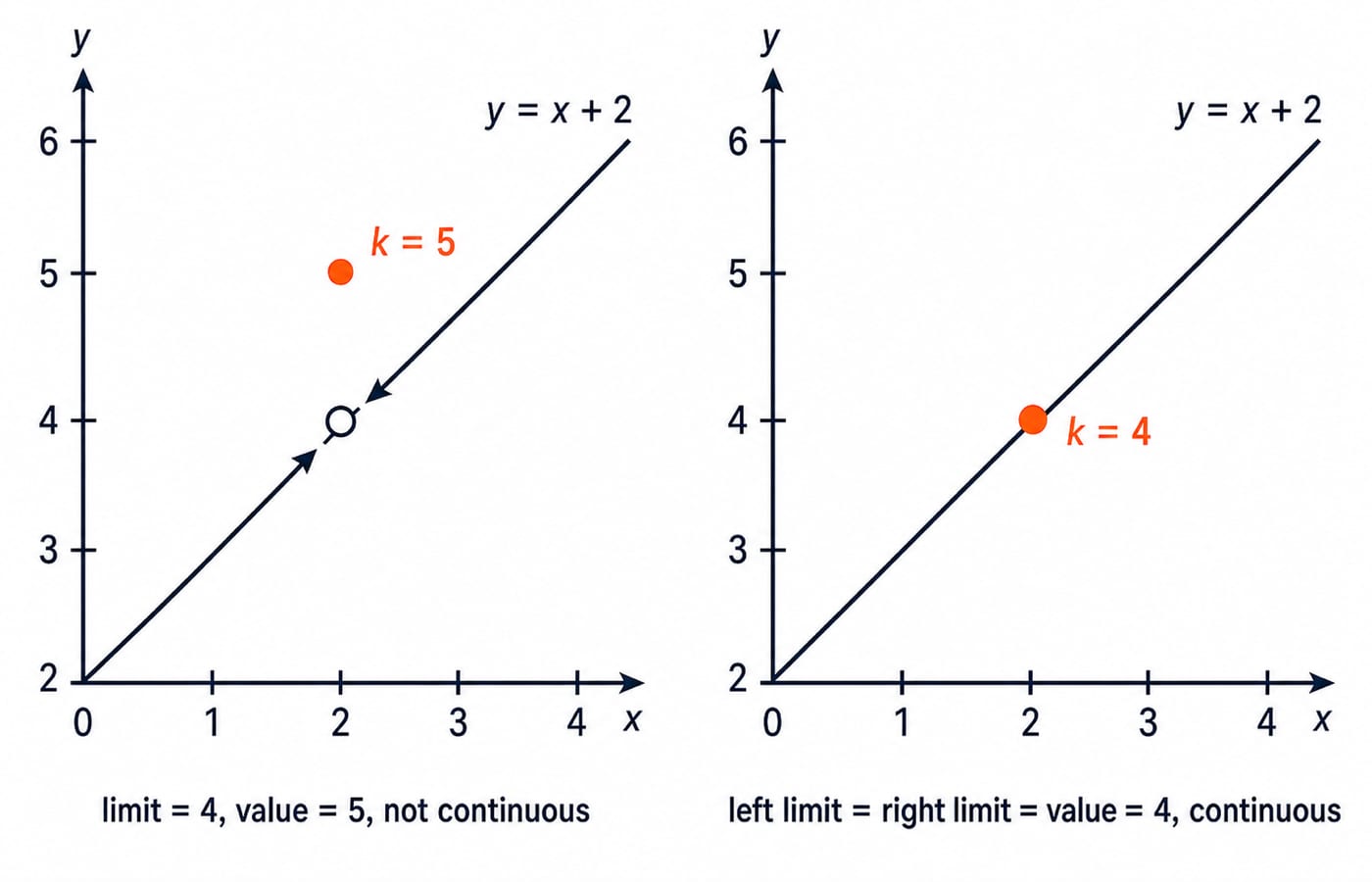
For g(x) = (x^2 - 4)/(x - 2), where x != 2, factoring gives g(x) = x + 2 on its domain. The graph is the line y = x + 2 with a hole at (2, 4). Its limit at 2 is 4; defining g(2) = 4 fills the hole, creates continuity and gives a completed line of slope 1.
On scratch paper: write the domain or bounds, name the requested object, simplify, select a rule, calculate, then check. Aptitude Courses for Exams and Placements collects related quantitative practice if you want more sets to work through.
Limits and continuity: remove the obstruction before substituting
Consider
lim(x->2) (x^2 - 4)/(x - 2).
Substitution produces 0/0, an indeterminate form, not the answer. Since x^2 - 4 = (x - 2)(x + 2), cancel x - 2 for x != 2. Then lim(x->2)(x + 2) = 4. Cancellation preserves nearby behaviour but does not restore the missing point.
If the same expression is used for x != 2 and f(2) = k, continuity requires left limit = 4, right limit = 4 and value k = 4. With k = 5, the limit exists but continuity fails.
For a radical difference, rationalise:
lim(x->0) [sqrt(1 + 3x) - 1]/x
= lim(x->0) 3/[sqrt(1 + 3x) + 1] = 3/2.
The conjugate removes the obstruction before substitution, just as factoring did above.
Derivatives: separate the outer rule from the inner change
For f(x) = x^2 at x = 3, first principles gives
[f(3 + h) - f(3)]/h = [(3 + h)^2 - 9]/h = (6h + h^2)/h = 6 + h.
As h -> 0, the slope is 6. The tangent through (3, 9) is y - 9 = 6(x - 3), hence y = 6x - 9.
Use the power rule for x^n, product for multiplying functions, quotient for division, and chain for a function inside another. For y = (x^2 + 1)^3, the outer function is u^3 and the inner is u = x^2 + 1:
dy/dx = 3(x^2 + 1)^2(2x) = 6x(x^2 + 1)^2.
At x = 1, this is 6 x 1 x 2^2 = 24. Omitting the inner derivative 2x produces the wrong value 12.
Maxima and minima: translate the words, then test the candidate
Choose a variable, write the objective, state its feasible interval, differentiate, find stationary points, then classify or compare them. A zero derivative gives a candidate, not automatically a maximum.
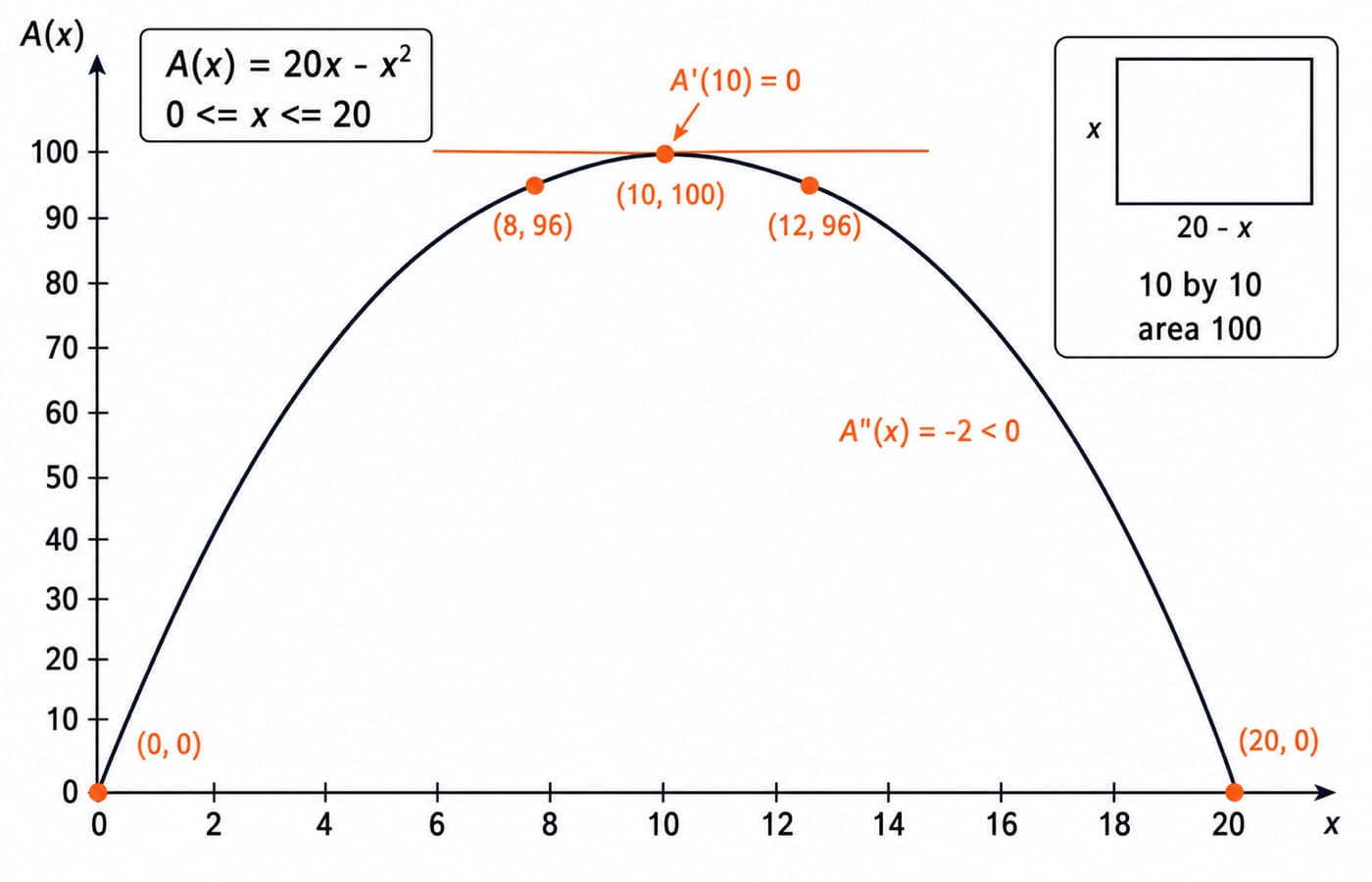
A rectangle has perimeter 40. If one side is x, the other is 20 - x, with 0 < x < 20. Its area is
A(x) = x(20 - x) = 20x - x^2.
Then A'(x) = 20 - 2x = 0 gives x = 10. Since A''(x) = -2 < 0, this is a maximum. The other side is 10, so the area is 100 square units. Extending the area formula to the boundary gives A(0) = A(20) = 0 and A(8) = A(12) = 96. This fixed-perimeter model favours a square, as the derivative proves.
Integration: reverse a derivative and keep the bounds visible
An indefinite integral is a family of antiderivatives and needs + C. A definite integral gives signed accumulation between bounds and has no final + C. The Fundamental Theorem connects them by evaluating an antiderivative at both boundaries.
For example,
integral from 0 to 3 of (2x + 1) dx = [x^2 + x] from 0 to 3
= (9 + 3) - 0 = 12.
The geometry check is [(1 + 7)/2] x 3 = 12, the area of a width-3 trapezium with end heights 1 and 7.
For substitution as reverse chain rule, evaluate
integral from 0 to 1 of 2x(x^2 + 1)^3 dx.
Let u = x^2 + 1, so du = 2x dx; bounds x = 0, 1 become u = 1, 2. The result is [u^4/4] from 1 to 2 = (16 - 1)/4 = 15/4. Never retain x bounds after changing to u.
Calculus shortcuts that work when the structure is visible
Signal | Shortcut | Condition |
|---|---|---|
Polynomial limit gives | Factor and cancel | Retain excluded domain values |
Radical difference gives | Multiply by the conjugate | Simplify before substituting |
Inner derivative multiplies a function of the inner expression | Substitute | Transform the bounds too |
Integral has bounds | Test parity | Odd integrands cancel only on symmetric finite bounds |
For the scaled standard limit, in radians,
lim(x->0) sin(5x)/(3x) = (5/3) lim(x->0) sin(5x)/(5x) = 5/3.
The result sin u/u -> 1 assumes radians. For symmetry, h(x) = x^3/(1 + x^2) is odd because h(-x) = -h(x). Hence integral from -2 to 2 of h(x) dx = 0. Both oddness and symmetric finite bounds are required.
How competitive questions hide the method
Common shapes are limits, continuity values, tangents, composite derivatives, constrained optimisation, substitution and symmetry. Recognition map: 0/0 -> simplify; piecewise point -> compare both limits and value; function inside function -> chain rule; best/largest/least -> objective plus domain; inner derivative present -> substitution.
Trap | Why it fails | Better move |
|---|---|---|
Report | It is a diagnosis, not a value | Simplify to get |
Cancel | It changes the domain | Retain the restriction |
Get | The factor | Differentiate inner and outer functions |
Call every stationary point a maximum | The point is unclassified | Use |
Use | It differentiates to | Use |
Add | Bounds already fix one value | Use |
Cancel an odd integrand on unequal bounds | Symmetry is missing | Check both parity and bounds |
Linear Algebra for GATE CS covers the adjacent topic if you want to widen the same recognition habit beyond calculus. For any named examination, confirm calculus coverage, weightage, marks and paper pattern in the organising body's current official syllabus and notification.
A concise calculus method with one mixed drill
Use six steps: mark domain or bounds; name the object; diagnose the form; simplify or select a rule; show every factor and bound; check sign, range, units and conditions. Anchor answers are 4 for the removable limit, 24 for the chain rule, 100 for maximum area and 12 for the definite integral.
Try p(x) = x^3 - 3x on [-2, 2]. From p'(x) = 3x^2 - 3, stationary points are x = -1, 1. Since p''(x) = 6x, p(-1) = 2 is a local maximum and p(1) = -2 is a local minimum. The function is odd, so integral from -2 to 2 of p(x) dx = 0. Name each recognition step first.
For a structured calculus path, continue with Engineering Mathematics for GATE Exam. For broader placement preparation that includes calculus within aptitude, use Aptitude for Placement.
Keep learning
Mensuration and Geometry for Competitive Exams: Formulas, Shortcuts and Solved Examples
Learn how to choose the right mensuration formula, avoid common geometry traps, and solve 2D path and 3D recasting problems step by step.
Updated 6 Oct 20266 min readAptitude & Reasoning
Age Comparison and Multiple-Condition Problems: 12 Solved MCQs
Practise 12 age-problem MCQs with equations, timelines, back-checks, relation chains, changing ratios, birth years, and family conditions.
1 Oct 20268 min readAptitude & Reasoning

True, False and Cannot Say Questions: 10 Solved Passage MCQs
Learn how to separate contradictions from missing evidence, then apply the method to 10 previous-year passage MCQs with concise, evidence-led solutions.
26 Sep 20268 min readAptitude & Reasoning
TCS Aptitude Questions: High-Yield Quant and Reasoning Topics, Solved Step by Step
Learn the first move for common quant and reasoning question families through solved examples on ratios, work, trains, data, remainders, and seating.
Updated 25 Sep 20266 min read104 viewsAptitude & Reasoning