vector is the sensible default for sequence storage, but front insertion, stable element handles or a forward-only mutation pattern can make another container attractive. The names alone do not reveal the cost of finding a position, shifting elements, chasing nodes or invalidating an iterator. The edit script runs over {10,20,30,40,50,60,70,80}, followed by a traversal-sum check.
C++ deque, list and forward_list: start with their structural contracts
Property |
|
|
|
|---|---|---|---|
Physical model | Segmented storage | Doubly linked node sequence | Singly linked node sequence |
Iterator category | Random access | Bidirectional | Forward only |
Random access |
| No | No |
Front insertion | Constant time | Constant time | Constant time |
Back insertion | Constant time | Constant time | No |
Insert at known middle position | Linear | Constant at exact iterator | Constant when exact predecessor is known |
Erase at known middle position | Linear | Constant at exact iterator | Constant when exact predecessor is known |
| Yes | Yes | No |
Typical link metadata | No per-element links; block and map bookkeeping | Next and previous links per node | One next link per node |
These are typical models, not guaranteed byte counts. For iterator and STL foundations, use the C++ Tutorial learning sequence.
Container complexity has two bills: locate the edit, then perform it
Separate finding a position from mutating there. Scanning by value is O(n) for all three containers. A list::insert is O(1) only after the destination iterator exists. A forward_list::insert_after is O(1) only after its predecessor exists. This lookup-versus-mutation distinction is central to Time Complexity and Asymptotic Notation.
From the beginning, finding 30 examines 10, 20, then 30. Finding 70 examines seven values. One scan can retain handles to 30, predecessor 60, 70 and tail 80; repeated scans consume much of a linked container's advantage.
A deque reaches a numeric index in constant time. A middle insert or erase still reorganises elements, with linear work on the nearer side. The standard does not promise the precise byte moves shown. End insertion avoids that middle-shift cost.
One editing workload on all three containers: get the exact final sequence
Begin with S0 = [10,20,30,40,50,60,70,80] and apply the same four edits:
E1, prepend5:[5,10,20,30,40,50,60,70,80].E2, insert35immediately after30:[5,10,20,30,35,40,50,60,70,80].E3, erase70:[5,10,20,30,35,40,50,60,80].E4, append90:S4 = [5,10,20,30,35,40,50,60,80,90].
The final traversal is 5 + 10 + 20 + 30 + 35 + 40 + 50 + 60 + 80 + 90 = 420, across 10 elements. Every implementation must print that sequence and checksum. We are comparing work and guarantees, not different answers.
For deque, call push_front(5), find 30, and run insert(std::next(pos30), 35). Reacquire 70 after the middle insertion, call erase(pos70), then push_back(90) and std::accumulate(begin, end, 0). Both middle operations are linear. Reacquisition is necessary because the insertion invalidates the saved iterator.
For list, call push_front(5), obtain pos30 and pos70 in one pass, then use insert(std::next(pos30), 35), erase(pos70) and push_back(90). Inserting 35 does not invalidate pos70, so the mutations are constant time after the handles have been found.
![Edit-trace: S0 plus four edits yields [5,10,20,30,35,40,50,60,80,90], count 10, checksum 420, same for deque, list, forward_list.](https://cdn.knowledgegate.ai/blog-assets/blog_asset_1784644033436_8ypggj.jpg)
forward_list changes the cursor: keep the predecessor and the tail
After push_front(5), make one forward scan that retains iterators to 30, 60 and 80. Call insert_after(it30, 35), erase_after(it60) to remove 70, and insert_after(it80, 90) to append through the retained tail. The result is the same ten-element sequence with checksum 420.
The cursor has a different meaning here. A list iterator to 70 is sufficient for erase(pos70). A forward_list must hold predecessor 60, because a singly linked node cannot move backwards to repair its incoming link. before_begin() provides the special predecessor needed for edits at the front.
Without retained it80, appending 90 requires walking from 5 through 10, 20, 30, 35, 40, 50, 60 and 80 before calling insert_after. There is no member push_back. Code that appends frequently must correctly maintain a tail or choose another container. If an operation erases the saved tail, it must also update that external handle.
Iterator guarantees decide whether saved cursors remain trustworthy
The guarantees for the operations in this trace are narrow and useful:
Operation |
|
|
|
|---|---|---|---|
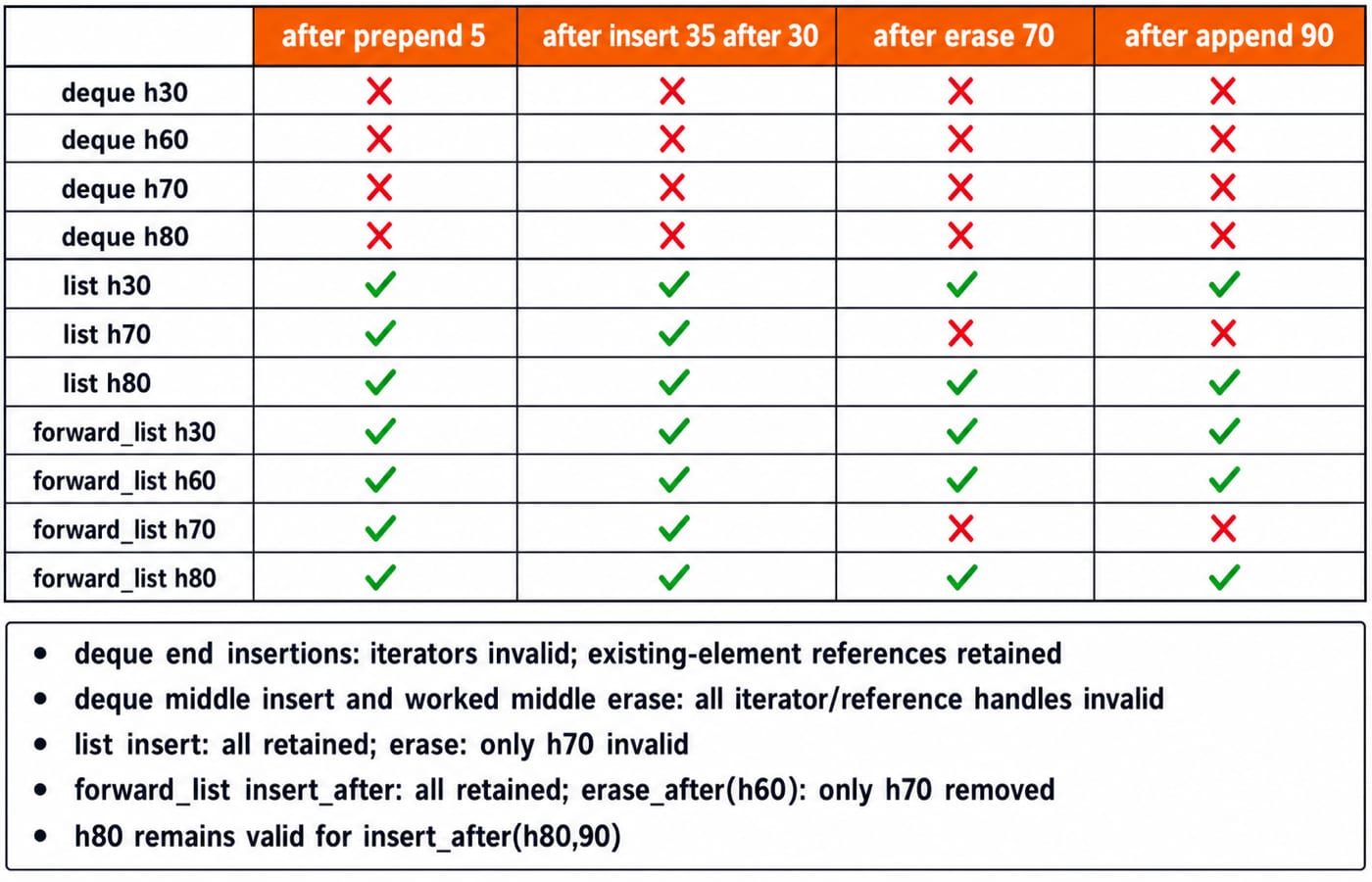
Prepend with | Invalidates all iterators; existing-element references survive | Existing handles survive | Existing handles survive |
Insert | Invalidates all iterators and references | Existing handles survive | Existing handles survive |
Erase middle value | Invalidates all iterators and references | Only handles to | Only handles to |
Append |
| Existing handles survive |
|
Apply this to h30, h60, h70 and h80. After the middle insertion, all four are unusable for deque; the relevant linked-container handles remain valid. After erasing 70, only h70 is lost for list and forward_list, while h80 can still append to the forward list. A pointer or reference surviving a deque end insertion is not a promise that its iterator survives.
Cache behaviour can overturn the Big-O story, so measure it
A deque uses separately allocated blocks but retains some within-block locality. list and forward_list usually chase separate nodes through pointers, adding indirection and weakening spatial locality. One link may reduce forward_list metadata, but alignment, allocator bookkeeping and value size can outweigh it.
For a repeatable experiment, build each container with exactly 1,000,000 std::uint64_t values, where element i is i % 1000. Traverse each container 25 times and consume the result. One pass is 1000 x (0 + 1 + ... + 999) = 499,500,000; the 25-pass checksum is 12,487,500,000. Run 3 warm-ups and 20 timed repetitions, rotate the container order, and report median and p95 nanoseconds per element.
Fix the compiler, flags, standard library, allocator, CPU and power mode. Any ranking applies only to that setup. For a FIFO pushing at one end and popping at the other, Stacks and Queues shows why deque fits; std::queue offers a narrower interface.
When each non-vector container wins, and when vector still wins
Choose from constraints:
Choose
dequefor both-end pushes and pops plusitems[37], without contiguous storage or stable iterators.Choose
listwhen valid iterators already exist, traversal is bidirectional, and node edits must preserve other handles.Choose
forward_listfor strictly forward traversal and predecessor-based edits, if measurement shows the missing second link matters.Keep
vectorfor traversal-heavy storage, end appends and index access when middle-handle stability is unnecessary.
Avoid six traps:
Treating
dequeas contiguous.Forgetting that
dequeend insertion invalidates iterators.Calling
listinsertion O(1) while hiding an O(n) search.Passing the target, rather than its predecessor, to
forward_list::erase_after.Expecting
forward_list::size()orpush_back().Using
std::sortwith list iterators instead of the containers' membersort().
Trace checksum 420, then select by constraint. Coding For Placements offers broader coding-assessment practice.
C++ container choice: the short version and next step
Start with vector. Move to deque for frequent end edits plus random access, to list when stable iterators and known-position relinking are central, and to forward_list only when one-way traversal and predecessor-based edits genuinely fit. Search cost and cache behaviour still count.
Implement all three versions for {10,20,30,40,50,60,70,80}. Assert [5,10,20,30,35,40,50,60,80,90] and checksum 420, then run the traversal experiment on your toolchain. For broader language and STL study, continue with C++ Programming.