BPSC Eligibility and Exam Pattern: Age, Attempts and the Three Selection Stages
Use the BPSC CCE notification correctly instead of borrowing UPSC assumptions. This guide separates degree, age, attempt and domicile checks, then maps the three selection stages.
KnowledgeGate Team
Exam prep & CS education
Updated 7 Aug 20266 min read144 views
Eligibility is where BPSC aspirants make some of their most avoidable mistakes. They borrow an age or attempt rule from UPSC, overlook the date on which age is calculated, or read a summary written for an older cycle. Bihar sets its own conditions, so your final check must always be the current official notification.
Related reading: BPSC syllabus map and BPSC Prelims paper analysis.
1. BPSC eligibility: which document decides
Treat the official BPSC website and the CCE notification hosted there as the source of truth. Save the PDF and note its advertisement number: a cropped table circulating on social media carries no cycle label, and these figures have all moved between cycles at least once. Four lines settle whether you can apply:
the degree requirement for the specific service you want;
the minimum and upper age for your category;
the date on which age is reckoned;
the attempt and domicile conditions that apply to you.
2. Educational eligibility
The baseline requirement for the BPSC Combined Competitive Examination is a bachelor's degree from a recognised university. The baseline is not the whole rule, because a particular post can carry its own subject or qualification condition, so read the educational-qualification table service by service and match the exact wording on your marksheet against the wording in the notification.
Two things catch final-year candidates. The first is the date by which the final result must be declared: appearing in a final-year examination does not by itself make you eligible. The second is equivalence, where you should look for the authority and the evidence the commission accepts rather than deciding equivalence yourself.
3. Age limits and category relaxations
BPSC CCE sets a minimum age of 20, 21 or 22 years depending on the service, and a category-wise upper age. Recent cycles have used these upper-age bands, and the table in the notification you apply under decides your own case:
Unreserved, male: 37 years.
Unreserved, female: 40 years.
Backward Class and Extremely Backward Class: 40 years, men and women alike.
Scheduled Caste and Scheduled Tribe: 42 years, men and women alike.
Persons with disabilities and ex-servicemen are relaxed further under their own clauses, and whether two relaxations may be combined is answered explicitly in the notification.
The detail that catches people is the reckoning date. Recent cycles have reckoned age on 1 August of the examination year, not on the day you submit the form, so a birthday in September can decide whether you sit that cycle at all. Read your category's row against that date, using your date of birth exactly as it appears on the certificate you will produce. A candidate can satisfy the headline range and still fail a condition sitting in the relaxation notes.
4. Number of attempts and domicile
Do not import UPSC's attempt logic into BPSC. The CCE has not run a general attempt counter: for most candidates nothing caps how many times you may sit it, and the upper age limit is the only thing that ends the run. Your real limit is arithmetic rather than a rule, so count how many CCE cycles fit between your age now and your category's upper edge, measured on each cycle's reckoning date, and plan against that number.
One group is treated differently. A government employee in continuous service for three years or more has been allowed a capped three attempts, with a five-year relaxation on the upper age. If that describes you, read the clause and its definitions rather than a summary, because what counts as continuous service decides whether the concession reaches you.
Domicile hides three separate questions: whether you may sit the examination, whether you may claim a reserved-category relaxation, and which document proves the claim. Summaries collapse all three into one word. Check the notification for the Bihar residence and category conditions and the prescribed certificate format, because a genuine certificate in the wrong format, or from an unlisted authority, still fails at verification.
5. The three selection stages
BPSC CCE selection has a three-stage shape.
Prelims: an objective General Studies screening stage. It shortlists candidates for mains, and its marks do not carry into the final merit total.
Mains: the descriptive stage, written across five papers. Only some of them count toward merit, and that split is what decides rank.
Interview or Personality Test: the final assessment. Its notified marks are added to the merit-counting mains total to prepare the final rank.
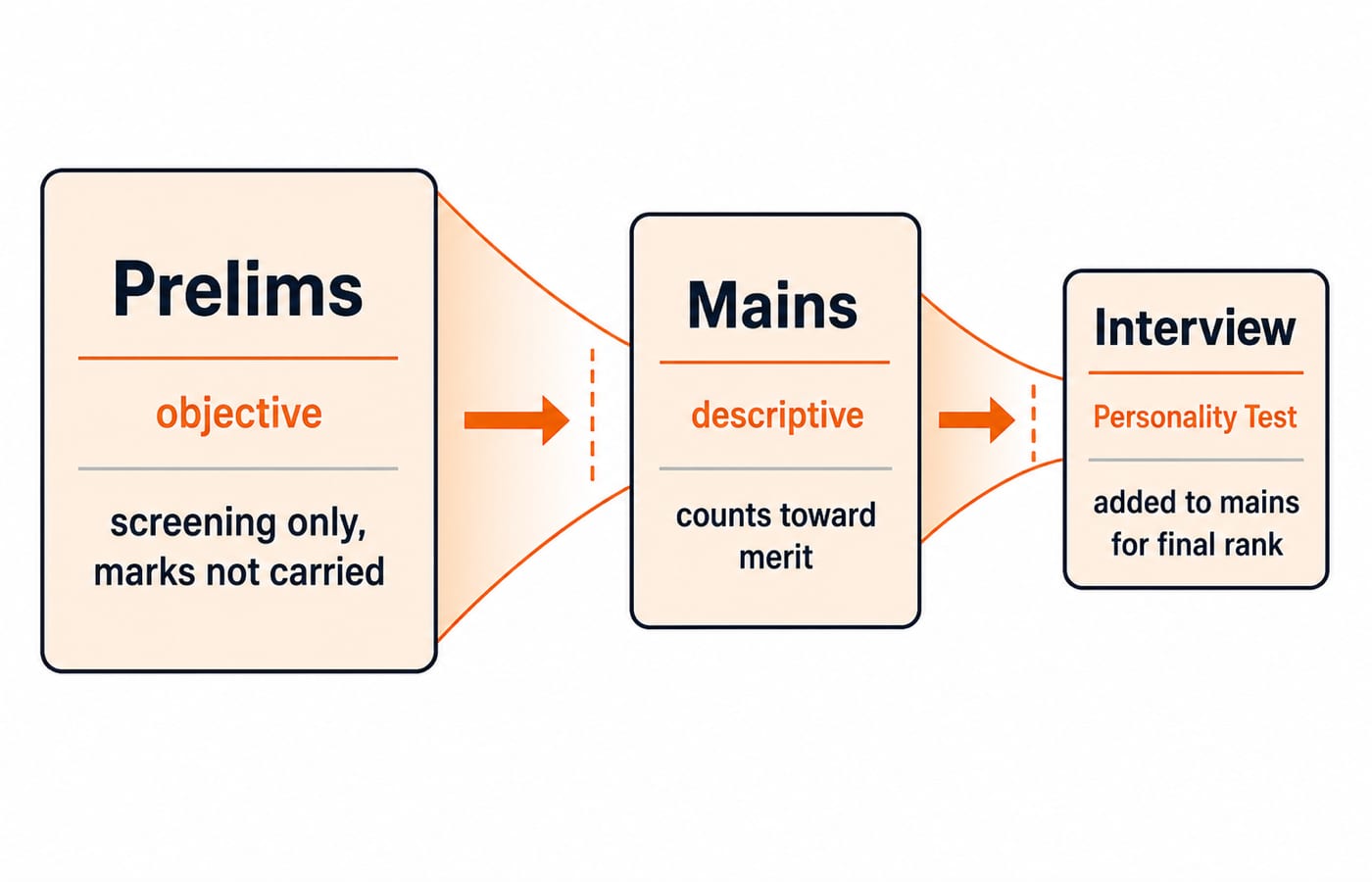
That funnel changes preparation. Prelims needs breadth, recall and elimination under objective conditions. Mains needs structured written answers and revision that supports recall without options. Interview preparation needs clarity about your own background, Bihar, and the public issues the services deal with.
6. Exam pattern per stage
Prelims is a single objective General Studies paper and its only job is to screen. Recent cycles have applied negative marking, and the exact penalty, question count, marks and duration belong to the latest notification. What does not move is the behaviour a penalty rewards: disciplined skipping beats hopeful guessing, so measure accuracy on attempted questions in your mocks, not raw attempts.
Mains has five papers. General Hindi is qualifying, so it must be cleared but does not build rank. General Studies Papers I and II and the Essay paper are descriptive, and that is where rank is earned. The optional-subject paper is the one objective paper in an otherwise descriptive stage, and how heavily it counts has moved between cycles, so take its weighting, and all marks and durations, from the notification you are applying under.
The Interview or Personality Test follows mains shortlisting, and the notification fixes both its weight and the process that feeds final merit. BPSC has changed structural details across cycles, so never build a timetable from an older pattern table.
7. The eligibility and pattern traps
Three traps survive even a careful read of the notification.
Assuming UPSC rules apply: BPSC has its own age, attempt, domicile and documentation conditions.
Missing the age reckoning date: eligibility is judged on the notified reckoning date, 1 August of the examination year in recent cycles, not on the date you fill the form.
Treating prelims marks as part of rank: prelims screens; merit is built from the notified mains components and the interview.
Selection structures differ sharply across recruitments. SSC CGL tier structure explained shows a tiered recruitment, and Bank PO prelims vs mains preparation split shows how screening and merit stages demand different study methods. Use them for strategy, never to transfer eligibility rules to BPSC.
8. The short version and your next step
Read the degree, age, reckoning-date, attempt and domicile clauses straight from the current BPSC CCE notification. In recent cycles that has meant a bachelor's degree, a minimum of 20 to 22 years by service, upper limits running from 37 to 42 years by category, all reckoned on 1 August, and no general cap on attempts. Then hold the funnel in mind: prelims screens, the descriptive mains papers build merit, and the interview is added for the final rank.
BPSC also runs teacher recruitment, on a pattern quite unlike the CCE. If BPSC TRE 4.0 is your target rather than the civil-services examination, the BPSC TRE 4.0 Preparation Course and BPSC TRE 4.0 Test Series are built for that pattern, and the government and teaching jobs category lists the neighbouring teaching exams. For the CCE, work from the official notification, the CCE syllabus and previous years' papers.
Keep learning
Browsers and Search Engines MCQs: 9 Solved Questions with Explanations
Solve nine published browser and search engine questions, check each answer, and rebuild the browser, cache, crawler and indexing distinctions that exam distractors blur.
Updated 6 Oct 20267 min readTeaching Recruitment (Computer Science)
IT Act, 2000 Explained: Key Sections, Digital Signatures and Worked Exam Examples
Build an exam-ready map of the IT Act, then apply it to an exact digital-signature walkthrough and a section 43, 66, 66C and 66D caselet.
Updated 2 Oct 20266 min readTeaching Recruitment (Computer Science)
Emerging Trends Introduction MCQs: 12 Solved Questions with Explanations
Solve 12 Emerging Trends Introduction questions with clear answer logic, exam-year labels and a compact trap check for focused revision.
Updated 27 Sep 20268 min readTeaching Recruitment (Computer Science)
MS Word Basics MCQs with Answers: 12 Solved Questions Explained
Work through 12 MS Word questions covering everyday commands, page layout, formatting, links, file features and mail merge. Each answer explains the decisive clue and the closest distractor.
Updated 25 Sep 20267 min readTeaching Recruitment (Computer Science)