Binary, Octal & Hexadecimal MCQs: 12 Solved Questions with Explanations
Solve 12 previous-year MCQs step by step, from binary, octal and hexadecimal conversions to fractional values, arithmetic, bit counts and bitwise AND.
KnowledgeGate Team
Exam prep & CS education
Updated 14 Aug 20268 min read
Base-conversion questions look mechanical, but one misplaced grouping boundary or one dropped fractional zero can change the answer. The errors are small on paper, and they often survive a rushed final check. Work each question on paper first, and write the binary bridge out in full before you read the solution. All twelve are previous-year questions, drawn from GATE, UGC NET and ISRO papers between 2004 and 2025. KnowledgeGate has over 100 practice questions on these three bases, with the wider syllabus organised under GATE CS Exam Preparation.
Use binary as the bridge between octal and hexadecimal
One octal digit maps to exactly three binary bits, while one hexadecimal digit maps to exactly four bits. For a number with a radix point, form groups outward from that point. Keep the radix point fixed throughout. Add zeros only at the far left of an integer part or the far right of a fractional part. Never remove an internal zero.
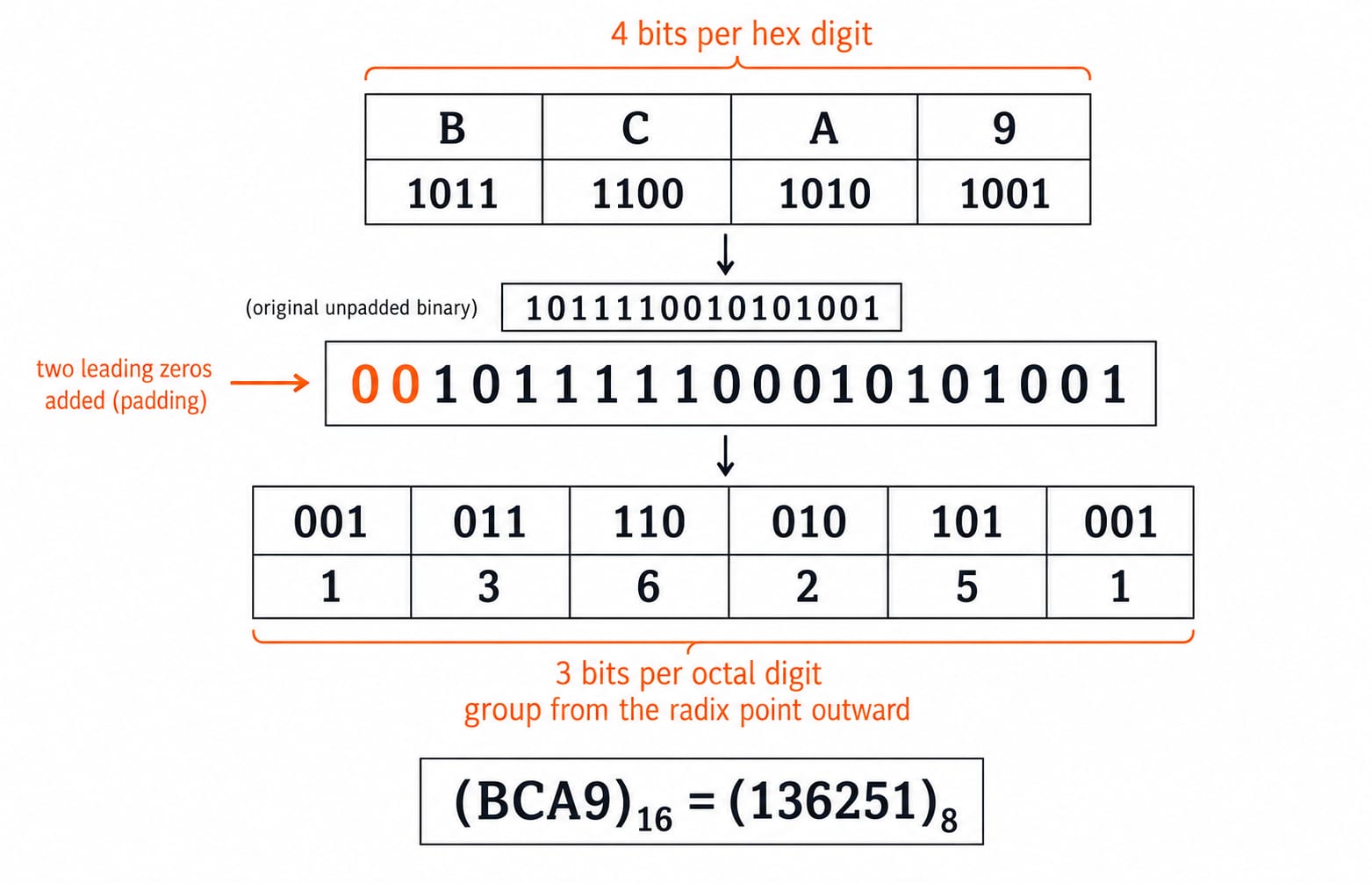
Take (BCA9)16. Convert each hexadecimal digit to four bits:
B C A 9 -> 1011 1100 1010 1001
Now regroup the same bit string from the right in sets of three. Two leading padding zeros complete the leftmost group:
001 011 110 010 101 001 -> 1 3 6 2 5 1
Therefore, (BCA9)16 = (136251)8. The two leading zeros do not change the value. If place value itself needs revision, read Number Systems and Base Conversions Explained before continuing.
Binary, octal and hex MCQs 1-2: regroup whole and fractional values
Question 1: GATE 2017 (Set 2)
The representation of the value of a 16-bit unsigned integer X in hexadecimal number system is BCA9. The representation of the value of X in octal number system is
A. 571244
B. 736251
C. 571247
D. 136251
Correct answer: D. 136251.
Use the bridge shown above: B C A 9 -> 1011 1100 1010 1001. Pad only the left edge, then regroup as 001 011 110 010 101 001. The groups give 1 3 6 2 5 1, so the octal value is 136251. The phrase “16-bit unsigned” fixes the original width, but the added leading zeros are value-neutral. Source.
Question 2: UGC NET 2021
The Octal equivalent of hexadecimal (D.C)16 is:
A. (15.6)8
B. (61.6)8
C. (15.3)8
D. (61.3)8
Correct answer: A. (15.6)8.
Map (D.C)16 to 1101.1100 in binary. Group away from the point: 001 101 . 110 000. This becomes (15.60)8, which may be written (15.6)8 after dropping the trailing fractional zero. The options that begin with 6 come from grouping the integer bits from the left instead, 110|1, which reads as 61. The .3 endings come from padding the fraction on its left edge, 011 000, rather than its right. Source.
Binary, octal and hex MCQs 3-4: choose the correct grouping width
Question 3: UGC NET 2018 (July)
The hexadecimal equivalent of the binary integer number 110101101 is :
A. D24
B. 1 B D
C. 1 A E
D. 1 A D
Correct answer: D. 1 A D.
Hexadecimal requires groups of four from the right. Pad the left edge to obtain 0001 1010 1101. These groups are 1, A and D, giving 1AD. The spaces in the source option do not alter the hexadecimal number. Source.
Question 4: UGC NET 2017 (November)
The Octal equivalent of the binary number 1011101011 is :
A. 7353
B. 1353
C. 5651
D. 5657
Correct answer: B. 1353.
Octal requires three-bit groups from the right: 001 011 101 011. Translate them as 1 3 5 3. Question 3 also started with binary, but its hexadecimal target required four-bit groups instead. Source.
For radix equations and signed-number questions on top of these conversions, continue with Number System MCQs: 12 Solved GATE Questions.
Binary, octal and hex MCQs 5-6: check every digit of the option, not just the first
Question 5: UGC NET 2017 (January)
The hexadecimal equivalent of the octal number 2357 is :
A. 2EE
B. 2FF
C. 4EF
D. 4FE
Correct answer: C. 4EF.
Expand every octal digit: 2 3 5 7 -> 010 011 101 111. Remove the visual separators and regroup from the right as 0100 1110 1111. These groups translate to 4 E F. Swapping the final two groups produces the tempting but incorrect 4FE. Source.
Question 6: UGC NET 2016 (August)
The octal number 326.4 is equivalent to
A. (214.2)10 and (D6.8)16
B. (212.5)10 and (D6.8)16
C. (214.5)10 and (D6.8)16
D. (214.5)10 and (D6.4)16
Correct answer: C. (214.5)10 and (D6.8)16.
Check the decimal value by place value: (326.4)8 = 3*64 + 2*8 + 6 + 4/8 = 192 + 16 + 6 + 0.5 = 214.5. For hexadecimal, write 3 2 6 . 4 -> 011 010 110 . 100, then regroup as 1101 0110 . 1000, giving (D6.8)16. The octal fractional digit 4 represents one half, so its hexadecimal form is .8, not .4. Source.
Binary, octal and hex MCQs 7-8: cross-check conversions and arithmetic
Question 7: GATE 2004 (IT)
The number (123456)8 is equivalent to
A. (A72E)16 and (22130232)4
B. (A72E)16 and (22131122)4
C. (A73E)16 and (22130232)4
D. (A62E)16 and (22120232)4
Correct answer: A. (A72E)16 and (22130232)4.
One bit string serves both targets: 1 2 3 4 5 6 -> 001 010 011 100 101 110, which is 1010011100101110 once the insignificant leading zeros go. Regroup it in fours for hexadecimal, 1010 0111 0010 1110 = A72E, and in twos for base 4, 10 10 01 11 00 10 11 10 = 22130232. One value check settles both halves: the octal, hexadecimal and base-4 forms are all 42798 in decimal. An option is correct only if both halves match, which rules out B on its base-4 half and C on its hexadecimal half. Source.
Question 8: GATE 2005 (IT)
(34.4)8 × (23.4)8 evaluates to:
A. (1053.6)8
B. (1053.2)8
C. (1024.2)8
D. None of these
Correct answer: A. (1053.6)8.
Convert to decimal: (34.4)8 = 3*8 + 4 + 4/8 = 28.5, and (23.4)8 = 2*8 + 3 + 4/8 = 19.5. Their product is 28.5*19.5 = 555.75. Now 555 = 512 + 40 + 3 = (1053)8, while 0.75*8 = 6. Therefore, the answer is (1053.6)8. Treating .4 as four-tenths would be a base-value error. Source.
Binary, octal and hex MCQs 9-10: exploit powers and bound the result width
Question 9: ISRO 2015
The number of 1's in the binary representation of (3*4096 + 15*256 + 5*16 + 3) are:
A. 8
B. 9
C. 10
D. 12
Correct answer: C. 10.
Recognise 4096=16^3, 256=16^2 and 16=16^1. The expression is hexadecimal 3F53. Count the ones nibble by nibble: 3=0011 has 2, F=1111 has 4, 5=0101 has 2, and the last 3 has 2. The total is 2+4+2+2=10. No large decimal expansion is needed. Source.
Question 10: ISRO 2017 (May)
When two n-bit binary numbers are added the sum will contain at the most,
A. n bits
B. (n + 3) bits
C. (n + 2) bits
D. (n + 1) bits
Correct answer: D. (n + 1) bits.
The largest unsigned n-bit number is 2^n-1. Adding two such numbers gives 2^(n+1)-2, which needs n+1 bits. For n=4, 1111 + 1111 = 11110, a five-bit result. Not every addition grows, but this question asks for the maximum possible width. Source.
Binary, octal and hex MCQs 11-12: keep nibbles aligned in representation and AND
Question 11: UGC NET 2025 (June)
Binary equivalent to (A0F)₁₆ is:
A. 111000111
B. 101001111
C. 101000001111
D. 11100001010
Correct answer: C. 101000001111.
Map every hexadecimal digit to four bits: A=1010, 0=0000 and F=1111. Concatenate them to obtain 1010 0000 1111 = 101000001111. Option B is what you get by letting the middle digit collapse to a single 0; that internal 0000 carries place value and all four bits must remain. Source.
Question 12: UGC NET 2004 (December)
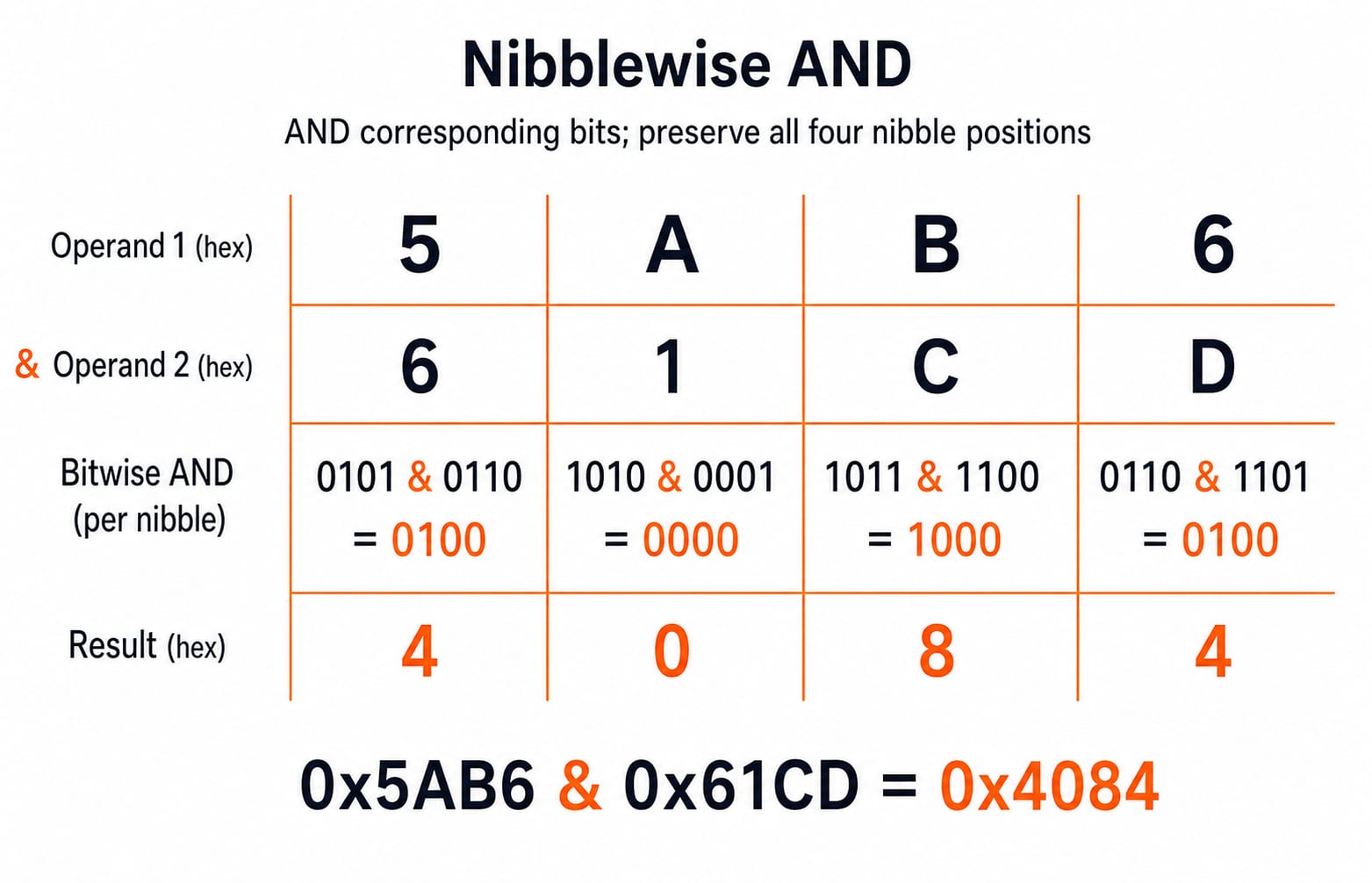
Suppose x and y are two integer variables having values 0x5AB6 and 0x61CD respectively. The result (in hex) of applying bitwise operator AND to x and y will be:
A. 0x5089
B. 0x4084
C. 0x78A4
D. 0x3AD1
Correct answer: B. 0x4084.
Align the four nibbles and AND their bits independently: 5 & 6 is 0101 & 0110 = 0100 = 4; A & 1 is 1010 & 0001 = 0000 = 0; B & C is 1011 & 1100 = 1000 = 8; and 6 & D is 0110 & 1101 = 0100 = 4. Concatenate the four results to get 0x4084. Ordinary arithmetic rules do not apply to a bitwise operator. Source.
For subject-wide practice after these conversions, use the Digital Electronics MCQs collection.
Audit the answer pattern and choose the next practice step
The compact key is 1-D, 2-A, 3-D, 4-B, 5-C, 6-C, 7-A, 8-A, 9-C, 10-D, 11-C, 12-B. For any miss, revisit the written grouping or calculation instead of memorising the option letter.
Wrong group width, Questions 1, 3-5 and 7: work one fresh conversion using three-bit octal groups or four-bit hexadecimal groups.
Mishandled radix point, Questions 2, 6 and 8: group outward from the point and preserve enough fractional zeros to complete the final group.
Missed positional shortcut or width bound, Questions 9-10: identify powers of the base or write the maximum representable value first.
Lost nibble alignment, Questions 11-12: keep each four-bit block in its original position.
In each weak bucket, solve one new example without a calculator and check it by a second method.
The short version
Use three-bit groups for octal and four-bit groups for hexadecimal. Group outward from the radix point, add padding only at the outer edges, and preserve every internal zero. For structured Digital Electronics lessons and further practice, continue with GATE Guidance by Sanchit Sir.
Keep learning
Special Logic Circuits MCQs: 12 Solved Questions on Adders, Encoders, PLA and DAC
Solve 12 special logic circuits MCQs covering recognition, hardware counts, Boolean identities and numerical calculations. Each answer includes the reasoning you should reproduce in an exam.
19 Sep 20268 min readDigital Electronics MCQs
Function Equivalence MCQs: 12 Solved Boolean Algebra Problems
Solve 12 function-equivalence questions step by step, from De Morgan's law and absorption to minterm sets, counterexamples and a four-option MSQ.
Updated 17 Sep 20268 min readDigital Electronics MCQs
CLA & Arithmetic Logic MCQs: 10 Solved Questions with Explanations
Solve ten CLA and arithmetic logic MCQs with compact workings for carry equations, timing paths, hardware sizing and operand-pair counting.
Updated 16 Sep 20267 min readDigital Electronics MCQs
Sync Counter Design MCQs: 11 Solved Questions on Modulus, State Sequences and Excitation Logic
Solve 11 synchronous-counter questions covering modulus boundaries, repeated outputs, common-clock tracing, excitation equations, enables and composite states.
Updated 14 Sep 20267 min readDigital Electronics MCQs