Binary Arithmetic Operations MCQs: 12 Solved Questions with Step-by-Step Explanations
Practise 12 real exam MCQs on binary arithmetic with step-by-step solutions covering carry chains, complements, division, BCD, mixed bases and shifts.
KnowledgeGate Team
Exam prep & CS education
Updated 12 Aug 20268 min read
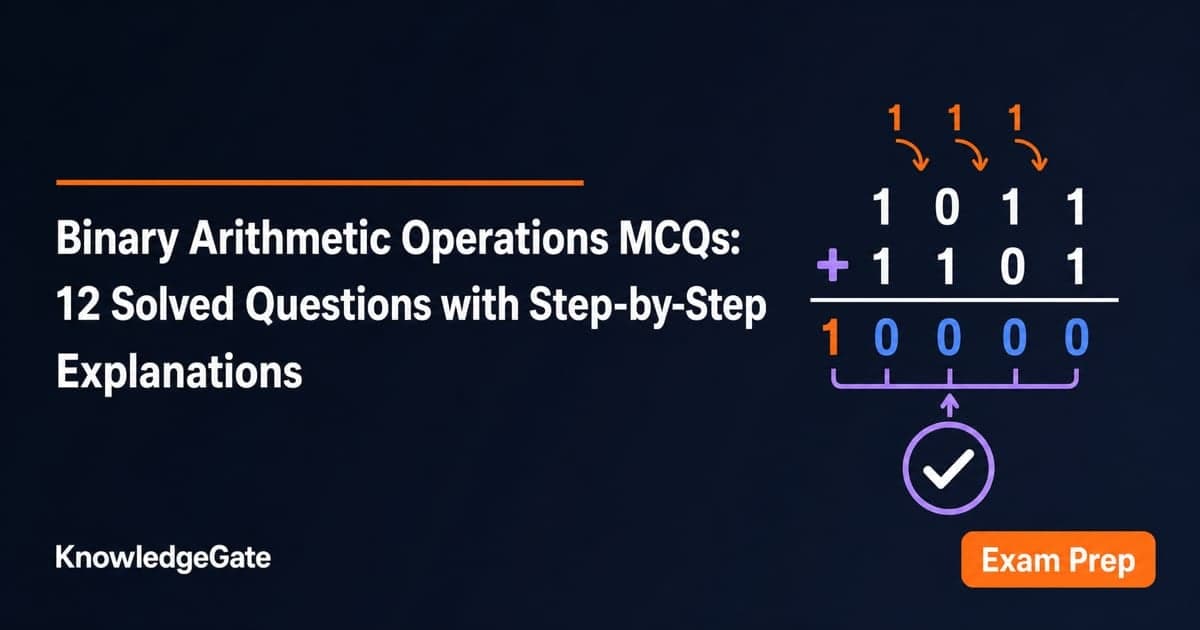
Binary arithmetic looks mechanical, but one missed carry, borrow, radix label or BCD correction changes the answer. All twelve questions below are real exam items, each labelled with the exam and year it came from: UP Police, TPSC, DSSSB, RSSB, ISRO and Beltron Programmer. The difficulty climbs steadily, from carries and borrows to products and quotients, and then to complements, mixed bases and signed shifts. Solve each one on paper before reading its explanation, then open its practice page for a second attempt. What you want at the end is a written method you can check, not a memorised option letter. If place values or base conversions are slowing you down, revise Number Systems and Base Conversions: GATE Worked Examples first.
1. Binary addition: carry chains and fractional places
Start with the one-bit rules: 0 + 0 = 0, 0 + 1 = 1, 1 + 0 = 1, and 1 + 1 = 10. When a carry enters a column, 1 + 1 + 1 = 11. For fractions, align the binary points before adding or converting.
Q1. UP Police 2016
Addition of binary number 11011 and 10111 is :
(a) 10010
(b) 11001
(c) 110010
(d) 010010
Answer: (c) 110010.
Align 11011 + 10111 and work from right to left. The column totals, including carry-ins, produce 0, 1, 0, 0, 1, followed by the final carry 1, so the result is 110010₂. A decimal check gives 11011₂ = 27, 10111₂ = 23, and 27 + 23 = 50 = 110010₂. Option 010010 drops the final carry. Open this question on the practice page.
Q2. TPSC 2025
The sum of three binary numbers 10110.10, 11010.01 and 10101.11 in decimal system is :
(a) 70.50
(b) 69.50
(c) 70.75
(d) 70.25
Answer: (a) 70.50.
Convert each value without rounding: 10110.10₂ = 22 + 1/2 = 22.50, 11010.01₂ = 26 + 1/4 = 26.25, and 10101.11₂ = 21 + 1/2 + 1/4 = 21.75. Therefore, 22.50 + 26.25 + 21.75 = 70.50. The first fractional binary position has weight 2^-1, not one decimal tenth. Open this question on the practice page.
2. Binary subtraction and 2's complement
Pad the shorter operand on the left before subtracting, then verify the result in decimal. For a fixed-width 2's complement, invert every bit and add 1 without changing the width.
Q3. TPSC 2024
Given two binary numbers A = 1101101 and B = 101011. Perform the binary subtraction A–B.
(a) 11001
(b) 111010
(c) 101010
(d) 1000010
Answer: (d) 1000010.
Left-pad B to seven bits:
1101101₂ - 0101011₂ = 1000010₂
At the 2^1 column, 0 - 1 needs a borrow from the 2^2 column, giving 10₂ - 1 = 1; the remaining columns then subtract directly. In decimal, 1101101₂ = 109 and 0101011₂ = 43, so 109 - 43 = 66. Rebuilding 66 as 64 + 2 gives 1000010₂. Open this question on the practice page.
Q4. UP Police 2016
The 2's complement of the binary number (100100)₂ is:
(a) (011101)₂
(b) (011110)₂
(c) (111100)₂
(d) (011100)₂
Answer: (d) (011100)₂.
Keep all six bits. Inverting 100100 gives 011011; adding 1 gives 011100. Verify the fixed-width property by adding the original and its complement: 100100 + 011100 = 1 000000. Discarding the carry-out leaves six zeroes, exactly as a six-bit 2's complement should. Open this question on the practice page.
3. Binary multiplication and division
Multiplying by 10₂ shifts a binary value left once. Exact division by 10₂ shifts it right once. For a general product or quotient, show the binary relation first and use decimal only as a cross-check.
Q5. DSSSB 2021
What is the value of product of (10110)₂ and (10011)₂?
(a) (11011010)₂
(b) (110100010)₂
(c) (110100001)₂
(d) (110100100)₂
Answer: (b) (110100010)₂.
Since 10011₂ = 10000₂ + 10₂ + 1₂, multiply 10110₂ by each nonzero place. The partial products are 101100000₂, 101100₂, and 10110₂.
  101100000
+ 000101100
+ 000010110
= 110100010
The decimal check is 10110₂ = 22, 10011₂ = 19, and 22 × 19 = 418. Also, 418 = 256 + 128 + 32 + 2 = 110100010₂. Open this question on the practice page.
Q6. DSSSB 2021
What will be the quotient when (10000)₂ is divided by (110)₂?
(a) (10)₂
(b) (110)₂
(c) (001)₂
(d) (100)₂
Answer: (a) (10)₂.
Here, 10000₂ = 16 and 110₂ = 6. Integer division gives quotient 2 and remainder 4, which are 10₂ and 100₂. Check the division identity: 110₂ × 10₂ + 100₂ = 1100₂ + 100₂ = 10000₂. The question asks only for the quotient, so the answer is 10₂, not the remainder 100₂. Open this question on the practice page.
Q7. RSSB 2023
On dividing a certain binary number exactly (remainder = 0) by 112, the quotient obtained is 102. Identify the correct option.
(a) 111
(b) 011
(c) 110
(d) 101
Answer: (c) 110.
Reverse the exact division: dividend equals divisor times quotient. Thus 11₂ × 10₂ = 110₂; in decimal, 3 × 2 = 6. Option 111₂ would give 7 ÷ 3, whose quotient is 2 but whose remainder is 1, so it fails the explicit remainder-zero condition. Open this question on the practice page.
4. BCD correction and mixed-base addition
A packed BCD nibble is valid only from 0000 through 1001. If a digit sum exceeds 9, add 0110 and carry into the next decimal digit. For mixed-base arithmetic, convert each complete operand to one common value before adding.
Q8. ISRO 2013
When two BCD numbers 0x14 and 0x08 are added, what is the binary representation of the resultant number?
(a) 0x22
(b) 0x1c
(c) 0x16
(d) Results in overflow
Answer: (a) 0x22.
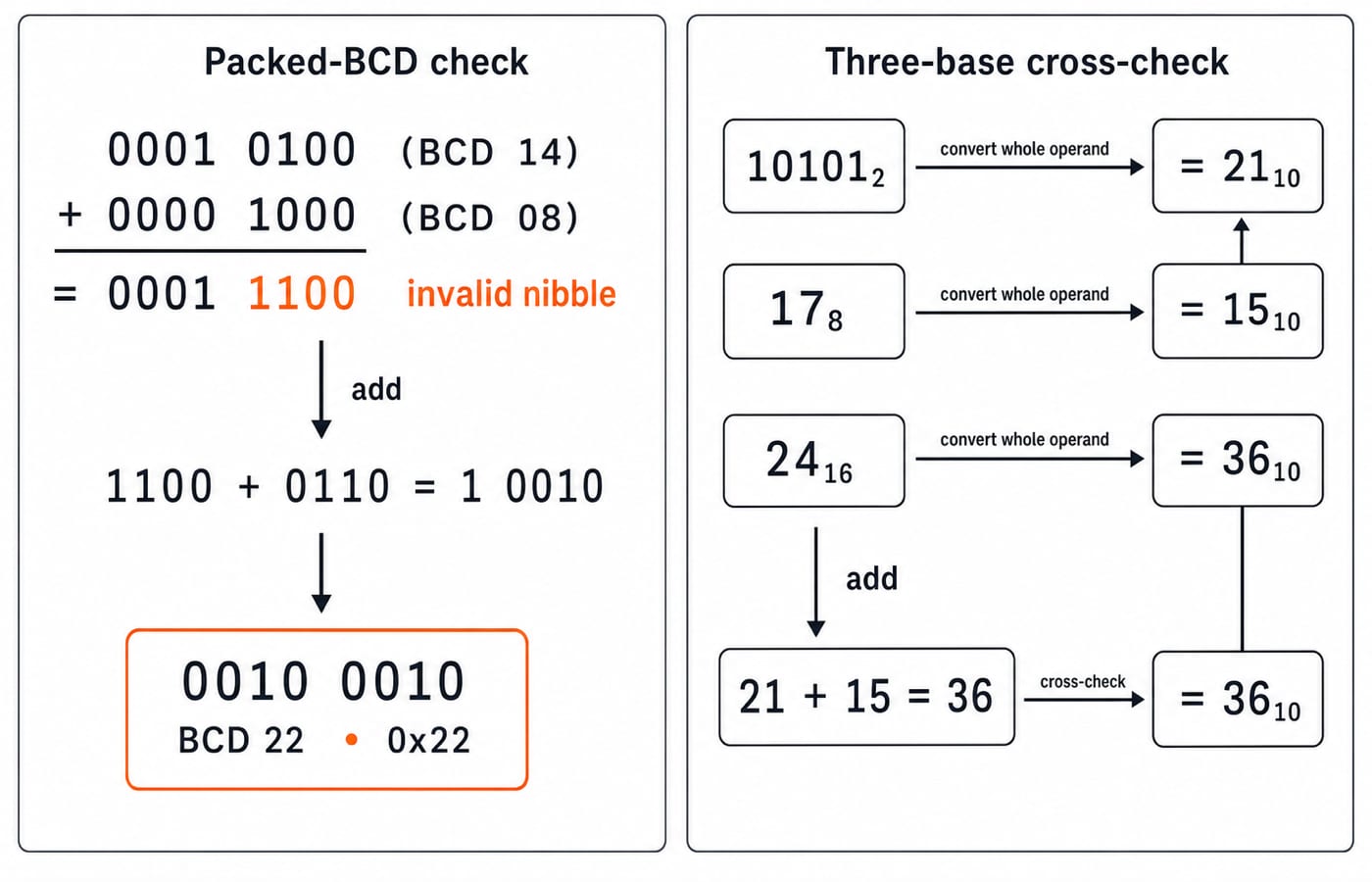
Treat the inputs as BCD digits, so decimal 14 + 08 = 22. At nibble level, 0100 + 1000 = 1100, which is not a valid BCD digit. Add the correction 0110: 1100 + 0110 = 1 0010. The carry changes the upper digit from 0001 to 0010, and the corrected lower digit is 0010, giving 0010 0010 = 0x22. The raw binary byte 0x1c is uncorrected BCD. Open this question on the practice page.
Q9. DSSSB 2018
Identify the missing digits in the following expression so that the left hand side is equal to the right hand side.
(1010?)2 + (?7)8 = (24)16
(a) 1, 2
(b) 1, 1
(c) 1, 6
(d) 0, 1
Answer: (b) 1, 1.
Convert the right side first: 24₁₆ = 2 × 16 + 4 = 36. Substituting (1, 1) gives 10101₂ = 21 and 17₈ = 1 × 8 + 7 = 15; therefore, 21 + 15 = 36. As a rejection check, (0, 1) produces 10100₂ + 17₈ = 20 + 15 = 35, not 36. Open this question on the practice page.
For a broader collection that tests the same base discipline, continue with Number System MCQs.
5. Radix equations and hexadecimal subtraction
A numeral's digits constrain its base before any algebra begins. A digit 6, for example, requires a base greater than 6. Keep the base label visible through every expansion and equality.
Q10. RSSB 2022
If (146)x + (313)x-2 = (246)8 , then the value of base x is-
(a) 5
(b) 6
(c) 7
(d) 9
Answer: (c) 7.
Expand each numeral:
(146)ₓ = x² + 4x + 6
(313)ₓ₋₂ = 3(x - 2)² + (x - 2) + 3 = 3x² - 11x + 13
(246)₈ = 2 × 8² + 4 × 8 + 6 = 166
Therefore, 4x² - 7x + 19 = 166, so 4x² - 7x - 147 = 0. Its roots are x = 7 and x = -21/4; only x = 7 is a valid base. The digit 6 had already told us that x > 6. Open this question on the practice page.
Q11. UP Police 2016
The value of subtraction (A0)16 - (6A)16 is:
(a) (36)16
(b) (46)16
(c) (63)16
(d) (30)16
Answer: (a) (36)16.
Subtract directly in hexadecimal. Borrowing one hexadecimal unit changes the low column to 16 - A = 6 and the upper A to 9; then 9 - 6 = 3, giving 36₁₆. The decimal check agrees: A0₁₆ = 10 × 16 = 160, 6A₁₆ = 6 × 16 + 10 = 106, and 160 - 106 = 54 = 36₁₆. Open this question on the practice page.
6. Signed binary shifts: preserve the sign bit
A logical right shift inserts 0 at the left. An arithmetic right shift copies the existing sign bit, which is what a signed 2's complement value needs. Shift behaviour around overflow and rounding can depend on the machine model, but sign extension itself is fixed: the leading bit is copied, never replaced by a zero.
Q12. Beltron Programmer 2025
Which of the following shift instructions is used to retain the sign bit during the shift operation on a signed binary number?
(a) Rotate Right
(b) Logical Shift Left
(c) Arithmetic Shift Right
(d) Logical Shift Right
Answer: (c) Arithmetic Shift Right.
In eight bits, 00001000 (+8) becomes 00000100 (+4). For a negative value, 11111000 (-8 in 2's complement) becomes 11111100 (-4). The leading 1 is copied, preserving the sign. A logical right shift would insert 0 instead. Open this question on the practice page.
7. Binary arithmetic MCQs: the short revision path
Use your misses as a diagnosis. Q1-Q2 test carries and fractional weights; Q3-Q4 test borrowing and complement width; Q5-Q7 test products, quotients and remainders; Q8-Q11 test BCD and radix discipline; Q12 tests signed shifting. For Q1-Q7, align places and verify in decimal. For Q8, inspect each nibble and add 0110 when required. For Q9-Q11, retain every base label until the final equality. For Q12, mark the sign bit before shifting.
Reattempt every missed item without looking at its option letter. Keep the wider syllabus organised through GATE CS Exam Preparation. For sequenced concept study, use GATE Guidance by Sanchit Sir; when you are ready to work under time pressure, move to the GATE Test Series.
Keep learning
Special Logic Circuits MCQs: 12 Solved Questions on Adders, Encoders, PLA and DAC
Solve 12 special logic circuits MCQs covering recognition, hardware counts, Boolean identities and numerical calculations. Each answer includes the reasoning you should reproduce in an exam.
19 Sep 20268 min readDigital Electronics MCQs
Function Equivalence MCQs: 12 Solved Boolean Algebra Problems
Solve 12 function-equivalence questions step by step, from De Morgan's law and absorption to minterm sets, counterexamples and a four-option MSQ.
Updated 17 Sep 20268 min readDigital Electronics MCQs
CLA & Arithmetic Logic MCQs: 10 Solved Questions with Explanations
Solve ten CLA and arithmetic logic MCQs with compact workings for carry equations, timing paths, hardware sizing and operand-pair counting.
Updated 16 Sep 20267 min readDigital Electronics MCQs
Sync Counter Design MCQs: 11 Solved Questions on Modulus, State Sequences and Excitation Logic
Solve 11 synchronous-counter questions covering modulus boundaries, repeated outputs, common-clock tracing, excitation equations, enables and composite states.
Updated 14 Sep 20267 min readDigital Electronics MCQs