Static vs Dynamic Typing: Errors, Feedback Loops and Refactoring Flexibility
Follow one OrderLine model from an integer price to an INR Money value. See what Java catches during checking, what Python reveals during execution, and what both still need tests to prove.
KnowledgeGate Team
Exam prep & CS education
Updated 25 Sep 20265 min read
“Static is safer” and “dynamic is faster” are slogans, not a method for predicting what happens when a real data model changes. SKU PEN-07 has a unit price of 499 paise and quantity 3; the integer price then becomes Money("INR", 499) in the Java and Python examples. Static checking surfaces mistakes before execution, while dynamic checking waits for a path to run; tests and boundary validation address gaps left by both disciplines.
Static vs dynamic typing: separate the type axis from nearby ideas
Static programs check type obligations before execution, usually through a compiler or checker. Dynamic values have types; invalid operations are checked when reached. Dynamic does not mean typeless.
Question | Java example | Ordinary Python example |
|---|---|---|
When an incompatible operation is reported | During checking or compilation | When execution reaches it |
What a variable may hold across assignments | Values compatible with its static type | Values of different runtime types |
Typical refactor feedback | Stale typed uses appear across compiled code | Stale uses appear on executed paths |
What still needs tests? | Arithmetic and business rules | Arithmetic, shapes and business rules |
Java inference remains static:
var total = 1497; // inferred as intPython annotations alone are not runtime enforcement in the standard interpreter:
total: int = 1497
total = "pending"  # still runs
Compiled versus interpreted is a separate axis. Explore Coding & Skills for wider language learning.
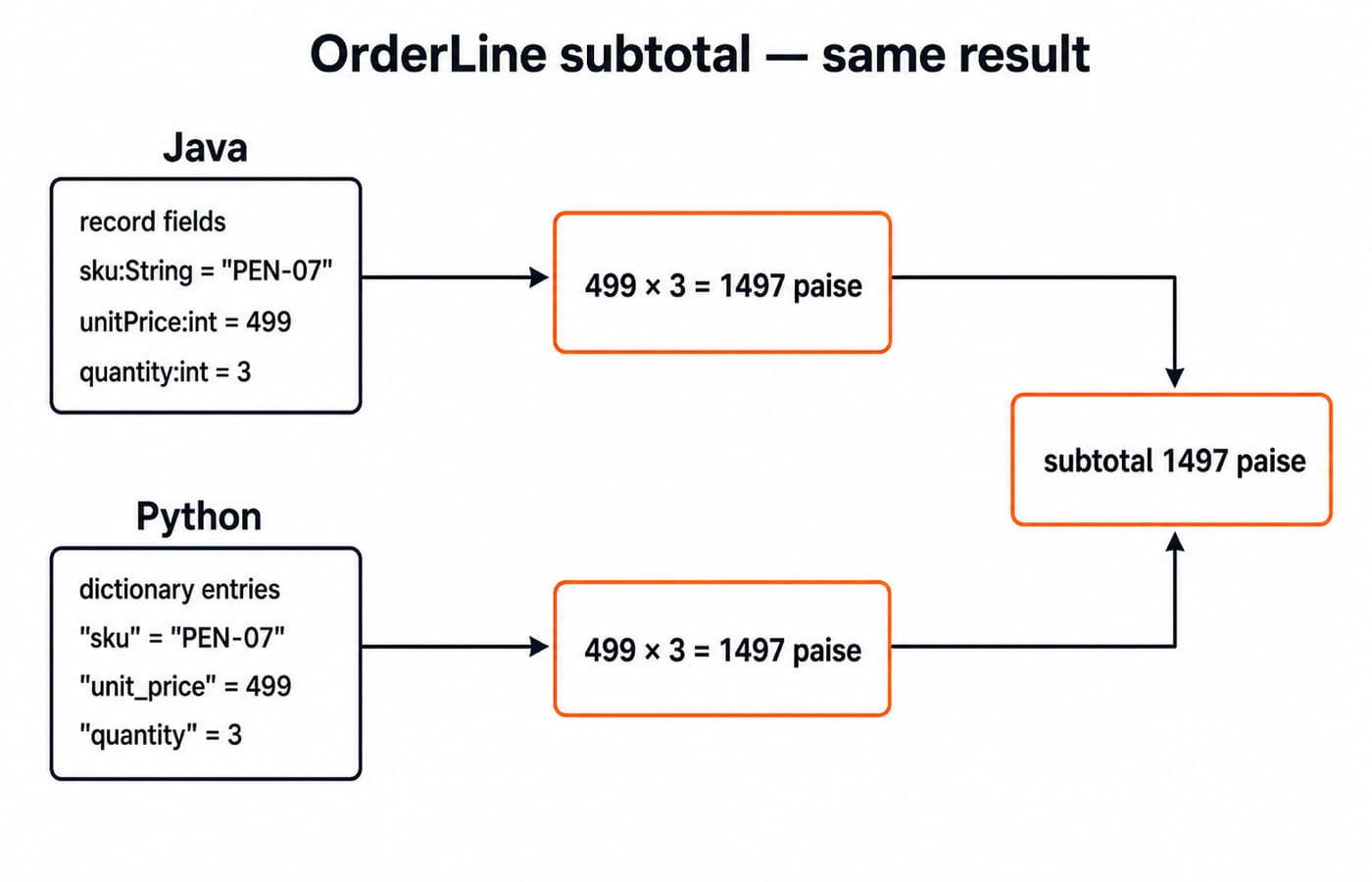
Static and dynamic typing on the same OrderLine calculation
record OrderLine(String sku, int unitPrice, int quantity) {
    int subtotalPaise() {
        return unitPrice * quantity;
    }
}

var line = new OrderLine("PEN-07", 499, 3);
System.out.println(line.subtotalPaise());
With unitPrice = 499 and quantity = 3, 499 * 3 = 1497, so Java prints 1497. var saves repetition, but line remains an OrderLine.
Python:
def subtotal_paise(line):
    return line["unit_price"] * line["quantity"]

line = {"sku": "PEN-07", "unit_price": 499, "quantity": 3}
print(subtotal_paise(line))
Python also prints 1497. Compare the contracts under change, not syntax or speed. Classic Programs in C, Java and Python offers cross-language practice.
Static vs dynamic refactoring: change 499 into an INR Money value
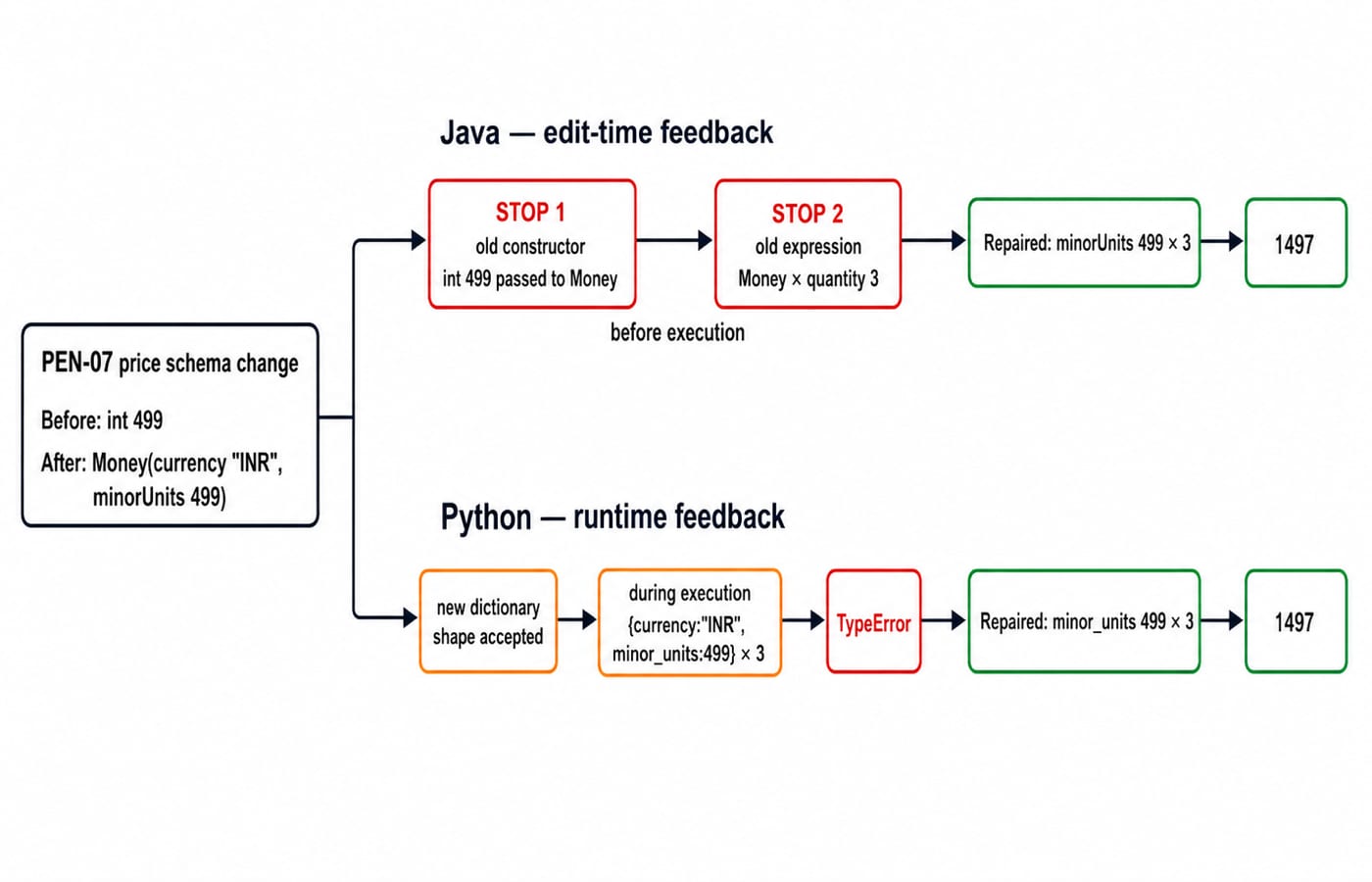
Now the price must carry currency. Java adds record Money(String currency, int minorUnits) {} and changes OrderLine.unitPrice from int to Money.
Keep two stale lines. new OrderLine("PEN-07", 499, 3) supplies an int where Money is required. return unitPrice * quantity; multiplies Money by int. Checking reports both categories before execution. Repair them with new OrderLine("PEN-07", new Money("INR", 499), 3) and return unitPrice.minorUnits() * quantity;. Again, 499 * 3 = 1497.
In Python, set "unit_price": {"currency": "INR", "minor_units": 499} but keep subtotal_paise unchanged. Construction succeeds. The call reaches dictionary multiplication and raises TypeError: a dictionary cannot be multiplied by 3. Repair the body to line["unit_price"]["minor_units"] * line["quantity"]; it returns 1497.
Java exposes both stale uses during checking. Ordinary Python exposes its stale operation when that path runs. This makes neither all static refactors safe nor all dynamic defects production failures.
Static typing catches incompatible uses, not incorrect business meaning
Java makes contracts visible: calls must supply Money, arithmetic must extract an integer, and methods expecting OrderLine reject unrelated objects. Object Oriented Technology Explained shows why a named value object carries more intent than a bare integer.
Static checking proves compatibility, not business meaning. new Money("USD", 499) is type-correct for an INR-only order. new OrderLine("PEN-07", new Money("INR", 499), -3) is also type-correct, and 499 * -3 = -1497. Currency policy and quantity > 0 need constructors, validators or domain types, plus tests.
A future JSON payload may contain "quantity": "3". Compilation cannot inspect it. Parsing and validation must reject the string before the typed core treats it as a quantity.
Dynamic typing buys shape flexibility but moves contract work elsewhere
One function returns 1497 for {"sku":"PEN-07", "unit_price":499, "quantity":3}. Unchanged, it returns 1000 for {"sku":"NOTE-02", "unit_price":250, "quantity":4, "campaign":"MONSOON"}. The extra field needs no new class because only price and quantity are read.
But {"sku":"PEN-07", "unit_price":499, "quantity":"3"} is subtle. Python evaluates 499 * "3" as a string of 499 copies of 3, not integer 1497. Adding 100 paise shipping later raises TypeError. Validation or assert isinstance(subtotal, int) catches this earlier. Practise with Python Output-Based Questions.
Dynamic shapes ease exploration, but contracts still need tests, validation, constructors, documentation or static analysis. Interfaces and generics also provide static flexibility.
Feedback loops depend on checkers, tests and executed paths
After the refactor, both implementations need this regression contract:
Case | Expected result |
|---|---|
| Compute |
| Compute |
String quantity | Reject at the boundary |
Legacy integer price | Reject after the |
Java checking finds stale uses across compiled code; tests verify arithmetic and rules. Python tests cover executed paths and shapes, making all four cases contractual.
Gradual typing moves Python feedback earlier. Define TypedDict shapes: Money has currency: str and minor_units: int; OrderLine has sku: str, unit_price: Money and quantity: int. A configured checker can flag the legacy integer price before execution. Untrusted input still needs runtime validation.
Run the checker or compiler first, then the four focused tests, then boundary validation, then one end-to-end path.
Static vs dynamic typing questions: trace the failure point, not the slogan
Java
var total = 1497uses static type inference.Python
total: int = 1497; total = "pending"runs in the ordinary interpreter.Stale Java
Money * 3fails checking before execution.A stale Python dictionary price multiplied by
3fails when that line runs.
After 499 becomes Money("INR", 499), identify two stale Java uses, one stale Python operation and corrected 1497. Why is -3 producing -1497 a validation defect, not a type mismatch?
Situation | Useful design signal |
|---|---|
Model shared by | Early whole-codebase refactor feedback helps |
One-file exploration whose fields change | Low-friction shapes may help |
External API accepting | Validate both versions at the boundary in either discipline |
Repository size, input trust and change frequency determine which feedback loop is useful. For each scenario, ask whether the next signal arrives during checking, boundary validation or execution.
Static vs dynamic typing: the short version and next step
Both baselines produced 1497. Static checking found stale uses before execution; dynamic checking found one on its path. Neither rejected -3 or wrong currency without encoded rules.
Recreate both OrderLine versions. Change 499 to Money("INR", 499), predict every failure, then implement the four-row regression table. Continue structured C, C++, Java and Python practice with Coding For Placements.
Keep learning
TypeScript vs C# Typing: Structural Compatibility, Nominal Identity, Generics and Runtime Checks
Follow one User/Admin example through TypeScript and C# to predict assignments, generic conversions, branded IDs, and JSON behaviour at runtime.
Updated 3 Oct 20266 min readProgramming Languages Survey
TypeScript Learning Roadmap: 20 Weeks from Everyday Types to a Full-Stack App
Follow a dependency-led TypeScript plan through BudgetLens, IssueBoard and TaskBoard, with exact weekly gates, strict checks and tested API boundaries.
Updated 28 Sep 20265 min readProgramming Languages Survey
Kotlin vs C#: Compare Null Safety, Async Models, Ecosystems and Platform Fit
Compare Kotlin and C# by building the same packing model in both. See how their managed runtimes, null checks, async behaviour and ecosystems differ.
Updated 24 Sep 20266 min readProgramming Languages Survey
C# vs C++: Managed .NET, Native Control, and the Trade-offs That Matter
Compare one component in C# and C++, then use its lifetime, generic, build, and interop behaviour to choose the right model for your software.
Updated 23 Sep 20266 min readProgramming Languages Survey