

8085 and 8086 Basics: Architecture, Worked Examples and Exam Traps
Build a clean side-by-side model of 8085 and 8086, then trace addition, flags, segment addressing and little-endian word storage step by step.
KnowledgeGate Team
Exam prep & CS education
Updated 30 Oct 20265 min read

8085 and 8086 are often revised as disconnected register lists. That confusion appears when a question asks for an actual trace. On 8085, data width and flags control an 8-bit addition; on 8086, segmentation and byte order control address-and-data traces.
8085 and 8086 at a glance: what changes and what stays familiar
A microprocessor is the CPU on a chip. Both 8085 and 8086 fetch an instruction, decode it and execute it. The important differences are the widths and the way each processor produces a memory address.
Feature | 8085 | 8086 |
|---|---|---|
ALU and main data width | 8 bits | 16 bits |
Address bus | 16 bits | 20 bits |
Byte-addressable memory space |
|
|
Address formation | Direct 16-bit address | Segment value plus 16-bit offset |
Data width does not decide memory capacity. Address-bus width does. The 8085 normally places a 16-bit address directly on its address path. The 8086 calculates a 20-bit physical address from a segment value and an offset. The GATE category is the broader preparation hub for topics around these processors.
Registers and the path an instruction follows
In 8085, A is the accumulator. B, C, D, E, H and L are general registers, and BC, DE and HL can act as register pairs. PC and SP are 16-bit registers. The flags are sign S, zero Z, auxiliary carry AC, parity P and carry CY.
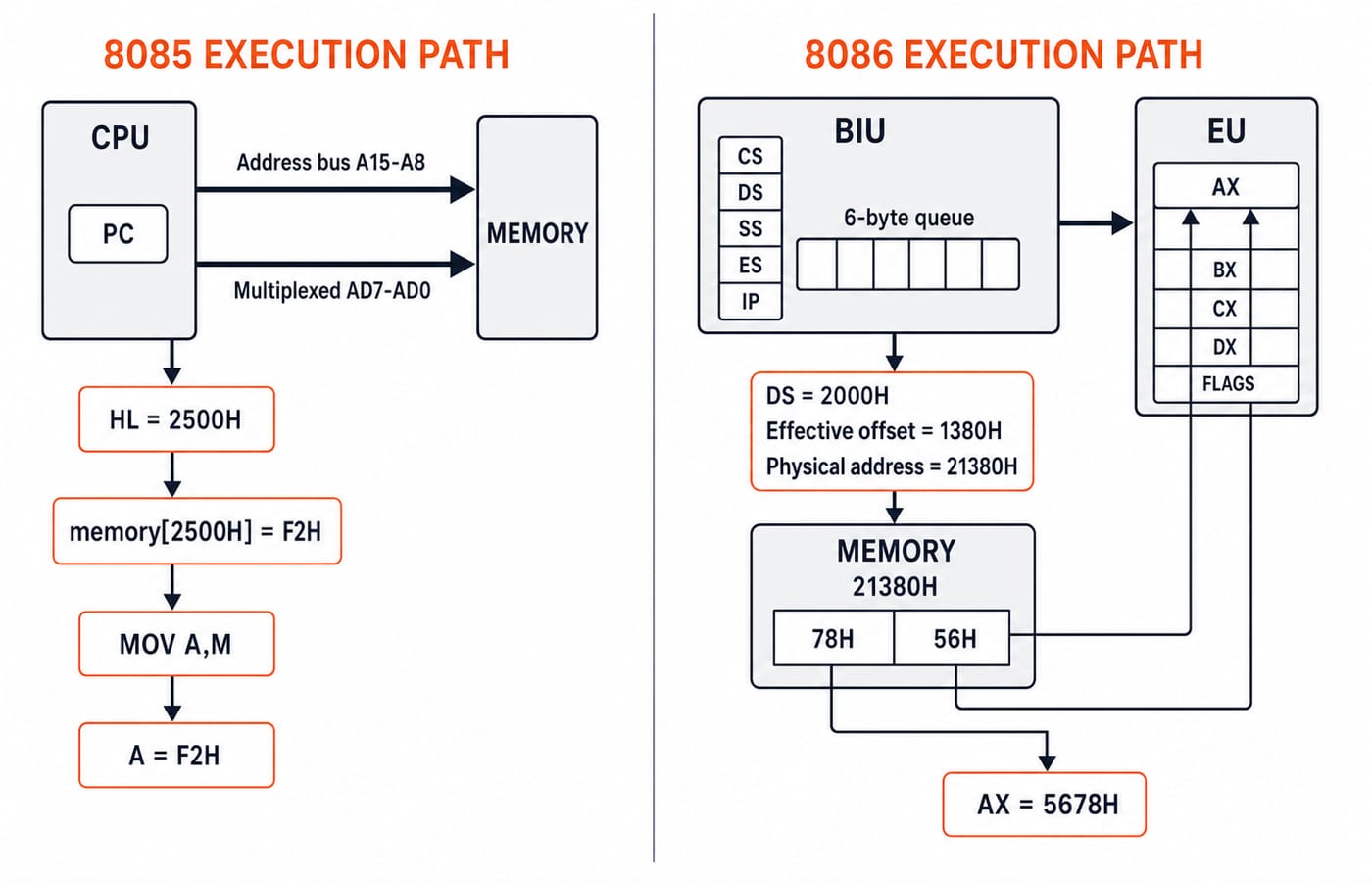
M is not a physical register. In MOV A,M, it means the byte in memory at the address held by HL. If HL=2500H and [2500H]=F2H, the instruction loads A=F2H.
The 8086 groups registers by work. AX, BX, CX and DX are general registers; SP, BP, SI and DI support stack and index operations; CS, DS, SS and ES hold segment values; IP identifies the instruction offset; and FLAGS records conditions. Its Bus Interface Unit handles addresses and fetching, while the Execution Unit decodes and executes. A 6-byte prefetch queue lets fetching overlap execution, an early idea that connects naturally to Pipelining in Computer Architecture Explained.
Addressing modes without mixing the two instruction sets
For 8085, keep the operand source visible:
MVI A,32His immediate. The value32His inside the instruction.MOV A,Bis register addressing. The operand comes from B.LDA 2500His direct. The instruction supplies the 16-bit memory address.MOV A,Mis register-indirect. HL supplies the address, soHL=2500Hmeans the operand comes from[2500H].
The parallel 8086 examples are MOV AX,1234H for immediate, MOV DX,AX for register, and MOV AX,[2500H] for direct memory using DS by default. In MOV AX,[BX+SI+20H], the processor computes a based-indexed effective address with displacement.
The effective address is the offset inside a segment. The physical address is (segment x 10H) + effective address. Segment-plus-offset formation is not textual concatenation, and it differs from an 8085 direct 16-bit address. For cross-architecture effective-address formulas and instruction-format trade-offs, use Addressing Modes and Instruction Formats; the processor-specific rule here is direct 16-bit addressing on 8085 versus segment-plus-offset formation on 8086.
Worked example A: add two 8-bit numbers on 8085 and preserve the carry
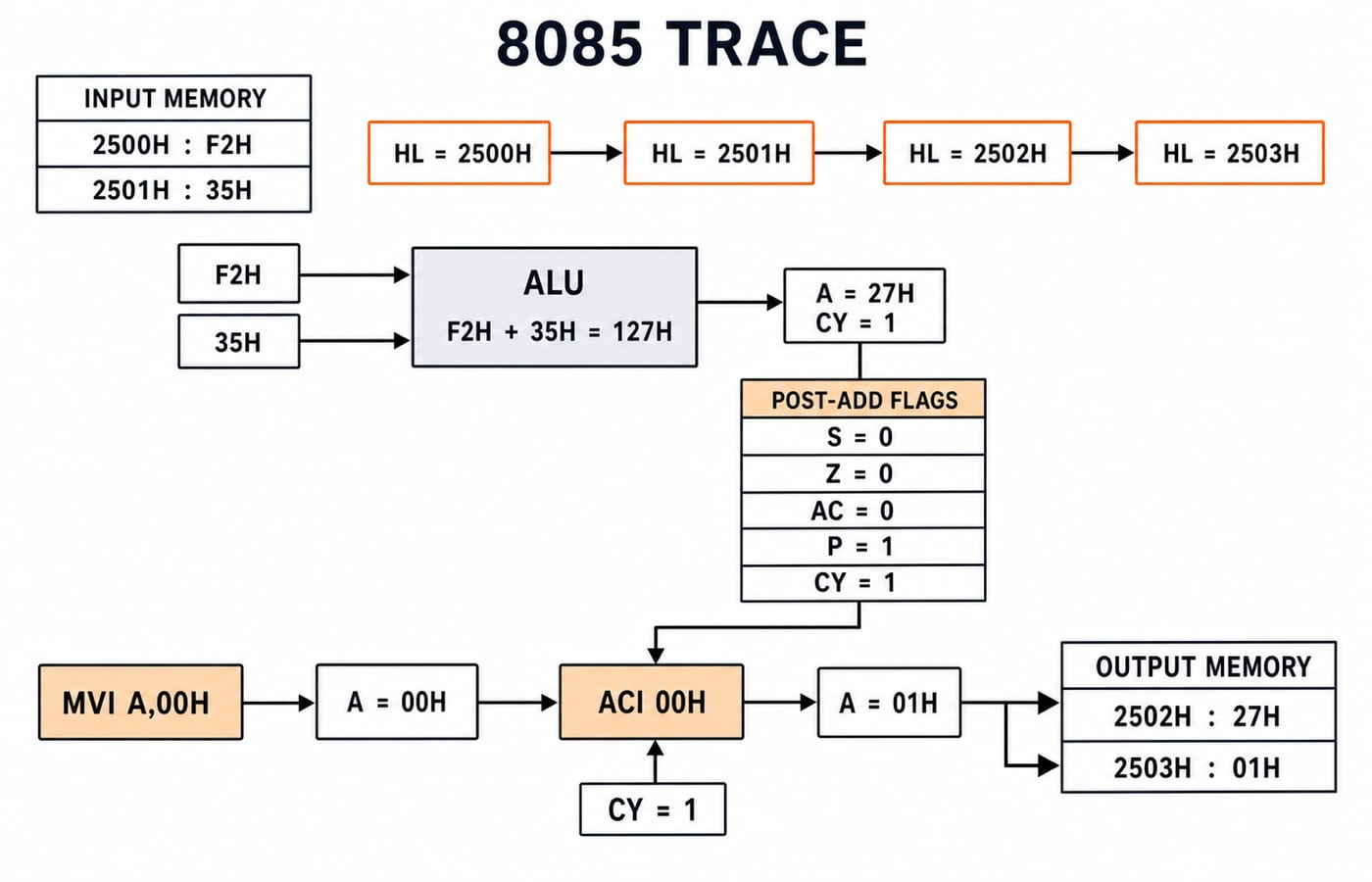
Set [2500H]=F2H and [2501H]=35H. Store the 16-bit result low byte first at 2502H and high byte at 2503H.
LXI H,2500H
MOV A,M
INX H
MOV B,M
ADD B
INX H
MOV M,A
MVI A,00H
ACI 00H
INX H
MOV M,A
HLT
Instruction | State after execution |
|---|---|
|
|
|
|
|
|
|
|
|
|
|
|
|
|
|
|
|
|
|
|
|
|
| Execution stops with output complete |
The low nibbles in the addition are 2H + 5H = 7H, so AC is 0. The result byte 27H has four set bits, so parity is even and P is 1. INX H, MOV M,A and MVI A,00H do not destroy CY. Therefore ACI 00H turns that saved carry into the high byte. The stored bytes 27H and 01H represent 0127H.
Worked example B: calculate an 8086 physical address and read a word
Execute MOV AX,[BX+SI+20H] with DS=2000H, BX=1350H and SI=0010H.
First calculate the effective offset:
1350H + 0010H + 0020H = 1380H
Now form the physical address:
2000H x 10H + 1380H = 20000H + 1380H = 21380H
Suppose [21380H]=78H and [21381H]=56H. The 8086 stores a word in little-endian order. The byte at the lower address enters AL, and the next byte enters AH. Therefore AL=78H, AH=56H and AX=5678H.
Next trace ADD AX,00A5H:
5678H + 00A5H = 571DH
There is no unsigned carry and no signed overflow, so CF=0 and OF=0. The result is nonzero with its sign bit clear, so ZF=0 and SF=0. At the low nibble, 8H + 5H = DH without a nibble carry, so AF=0. The low result byte 1DH has four set bits, giving even parity and PF=1.
Repeat the same three-line check: calculate the offset, add the segment base, then assemble the word low byte first. Keep every step in hexadecimal.
The traps that make correct-looking answers fail
Width trap: An 8-bit 8085 addresses 64 KiB, while a 16-bit 8086 addresses 1 MiB. Their address buses are 16 and 20 bits respectively.
Memory trap:
Mmeans memory through HL on 8085. It is not another register.Address trap: A segment is shifted left by four bits and added to the offset. Segments can overlap, so different segment:offset pairs can reach the same physical address.
Byte-order trap: The word
5678Happears as78Hfollowed by56Hat increasing addresses.Flag trap: CY or CF records unsigned carry. The 8086 OF records signed overflow, but 8085 has no overflow flag. On 8085, parity is based on the 8-bit result.
How exam questions test this, then the short version
Common question forms include direct comparison statements, 2^n address-space calculations, register and memory traces, 8085 carry and flag updates, 8086 physical-address calculations, little-endian word reconstruction and addressing-mode identification.
Try one self-check with the same values. If SI becomes 0030H, then EA = 1350H + 0030H + 0020H = 13A0H. The segment base remains 20000H, so the physical address becomes 213A0H.
KnowledgeGate currently has 60+ questions live in its practice bank for 8085 & 8086 Basics. For timed, mixed practice, use the GATE Test Series.
Use these four core rules:
8085 means 8-bit data plus a direct 16-bit address.
8086 means 16-bit data plus a 20-bit physical address.
Trace bytes in address order.
Compute the result before choosing a flag.
Reproduce both worked traces without looking. Then use GATE Guidance by Sanchit Sir for a structured subject path.
Keep learning
8085 & 8086 Basics MCQs: 12 Solved Questions with Explanations
Attempt 12 question-bank MCQs on the 8085 and 8086, then check clear explanations covering buses, addressing, instructions, flags, interrupts and stack behaviour.
Updated 16 Sep 20267 min read57 viewsComputer Organization MCQs

Instruction Set Architecture (ISA) Design Explained: A Worked 16-Bit Encoding and Exam Traps
Build a small ISA, fit its fields into 16 bits, and trace one ADDI instruction from binary encoding to the final register and program counter values.
Updated 10 Nov 20266 min readComputer Organization & Architecture

Performance & Speedup in Computer Architecture: Formulas, Worked Examples and GATE Traps
Learn to compare processors fairly, calculate pipeline gains and apply Amdahl's law through step-by-step numericals with unit checks.
Updated 4 Nov 20266 min readComputer Organization & Architecture

Interprocessor Communication Unit: Architecture, Worked Mesh Example and Exam Traps
Trace a three-word processor message, verify handshake ordering, and solve mesh and crossbar numericals without mixing communication, synchronization, and coherence.
Updated 1 Nov 20266 min readComputer Organization & Architecture