Point U is 12 m to the South of Point T. Point V is 17 m to the southwest of…
2025
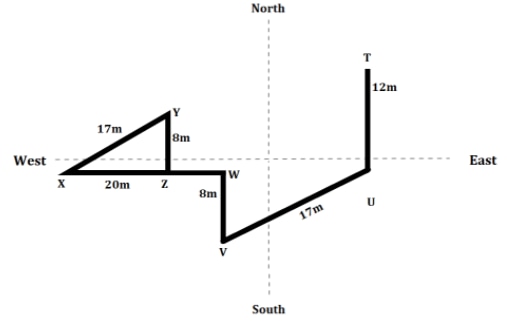
Point U is 12 m to the South of Point T. Point V is 17 m to the southwest of point U. Point W is 8 m to the north of point V and 20 m to the east of point X. UWV forms a right-angled triangle. Point Y is 17 m to the northeast of point X. Point Z is 8 m to the south of Point Y. XZY forms a right-angled triangle.
Point Y is in which direction with respect to point W?
Answer: D. North West — Concept: When a diagonal movement (northeast, southwest, etc.) between two points is combined with a stated right-angled triangle and one perpendicular leg…
- A.
South East
- B.
North
- C.
South West
- D.
North West
Attempted by 3 students.
Show answer & explanation
Correct answer: D
Concept: When a diagonal movement (northeast, southwest, etc.) between two points is combined with a stated right-angled triangle and one perpendicular leg length, the remaining leg can be found with the Pythagorean theorem — here every triangle uses the 8-15-17 triple (8² + 15² = 17²). Once each point's position is written as an (East-West, North-South) offset from a common origin, the direction from one point to another follows from the sign of each offset: a single non-zero offset gives a pure cardinal direction (N/S/E/W), while two non-zero offsets give a compound direction (NE/NW/SE/SW).
Application:
Take point X as the origin (0 m East-West, 0 m North-South).
Triangle X-Z-Y is right-angled, with hypotenuse XY = 17 m (Y is northeast of X) and vertical leg ZY = 8 m (Z is south of Y). The horizontal leg is XZ = √(17² − 8²) = √225 = 15 m, so Z sits 15 m east of X, and Y sits 15 m east and 8 m north of X.
W is given as 20 m east of X, lying on the same West-East line as X and Z.
Triangle U-W-V is right-angled, with hypotenuse UV = 17 m (V is southwest of U) and vertical leg VW = 8 m (W is north of V). The horizontal leg is UW = √(17² − 8²) = 15 m, so U sits 15 m east of W — the only placement consistent with V being southwest (not southeast) of U.
Comparing Y's position (15 m east, 8 m north of X) with W's position (20 m east of X, on the same West-East line as X): Y is (15 − 20) = 5 m west of W, and 8 m north of W.
Both offsets are non-zero (5 m west and 8 m north), so the direction of Y with respect to W is the compound North-West direction.
Cross-check: The two right-angled triangles are mirror constructions of the same 8-15-17 triple on either side of the West-East line through X, Z, and W. The X-Z-Y triangle raises Y by 8 m above that line, while W itself lies on that line, so Y must be north of W regardless of the exact horizontal gap. Combined with the 5 m East-West offset already found between Y and W, this independently confirms a North-West relationship, not a purely North one.
Hence, the direction of Y with respect to point W is North-West.