Shubhanshi starts from point P, walks 6 m north and reaches point Q. At point…
2024
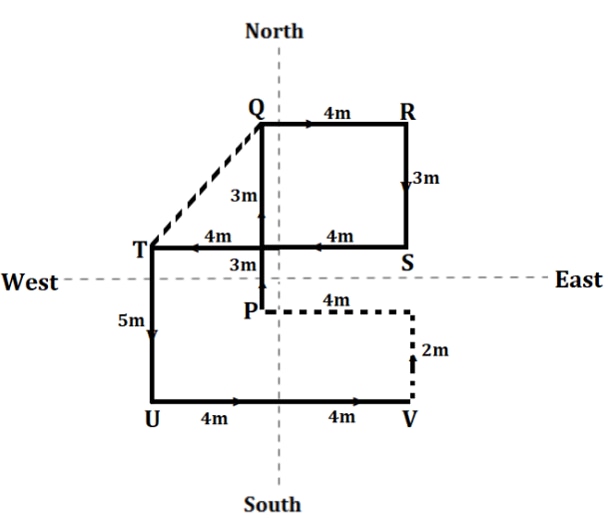
Shubhanshi starts from point P, walks 6 m north and reaches point Q. At point Q, she turns right and reaches point R after walking 4 m. After reaching point R, she turns right and walks 3 m to reach point S. Further, she walks to point T which is 8 m to the west of point S. She further goes 5 m south to point U, turns left and walks 8 m to reach point V. Shubhanshi goes 2 m North from her final position V. Now, she is how far and in which direction from her initial position P?
Answer: D. 4 m, East — In direction-and-distance problems, plot the walker's position on a coordinate grid starting at the origin, moving the stated distance along the current…
- A.
4 m, North
- B.
4 m, West
- C.
5 m, West
- D.
4 m, East
Attempted by 4 students.
Show answer & explanation
Correct answer: D
In direction-and-distance problems, plot the walker's position on a coordinate grid starting at the origin, moving the stated distance along the current facing direction for each leg. A stated turn (left or right) rotates the facing direction by 90 degrees from the direction just walked. The net displacement from the start is then read off the final coordinates, working out the east-west and north-south shift separately.
Start at P = (0, 0), facing north.
Walk 6 m north to Q: position becomes (0, 6).
At Q, turn right (now facing east) and walk 4 m to R: position becomes (4, 6).
At R, turn right (now facing south) and walk 3 m to S: position becomes (4, 3).
Walk 8 m west to T: position becomes (-4, 3).
Walk 5 m south to U: position becomes (-4, -2).
At U, turn left (now facing east) and walk 8 m to V: position becomes (4, -2).
Walk 2 m north from V: final position becomes (4, 0).
Cross-checking along each axis independently: the east-west legs are +4 (Q to R), -8 (S to T), and +8 (U to V), which sum to a net +4, i.e. 4 m east; the north-south legs are +6 (P to Q), -3 (R to S), -5 (T to U), and +2 (final leg), which sum to zero. This matches the coordinate trace above.
Comparing the final coordinates (4, 0) with the starting point P (0, 0), Shubhanshi ends up 4 m to the east of P.