There is an NM axis in such a way that N is in the north and M is in the south…
2023
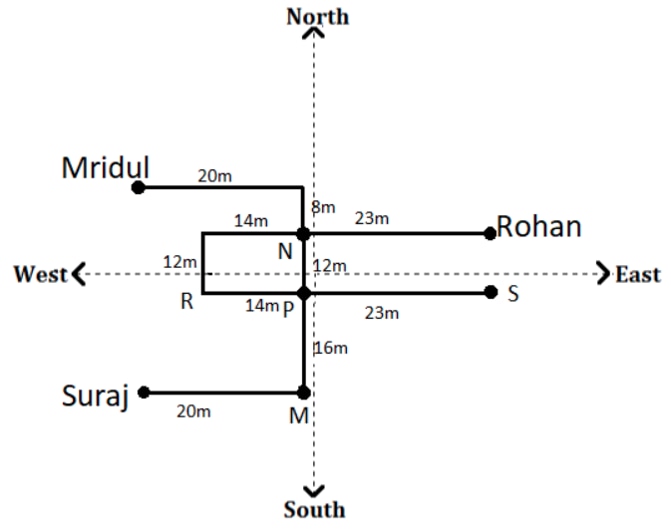
There is an NM axis in such a way that N is in the north and M is in the south direction. There is an RS axis in such a way that R is in the west direction and S is in the east direction. NM axis and RS axis intersect at a point P in such a way that NP is 12 m, PM is 16 m, PR is 14 m, PS is 23 m.
Mridul starts walking from point P and walks 20 m in the north direction and then he takes a turn to his left and walks 20 m. Suraj starts walking from point M and walks 20 m in the west direction. Rohan starts walking from point R and walks 12 m in the north direction and then he takes a turn to his right and walks 37 m.
What is the minimum distance between Suraj’s current position and Mridul’s current position?
Answer: C. 36 m — Concept In direction-sense problems, place one person's reference point at the origin, assign each given axis to a compass direction (North = +y, East = +x),…
- A.
16 m
- B.
42 m
- C.
36 m
- D.
18 m
Attempted by 2 students.
Show answer & explanation
Correct answer: C
Concept
In direction-sense problems, place one person's reference point at the origin, assign each given axis to a compass direction (North = +y, East = +x), and plot every other named point from the stated distances along those axes. Track each person's walk as vector steps, applying left/right turns relative to their current facing direction, to reach their final coordinate. The distance asked between two people is simply the straight-line separation between their two final coordinates.
Application
Take P as the origin (0, 0). Since NP = 12 m with N to the north, N is at (0, 12); since PM = 16 m with M to the south, M is at (0, −16).
Mridul starts at P and walks 20 m north, reaching (0, 20). Facing north, a left turn now faces him west, so his next 20 m walk brings him to (−20, 20).
Suraj starts at M (0, −16) and walks 20 m west, reaching (−20, −16).
Both final points share the same x-coordinate (−20), so the straight-line distance between them equals the difference of their y-coordinates: 20 − (−16) = 36 m.
Cross-check
Mridul ends 20 m north of P and Suraj ends 16 m south of P, and both lie on the same north–south line after their moves. So the direct separation is simply the sum of their vertical distances from P: 20 m + 16 m = 36 m — confirming the result.