Directions: The table given below shows information about the total number of…
2023
Directions: The table given below shows information about the total number of products sold by five shops (A, B, C, D and E) over three days (Monday, Tuesday, and Wednesday). Read the data carefully and answer the questions.
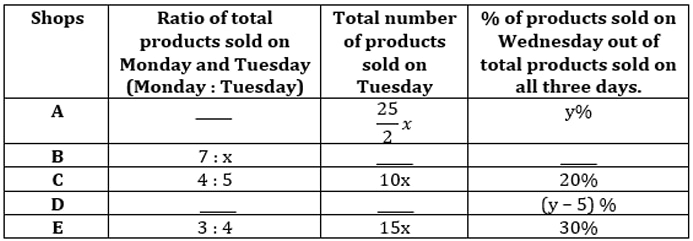
Note: (i) The difference between total number of products sold by C and E in all three days is 120.
(ii) The total number of products sold by D over all three days is 120.
(iii) Some data are missing; calculate them if required.
The total number of products sold by shop A over all three days is 246 more than the combined number sold by shops C and E on Monday. If the numbers of products sold by A on Monday and Wednesday are equal, then find the ratio of ‘x’ to ‘y’.
Answer: C. 16: 75 — ConceptFor each shop, the three-day total equals Monday sales + Tuesday sales + Wednesday sales. If Wednesday is p% of that total, then (1 − p/100) × total =…
- A.
16: 73
- B.
17: 25
- C.
16: 75
- D.
18: 77
- E.
None of these
Attempted by 12 students.
Show answer & explanation
Correct answer: C
Concept
For each shop, the three-day total equals Monday sales + Tuesday sales + Wednesday sales. If Wednesday is p% of that total, then (1 − p/100) × total = Monday sales + Tuesday sales. A given Monday:Tuesday ratio converts the Tuesday entry into Monday sales.
Application
For shop C, Monday:Tuesday = 4:5 and Tuesday sales are 10x. Therefore Monday sales are (4/5) × 10x = 8x. Since Wednesday is 20% of C’s three-day total, 0.80 × C total = 8x + 10x = 18x, so C total = 22.5x.
For shop E, Monday:Tuesday = 3:4 and Tuesday sales are 15x. Therefore Monday sales are (3/4) × 15x = 11.25x. Since Wednesday is 30% of E’s three-day total, 0.70 × E total = 11.25x + 15x = 26.25x, so E total = 37.5x.
The difference between the C and E totals is 120. Hence 37.5x − 22.5x = 120, so 15x = 120 and x = 8.
With x = 8, the Monday sales are 8x = 64 for C and 11.25x = 90 for E. Their combined Monday sales are 64 + 90 = 154.
A’s three-day total is 246 more than 154, so A total = 154 + 246 = 400. A’s Tuesday sales are (25/2)x = 12.5 × 8 = 100.
Let A’s equal Monday and Wednesday sales each be W. Then W + 100 + W = 400, so 2W = 300 and W = 150.
Wednesday sales are y% of A’s total. Thus (y/100) × 400 = 150, giving y = 37.5. Therefore x:y = 8:37.5 = 16:75.
Cross-check
For x = 8, C total = 22.5 × 8 = 180 and E total = 37.5 × 8 = 300; their difference is 120. For A, 150 + 100 + 150 = 400, and 150 is 37.5% of 400. Both independent checks reproduce the conditions, so the required ratio is 16:75.