Directions : Line chart given below shows expense of five persons (in %) out…
2018
Directions : Line chart given below shows expense of five persons (in %) out of total income of two months. Income of persons is same in both months.
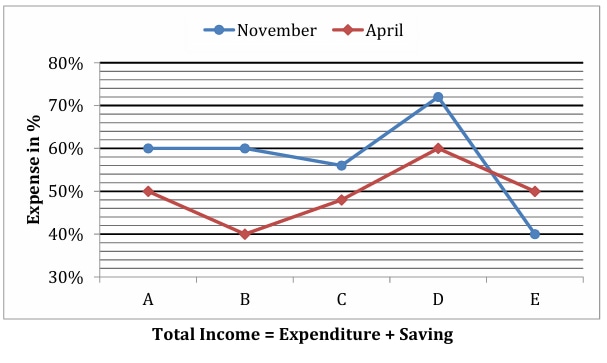
Find the difference between income of D and E ?
(I) Difference between expense of ‘D’ in November and saving of ‘E’ in April is Rs 3200.
(II) Difference between Saving of ‘D’ in April and Expense of ‘E’ in November is Rs 8000.
Answer: B. Statement (II) alone is sufficient to answer the question but statement (I) alone is not sufficient to answer the question. — ConceptIn a data-sufficiency item you do not solve for a number; you test whether each given statement, on its own, pins down the asked quantity. Here income…
- A.
Statement (I) alone is sufficient to answer the question but statement (II) alone is not sufficient to answer the questions.
- B.
Statement (II) alone is sufficient to answer the question but statement (I) alone is not sufficient to answer the question.
- C.
Both the statements taken together are necessary to answer the questions, but neither of the statements alone is sufficient to answer the question.
- D.
Either statement (I) or statement (II) by itself is sufficient to answer the question.
- E.
Statements (I) and (II) taken together are not sufficient to answer the question.
Attempted by 2 students.
Show answer & explanation
Correct answer: B
Concept
In a data-sufficiency item you do not solve for a number; you test whether each given statement, on its own, pins down the asked quantity. Here income of each person is the same in both months, so let income of D = d and income of E = e; the asked quantity is |d - e|. From the chart, Saving% = 100% - Expense% for any person in any month. A statement is sufficient only if its single equation reduces to a multiple of (d - e); a statement that mixes d and e with unequal coefficients leaves two unknowns and cannot isolate the difference.
Applying each statement on its own
Statement involving expense of D in November and saving of E in April: Expense of D in November = 72% of d = 0.72d; Saving of E in April = (100 - 50)% of e = 0.50e. The equation 0.72d - 0.50e = 3200 has unequal coefficients on d and e, so it is one equation in two unknowns and cannot yield |d - e|. Not sufficient on its own.
Statement involving saving of D in April and expense of E in November: Saving of D in April = (100 - 60)% of d = 0.40d; Expense of E in November = 40% of e = 0.40e. The equation 0.40d - 0.40e = 8000 has equal coefficients, so it factors as 0.40(d - e) = 8000, giving |d - e| = 20000 directly. Sufficient on its own.
Cross-check
The second statement's coefficients on d and e are identical (both 0.40), which is exactly the condition that collapses the equation into the asked difference; the first statement's coefficients (0.72 vs 0.50) are not, so no amount of algebra extracts (d - e) from it alone. Hence one statement alone answers the question and the other does not, so the statements are neither both required nor interchangeable.
Result: The difference between the incomes of D and E is Rs 20000, obtainable from the second data statement alone.