Find out which of figures (1), (2), (3) and (4) can be formed from the pieces…
2025
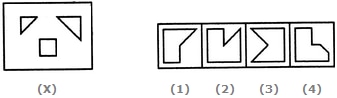
Find out which of figures (1), (2), (3) and (4) can be formed from the pieces given in figure (X).
Answer: A. 1 — CONCEPT: In a figure-formation (dissection) problem, an answer figure can be “formed” from the given pieces only if that figure can be cut, with no gaps and…
- A.
1
- B.
2
- C.
3
- D.
4
Attempted by 33 students.
Show answer & explanation
Correct answer: A
CONCEPT: In a figure-formation (dissection) problem, an answer figure can be “formed” from the given pieces only if that figure can be cut, with no gaps and no overlaps, into exactly the set of pieces supplied in figure (X) — the same number of pieces, the same shapes and the same sizes. Rotating and flipping a piece is allowed, but no piece may be added, dropped, stretched or used twice.
PIECES IN (X): the box holds three pieces — a right triangle in the upper-left (right angle at the top-left, slanted edge sloping down to the right), a mirror-image right triangle in the upper-right (right angle at the top-right, slanted edge sloping down to the left), and one small square near the bottom.
APPLICATION: Check each answer figure against the three pieces by size and by edges — same total area, same edge lengths, only rotation/flipping allowed, no resizing, no gaps, no overlaps:
Add up the areas: the two right triangles plus the square must exactly equal the area enclosed by the answer figure's outline.
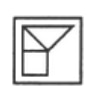
In the first answer figure, the one slanted edge (from the top-right corner down to the bend point) matches a triangle's hypotenuse exactly in length and slope.
The rest of that figure's outline — the top edge, the lower-left step, and the base — matches the remaining sides of the two triangles and the square's own sides, with equal edges glued flush wherever two pieces meet.
Every edge and the full enclosed area are accounted for, with nothing left over and nothing overlapping — so the first figure is exactly the one these three pieces can form.
CROSS-CHECK — why the other figures fail:
The figure with the deep V-shaped cut in its top edge: one side of that cut runs straight down, the other runs diagonally — an uneven pairing, unlike the two mirror-image triangles, and no square-shaped region is set aside anywhere in it.
The figure built around a rightward-pointing arrowhead: the notch is two triangular cuts meeting at a single point, consuming the whole box, leaving no separate square-sized region.
The boot / L-shaped figure with a single diagonal corner sliced off: that is only one triangle removed from a rectangle — one triangle short, and no distinct square piece either.
Only the first arrangement consumes all three pieces exactly, so it is the figure that can be formed.