Select the alternative which represents three out of the five alternative…
2023
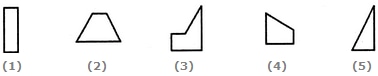
Select the alternative which represents three out of the five alternative figures which when fitted into each other would form a complete square.
- A.
123
- B.
134
- C.
235
- D.
345
Attempted by 2 students.
Show answer & explanation
Correct answer: B

When several figures are said to combine (by pure rotation, without resizing, reflecting, or overlapping) into one named shape, the combined edges must retrace the target's own outline exactly: at any point strictly inside the assembled figure where two or more chosen pieces meet, the angles they contribute there must add up to 360 degrees; along a straight stretch of the boundary the contributed angles add up to 180 degrees; and at one of the target's own corners they must add up to that corner's own angle. A piece that is convex (bulges outward) everywhere can never occupy a spot where the target's own diagram folds inward (concave), and vice versa.
The square's own cut lines are: one vertical line running the full height, splitting off a narrow rectangular strip on the left; then, in the remaining area, a horizontal segment starting partway up that vertical line and running right, followed by a diagonal line from the end of that segment up to the square's own top-right corner. This produces exactly three regions: a plain rectangle (the left strip, all four corners close to 90 degrees), a quadrilateral tucked into the top-right corner (two corners close to 90 degrees, one corner near 60 degrees, one corner near 120 degrees), and a five-sided region covering the rest (one sharp corner near 30 degrees, three corners close to 90 degrees, and one reflex corner near 235 degrees where the horizontal and diagonal cuts meet).
Among the five candidate figures, only one is a plain four-right-angled rectangle, so it is the only candidate that can supply the left strip.
Of the two remaining quadrilateral-shaped candidates, one has two right-angle corners plus one acute (around 60 degrees) and one obtuse (around 120 degrees) corner, matching the top-right region's angle set precisely, while the other candidate has no right angle at all (two acute, two obtuse corners), so it cannot close that region's seams.
The only remaining candidate with a reflex (inward-folding) corner has a sharp tip near 30 degrees, three corners close to 90 degrees, and one reflex corner near 235 degrees, an angle-for-angle match with the five-sided region. The last candidate is a plain three-sided triangle, which cannot retrace any region that has four or five corners.
Rotating the rectangle into the left strip, the two-right-angle quadrilateral into the top-right corner, and the reflex-cornered figure into the remaining five-sided region reproduces the square's outline exactly, with the angles meeting at every interior seam adding up to 360 degrees and no gap or overlap remaining; the trapezoid (no right angle) and the plain triangle are left over and do not fit either used region.
Hence figures 1, 3 and 4 - option 134 - combine to form the complete square.