Select the alternative which represents three out of the five alternative…
2025
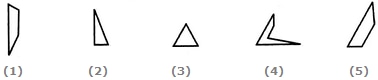
Select the alternative which represents three out of the five alternative figures which when fitted into each other would form an equilateral triangle.
- A.
124
- B.
135
- C.
134
- D.
345
Attempted by 3 students.
Show answer & explanation
Correct answer: B
Concept: To reconstruct a straight-edged target figure — here, an equilateral triangle divided, as shown in the reference diagram, into three regions by two straight lines running from its apex to its base — from three of the given pieces fitted edge to edge, each piece must supply exactly one of these three regions: its own boundary must be made only of straight segments matching, in length and angle, either the triangle's outer sides or the two internal dividing lines shown. A piece with an inward-pointing (concave) corner cannot trace any of these three straight-edged regions, so it cannot take the place of any of the three pieces this specific dissection needs.
Application: The equilateral triangle shown is split by two straight lines running from its apex down to two points on the base, creating two outer quadrilateral wedges and one small triangular sliver in between. Figures (1) and (5) are mirror-image quadrilateral wedges whose slanted sides match these two dividing lines and the triangle's own slanted sides, and figure (3) is the small triangular sliver that fits snugly between them.

Cross-check: Matching each piece to the three regions of the reference dissection — two outer wedges and one inner sliver — figures (1), (3), and (5) fit exactly, tracing the triangle's outline with no gap or overlap. The other combinations each substitute a piece that cannot take the shape of any of these three regions:
1-2-4 — figure (2)'s tapering pointed ends do not match the straight-edged shape either region needs, and figure (4)'s inward corner does not match it either, so this trio cannot fill the three regions.
1-3-4 — figure (4)'s inward-pointing corner does not match the straight-edged shape the region it would occupy needs, so this trio cannot fill the three regions.
3-4-5 — figure (4) again does not match the straight-edged shape the region it would occupy needs, so this trio cannot fill the three regions.
Only 1-3-5 supplies pieces matching all three region shapes of the reference dissection exactly, so it is the trio that reconstructs the equilateral triangle shown.