Find out which of the figures (1), (2), (3) and (4) can be formed from pieces…
2024
Find out which of the figures (1), (2), (3) and (4) can be formed from pieces given in figure (X).
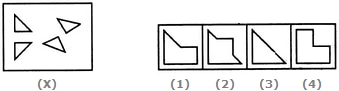
[Asked in Tech Mahindra][ This test belongs to Paid Members of KNOWLEDGE GATE ]
- A.
1
- B.
2
- C.
3
- D.
4
Attempted by 2 students.
Show answer & explanation
Correct answer: C
In a "pieces to figure" spatial-reasoning problem, the four pieces given in (X) must be reassembled edge-to-edge, without gaps or overlap, so that their combined outline and area exactly match one of the answer figures. A useful starting fact here: a square's diagonal always splits the square into two congruent right-angled triangles with equal legs (each leg equal to the square's own side) - that is, each half is a right isosceles triangle.
In any right isosceles triangle, joining the midpoint of the hypotenuse to the right-angle vertex, and dropping perpendiculars from that same midpoint to each leg, divides the triangle into four smaller triangles - all of them congruent right isosceles triangles in their own right. Figure (X) supplies exactly four such congruent right-angled triangles. Rebuilding two of them leg-to-leg recreates one of these smaller right isosceles triangles, and joining that pair to the other pair along the remaining matching legs recreates the full big right triangle - its two legs equal to the square's own two sides, its hypotenuse equal to the square's diagonal. That is exactly the outline in figure (3): only the square's two sides plus the one corner-to-corner diagonal.
Figure (1) breaks its slanted edge into a horizontal step partway down. The worked solution's verified reassembly of the four pieces keeps that edge unbroken all the way to the base, so this stepped outline does not match it.
Figure (2) replaces part of the slanted edge with a stepped notch near the top and a second, shorter diagonal near the bottom-right - again, not what the worked solution's reassembly produces.
Figure (3)'s outline - the square's two sides plus one unbroken diagonal - is exactly what the worked solution's reassembly produces.
Figure (4) has no slanted edge at all, only right-angle steps, which likewise does not match the one continuous diagonal that the worked solution's reassembly keeps.
The worked diagram confirms this directly: the boundary shown is the square's two sides plus its one diagonal (figure (3)'s outline), and that diagonal's midpoint is joined to the right-angle corner and to the midpoints of both legs, subdividing the shape into exactly the four smaller congruent right triangles supplied in (X), matching piece for piece with no leftover or missing area.

Hence, the pieces in (X) form figure (3).