An opaque pyramid (shown below), with a square base and isosceles faces, is…

GATE · 2023 · AR · General AptitudeGATE · 2023 · ME · General Aptitude

An opaque pyramid (shown below), with a square base and isosceles faces, is suspended in the path of a parallel beam of light, such that its shadow is cast on a screen oriented perpendicular to the direction of the light beam. The pyramid can be reoriented in any direction within the light beam. Under these conditions, which one of the shadows P, Q, R, and S is NOT possible?
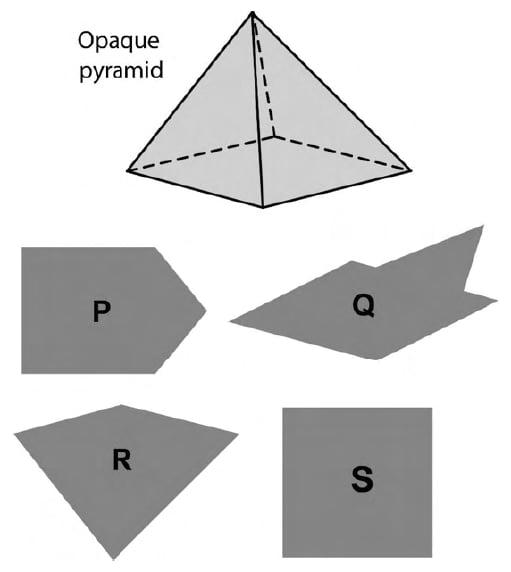
An opaque grey pyramid is shown above four separate grey silhouettes labelled P, Q, R and S. The pyramid has a top apex, left and right base vertices, a lower front base vertex and a hidden rear base vertex. Solid lines join the apex to the left, right and front vertices and outline the front base edges. Dashed lines join the hidden rear vertex to the apex and to the left and right base vertices. P has a vertical left edge, horizontal top and bottom edges, and two slanting edges meeting at a pointed right end. Q is an irregular concave outline: from its leftmost point the upper boundary rises rightward to a shoulder, dips into a shallow notch, rises to a high upper-right tip, descends leftward to a deeper right-side notch, then runs rightward to a second right tip; the lower boundary returns through a low central corner to the leftmost point. R is a downward-pointing four-sided outline with a shallow upper central vertex, upper-left and upper-right corners and a low bottom vertex. S is a square.
  1. A.

    P

  2. B.

    Q

  3. C.

    R

  4. D.

    S

Attempted by 38 students.

Sign up free to check your answer

Sign up free

Explore the full course: Aptitude For Gate

Loading lesson…