

Zoho Recruitment Preparation for Freshers: What to Confirm and Practise
Conflicting Zoho pattern tables can distract you from useful preparation. Start with your invitation, then work through aptitude, coding, project explanations and a focused diagnostic.
KnowledgeGate Team
Exam prep & CS education
Updated 21 Nov 20265 min read

Conflicting Zoho test-pattern tables can leave a fresher unsure what to practise first. Software-development roles call for evidence across aptitude, coding and project explanations, while the invitation determines the actual assessment rules.
Confirm the Zoho drive before following a test pattern
Zoho’s careers page is the official starting point for open roles; use your role’s invitation for assessment instructions.
The published Accenture recruitment process guide owns Accenture’s role-specific journey; this Zoho page uses the invitation as its source and concentrates on worked aptitude, coding and stateful-project reasoning.
Your applicable posting and invitation decide the actual stages and rules. Missing information means unconfirmed, not zero or unrestricted.
Field to confirm | Where to check |
|---|---|
Role and hiring route | Applicable posting |
Eligibility and graduating batch | Posting and invitation |
Assessment mode and venue | Invitation |
Named stages | Invitation |
Permitted languages and tools | Assessment instructions |
Duration and question format | Assessment instructions |
Scoring and negative marking | Assessment instructions |
Documents and reporting instructions | Invitation |
For example, “programming assessment” alone establishes neither a multiple-choice format nor access to a compiler. Ask the recruiter for the missing format before choosing mocks. Record each confirmed detail beside its source so a generic pattern table cannot override it.
Aptitude and programming reasoning: method before speed
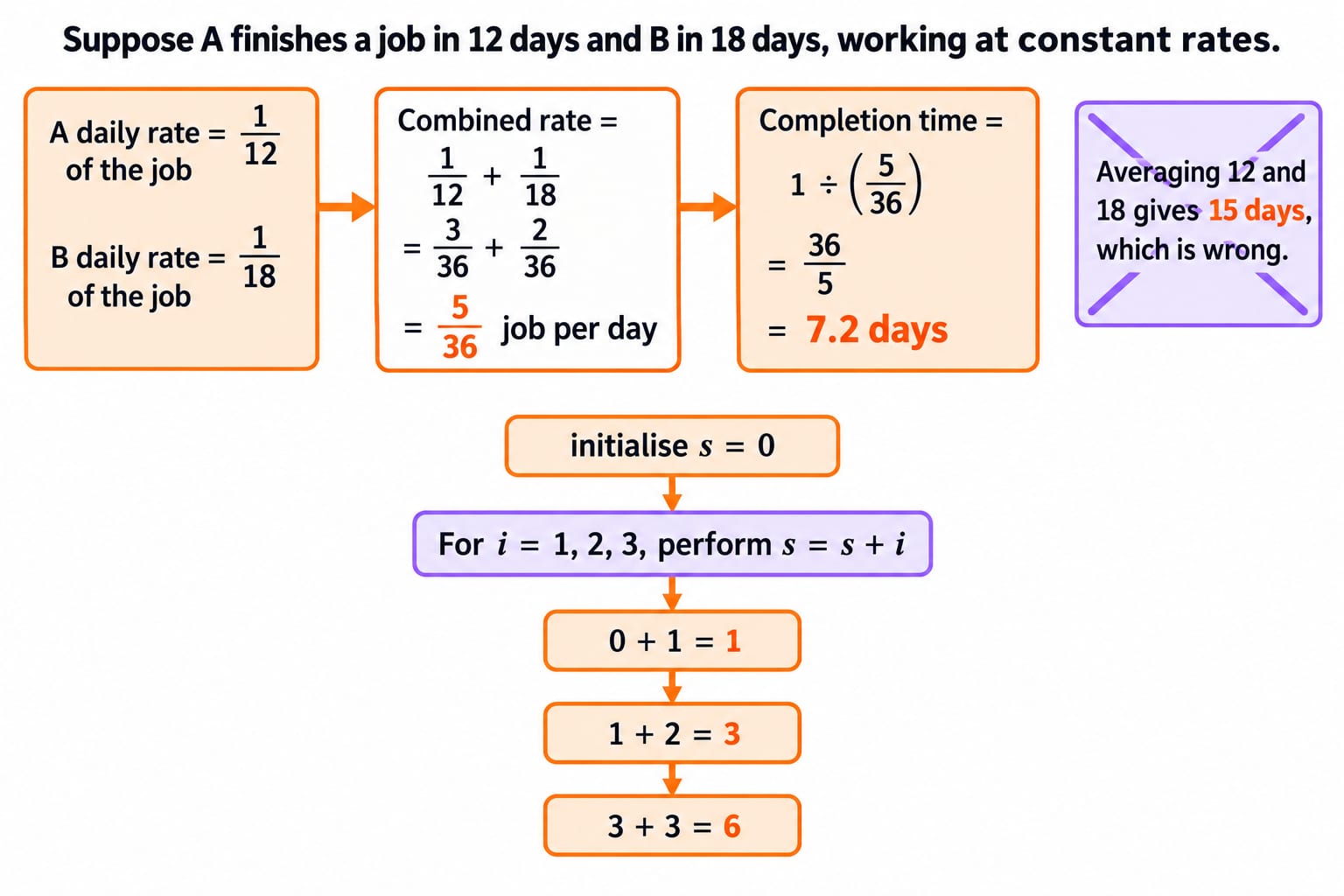
Practise explaining the method before reducing your solving time. Percentages, time and work, series and data sufficiency are useful areas for general aptitude and reasoning preparation.
Use these short exercises to practise a rate calculation and a programming trace.
Suppose A finishes a job in 12 days and B in 18 days, working at constant rates. Their daily rates are 1/12 and 1/18 of the job. Together:
Combined rate = 1/12 + 1/18 = 3/36 + 2/36 = 5/36 job per day.
Completion time = 1 ÷ (5/36) = 36/5 = 7.2 days.
Averaging 12 and 18 gives 15 days, which is wrong: work rates add, completion times do not.
For a programming trace, initialise s = 0. For i = 1, 2, 3, perform s = s + i: the updates are 0 + 1 = 1, 1 + 2 = 3, and 3 + 3 = 6. Write each update before answering.
Use a small coding task to prove correctness
Define the input, expected output and boundary behaviour before writing a working baseline.
Find the second-largest distinct integer in [4, 9, 9, 2, 7]. Initialise largest and second as unset. A new maximum moves the previous maximum into second place; otherwise, update second only with a smaller distinct value that improves it.
Value read | Largest | Second |
|---|---|---|
4 | 4 | unset |
9 | 9 | 4 |
9 | 9 | 4 |
2 | 9 | 4 |
7 | 9 | 7 |
The answer is 7. The repeated 9 cannot become the second distinct maximum. Define the output as NO_RESULT for [5, 5] and an empty array. Test negative integers too; zero is not a safe initial maximum.
This takes O(n) time and O(1) extra space. Use the coding-round strategy guide to practise task triage and checking solutions.
Practise a larger implementation that keeps state consistent
A small function produces an answer from an input. A larger component must preserve correct state across operations. Extend your practice with a tiny library-loan component.
Book B1 has total copies 2 and available copies 2:
Issue to M1 succeeds: available copies change from 2 to 1.
Issue to M2 succeeds: 1 to 0.
Issue to M3 is rejected: availability stays 0.
Return M1’s loan: 0 to 1.
Repeat the same return: reject it and keep availability at 1.
Tests should keep availability between 0 and 2 and leave state unchanged after a rejected operation. The repeated return fails because its loan is already closed; a unique loan ID, member and open/closed status make that rule explicit.
A review should confirm the requirements, the separation between issue and return operations, and each state transition. Be ready to explain why every stored field is needed.
Prepare to explain your project in a technical conversation
Prepare evidence of your own contribution: the requirement, your decision, a failure you found and the resulting fix. Use implementation choices to explain CS concepts.
Consider the library with one available copy. Two requests both read 1 before either updates it. A naive read-then-write flow can approve two loans, with each request writing availability as 0. The counter looks valid, but the loans exceed stock.
An atomic conditional decrement, allowed only when available > 0, lets exactly one issue succeed. The other receives failure. Loan creation and the stock update must succeed together in a transaction; otherwise a failed loan creation could still reduce availability.
Broaden this reasoning through technical interview preparation across CS subjects. Connect each concept to a decision you can explain and defend.
Handle role-fit and HR questions with concrete evidence
Explain your interests, contribution and practical availability honestly. Use a specific example instead of describing yourself only as hardworking.
A concise evidence-based answer could sound like this:
“In a three-person library project, I implemented issue and return validation and wrote six boundary checks. A repeated-return test exposed an error; I added loan status validation.”
Replace every figure and achievement with truthful personal evidence. Be ready to explain what the team did and what you personally implemented.
Ask about location, work arrangements, joining expectations and next communication steps when relevant.
Turn confirmed stages into a focused next step
Run a self-set 90-minute diagnostic:
20 minutes: aptitude and trace practice.
35 minutes: the second-distinct-maximum problem and boundary tests.
20 minutes: explain the library implementation.
15 minutes: review mistakes.
The total is 20 + 35 + 20 + 15 = 90 minutes. Move time from any omitted component to a confirmed assessment area.
Label each error as concept, implementation or explanation, then repair the largest gap first. If aptitude is that gap, the Aptitude for Placement course covers general aptitude, reasoning and verbal ability. Use it to strengthen those foundations. Check your drive instructions before relying on any pattern table.
Keep learning

Google Recruitment: A Preparation Map for Freshers
Prepare for your next confirmed Google hiring step with a role-specific checklist, a worked coding trace and a college-project story backed by evidence.
Updated 18 Nov 20264 min readCompany-Specific Prep
Infosys Recruitment Process and Test Pattern: Freshers' Stage-by-Stage Guide
Learn which Infosys hiring details come from your invitation, how to prepare for possible assessments and interviews, and how to verify an offer safely.
Updated 30 Oct 20265 min read170 viewsCompany-Specific Prep
Operating Systems Semester Guide: Learn Theory, Solve Numericals and Practise Labs
Connect OS concepts to semester calculations and programs through scheduling, Banker's Algorithm, paging, storage, and five lab checks.
Updated 24 Oct 20266 min readOperating Systems
IBPS Clerk State and Language Choice: Decide Before Applying
Choose an IBPS Clerk State or UT and listed language through three decision gates: location commitment, exact language match, and functional four-skill ability.
Updated 29 Oct 20265 min readIBPS Exams