

C Operators Interview Questions and Answers: Worked Outputs Explained
Prepare clear C operator answers by tracing grouping, values and side effects separately. The worked examples cover precedence, increments, short-circuiting, bit masks, division and sizeof.
KnowledgeGate Team
Exam prep & CS education
Updated 24 Nov 20266 min read
Memorising an operator table is not enough when an interviewer changes one pair of parentheses, mixes && with &, or asks whether an expression has a defined result. You need a method that separates parsing, value computation and side effects. The useful interview method separates parsing, value computation and side effects, then applies it to exact traces. With x = 5, y = 2 and mask = 6, one expression produces 13, while the version without parentheses produces 1. Treat fundamentals-first and depth-oriented questions as preparation lenses, not fixed employer patterns.
What is an operator in C, and how should you classify it?
"What is an operator?" An operator is a symbol or keyword-like construct that tells C to perform an operation on one or more operands. It can produce a value, a side effect, or both. In a + b, + computes a value. In x++, the expression yields a value and also schedules an increment of x.
Classify operators first by operand count:
Unary:
-x,!x,++x,sizeof xBinary:
a + b,a < b,a && bTernary:
condition ? value_if_true : value_if_false
The same symbol can have different roles. Binary * multiplies, while unary * dereferences. Binary & performs bitwise AND, while unary & takes an address. The main families are arithmetic, relational and equality, logical, bitwise, assignment, conditional, increment and decrement, and sizeof.
Precedence, associativity and evaluation order are different answers
"Does operator precedence decide which operand is evaluated first?" No. Precedence decides grouping when parentheses are absent. Associativity resolves grouping among operators at the same precedence. Evaluation order decides when operand computations and side effects occur.
For 2 + 3 * 4, multiplication has higher precedence, so the grouping is 2 + (3 * 4). Calculate 3 * 4 = 12, then 2 + 12 = 14.
For 20 / 5 * 2, / and * have equal precedence and associate left to right. The grouping is (20 / 5) * 2: 20 / 5 = 4, then 4 * 2 = 8.
In f() + g(), the parse is clear, but + does not promise whether f() or g() is called first. If that order matters, call them in separate statements.
Worked output: why parentheses change 13 to 1
"Evaluate both expressions and explain every step." Start each expression afresh with:
int x = 5;
int y = 2;
unsigned mask = 6u;
Expression A is int resultA = x++ + y * 3 + (mask & 3u);.
x++contributes the old value5. After the full expression,xbecomes6.y * 3 = 2 * 3 = 6.mask & 3u = 6 & 3. In four bits,0110 & 0011 = 0010, which is2.Therefore,
resultA = 5 + 6 + 2 = 13.
Reset the values. Expression B is int resultB = x++ + y * 3 + mask & 3u;. Postfix ++ binds before *, * before +, and + before bitwise &. It therefore parses as (x++ + (y * 3) + mask) & 3u. The sum is 5 + 6 + 6 = 17. Then 17 & 3 is 10001 & 00011 = 00001, so resultB = 1. Again, final x = 6.
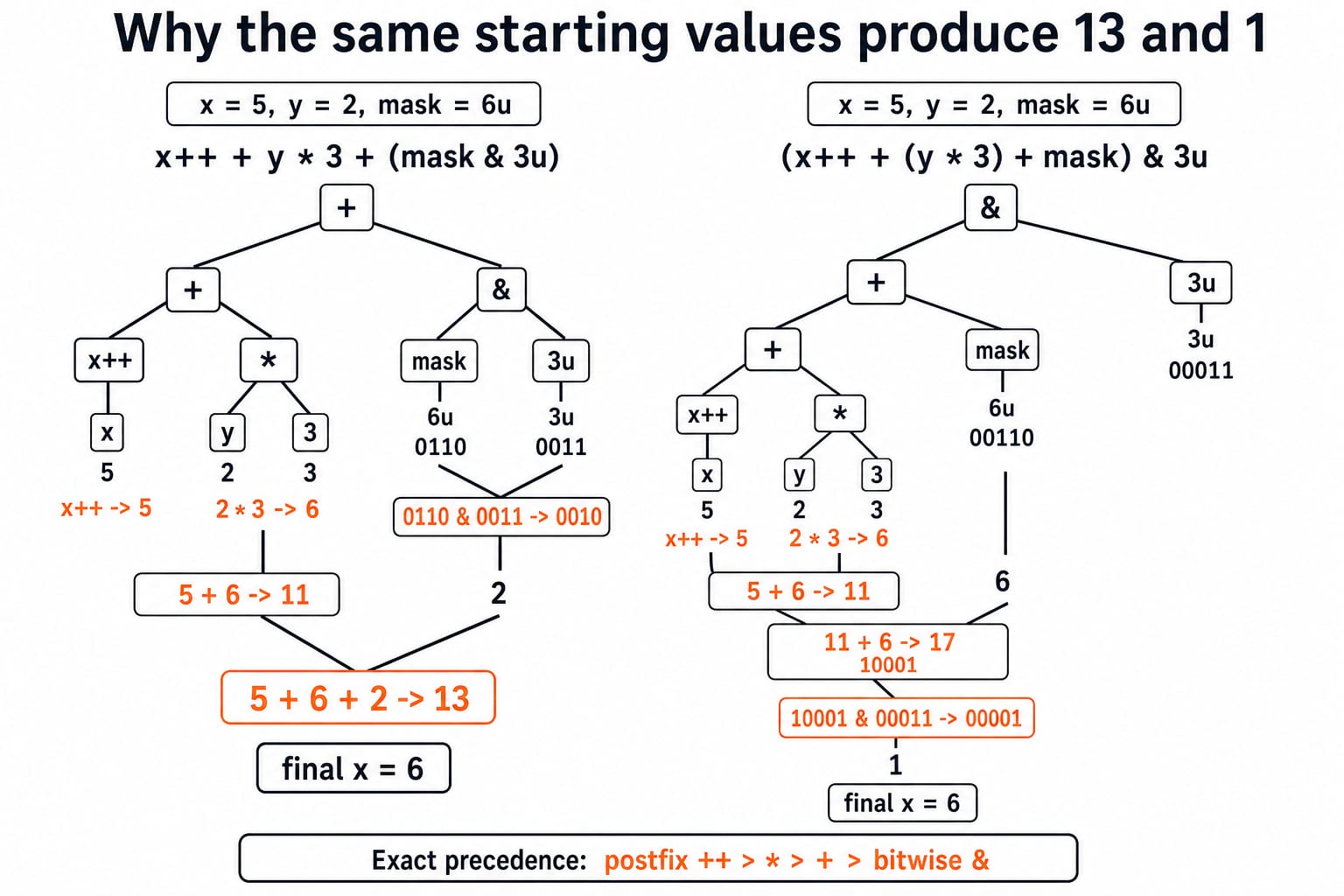
Parentheses are executable clarification, not decoration. Practise more traces in C Operator Precedence: Step-by-Step Worked Examples.
Prefix, postfix, assignment and unsequenced side effects
"What is the difference between x++ and ++x?" Use separate statements. With x = 5, int a = x++; gives a = 5, then x = 6. Reset x = 5; int b = ++x; increments first, so b = 6 and x = 6. Both increment x, but they yield different expression values.
"What is wrong with if (x = 0)?" It assigns 0 to x, and the condition is false. if (x == 0) compares. Any deliberate assignment inside a condition should be explicit and explained.
Do not predict an output for i = i++ + 1; or printf("%d %d", i++, i++);. Each modifies i more than once without the required sequencing, so the behaviour is undefined. Split the changes into separate statements with an obvious order.
Logical, bitwise and short-circuit operators
"How do && and & differ?" Since both operands are nonzero, 6 && 3 is logical true, represented as 1. By contrast, 6 & 3 compares bits: 0110 & 0011 = 0010, so the result is 2. Logical && yields 0 or 1 and short-circuits. Bitwise & evaluates both operands and examines corresponding bits.
Short-circuiting can prevent an invalid operation. With int divisor = 0;, the expression divisor != 0 && 24 / divisor > 2 is false after its left operand, so division is not evaluated. Reset divisor = 4; the left side is true, 24 / 4 = 6, and 6 > 2 is true, so the full expression yields 1.
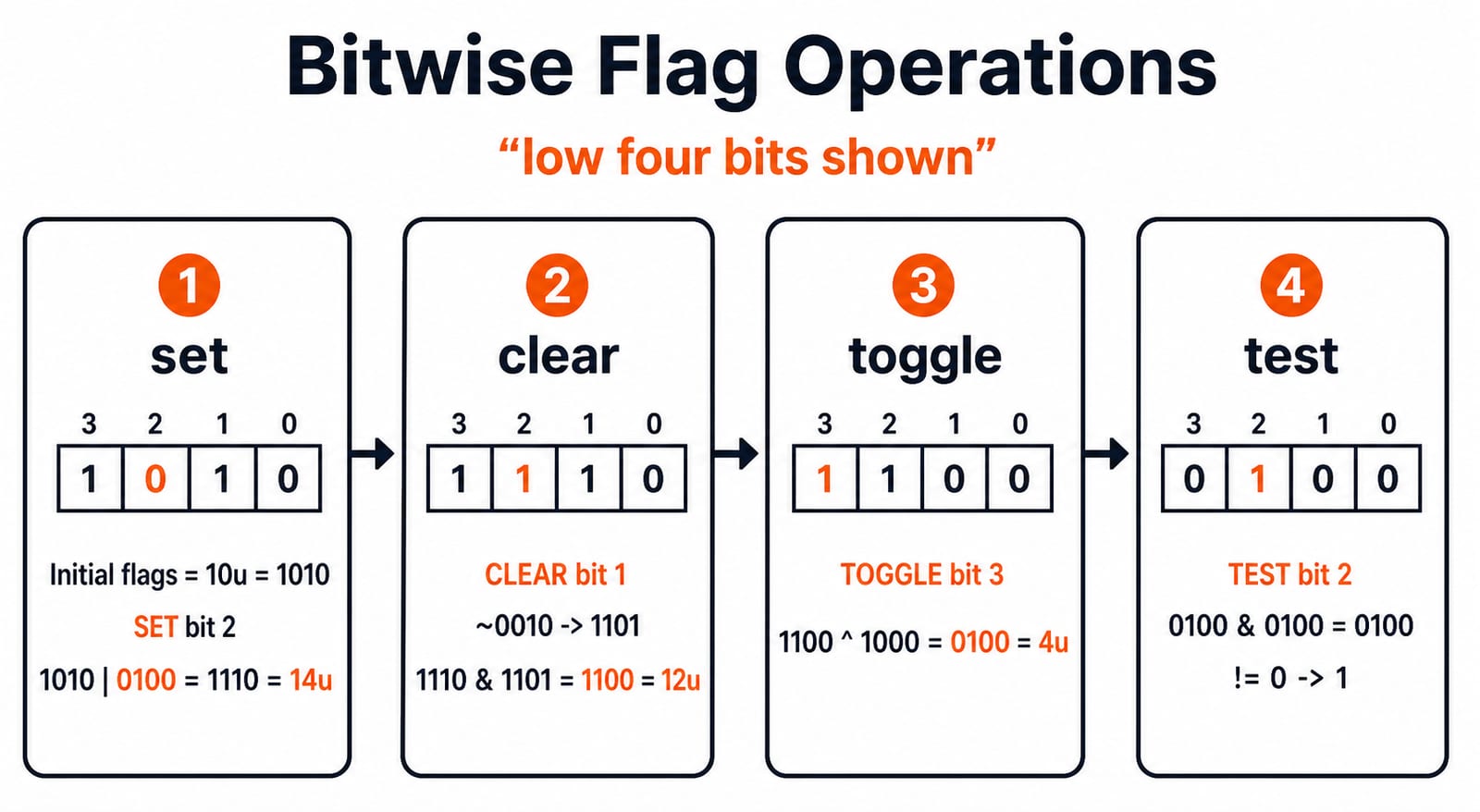
Now trace unsigned flags in four bits. Start with flags = 10u, or 1010. flags |= 4u sets bit 2, giving 1110, or 14. flags &= ~2u clears bit 1, giving 1100, or 12. flags ^= 8u toggles bit 3, giving 0100, or 4. Finally, (flags & 4u) != 0 yields 1.
Integer division, conversion, the conditional operator and sizeof
For division, operand types decide the operation:
7 / 2 = 3by integer division.double q = 7 / 2;stores3.0, because integer division happens before assignment.(double)7 / 2 = 3.5.Signed division truncates towards zero, so
-17 / 5 = -3and-17 % 5 = -2. Check:(-3 * 5) + (-2) = -15 - 2 = -17.
"What does sizeof return?" It returns a size in bytes as a value of type size_t; sizeof(char) is 1 by definition. With int a[5]; in its defining scope, sizeof a / sizeof a[0] = 5 without assuming the byte size of int. In a function parameter declared int a[], the parameter is adjusted to a pointer, so that expression cannot recover the array length.
The conditional expression int max = 12 > 9 ? 12 : 9; yields 12. Only the selected second or third operand is evaluated. For the next conversion layer, read Data Types and Operators in C: Promotion, Overflow Traps.
How interviews probe C operators at different depths
A fundamentals-first screen may ask for operator families and the outputs of 7 / 2, x++ and 6 && 3. A depth-oriented follow-up may remove parentheses, ask why f() + g() has no promised call order, request a portable rewrite of undefined code, or demand the bit-mask trace. These are useful preparation depths, not universal employer formats.
Use four passes:
Write operand types and starting values.
Add parentheses according to precedence and associativity.
Mark short-circuiting and every side effect.
Decide whether behaviour is defined, unspecified or undefined, then calculate.
The two result expressions are defined. The operand evaluation order in f() + g() is unspecified. The repeated i++ expressions are undefined. Continue with C Programming Interview Questions for Freshers: 40 Answered, then practise presenting the method aloud with the Interview & Resume Preparation Course.
C operators interview answer in 60 seconds
Operators act on operands. Precedence groups unlike operators; associativity groups equal-precedence operators. Neither promises evaluation order. && and || short-circuit, bitwise operators work bit by bit, prefix and postfix yield different values, and unsequenced repeated modification has no valid output.
Reproduce 13 versus 1, 6 && 3 = 1 versus 6 & 3 = 2, and the zero-divisor guard. Use C Language: Concepts, MCQs and Coding Questions for focused fundamentals and Placement Preparation & Coding: Exams, Eligibility & Courses for the wider route.
Keep learning

C Operators Explained: Precedence, Types and Worked Examples
Learn how C groups and evaluates operators, then trace arithmetic, masks, conditions, and a complete program that prints 4 5 21 1 39.
Updated 9 Sep 20266 min read98 viewsC Programming & Data Structures

Understanding Diverse Learners for Teaching Exams: Concepts, Caselets and a Six-Learner Classroom Plan
Learn a four-filter method for diverse-learner caselets, then follow a complete Class VI fraction lesson from diagnostic evidence to reassessment.
Updated 31 Oct 20265 min readCTET & UPTET
ORDER BY and LIMIT in SQL: Tutorial with Exact Outputs
Learn to sort SQL results deterministically, resolve ties, select top rows, and paginate with LIMIT and OFFSET using one eight-row orders table.
Updated 30 Oct 20266 min read50 viewsDBMS
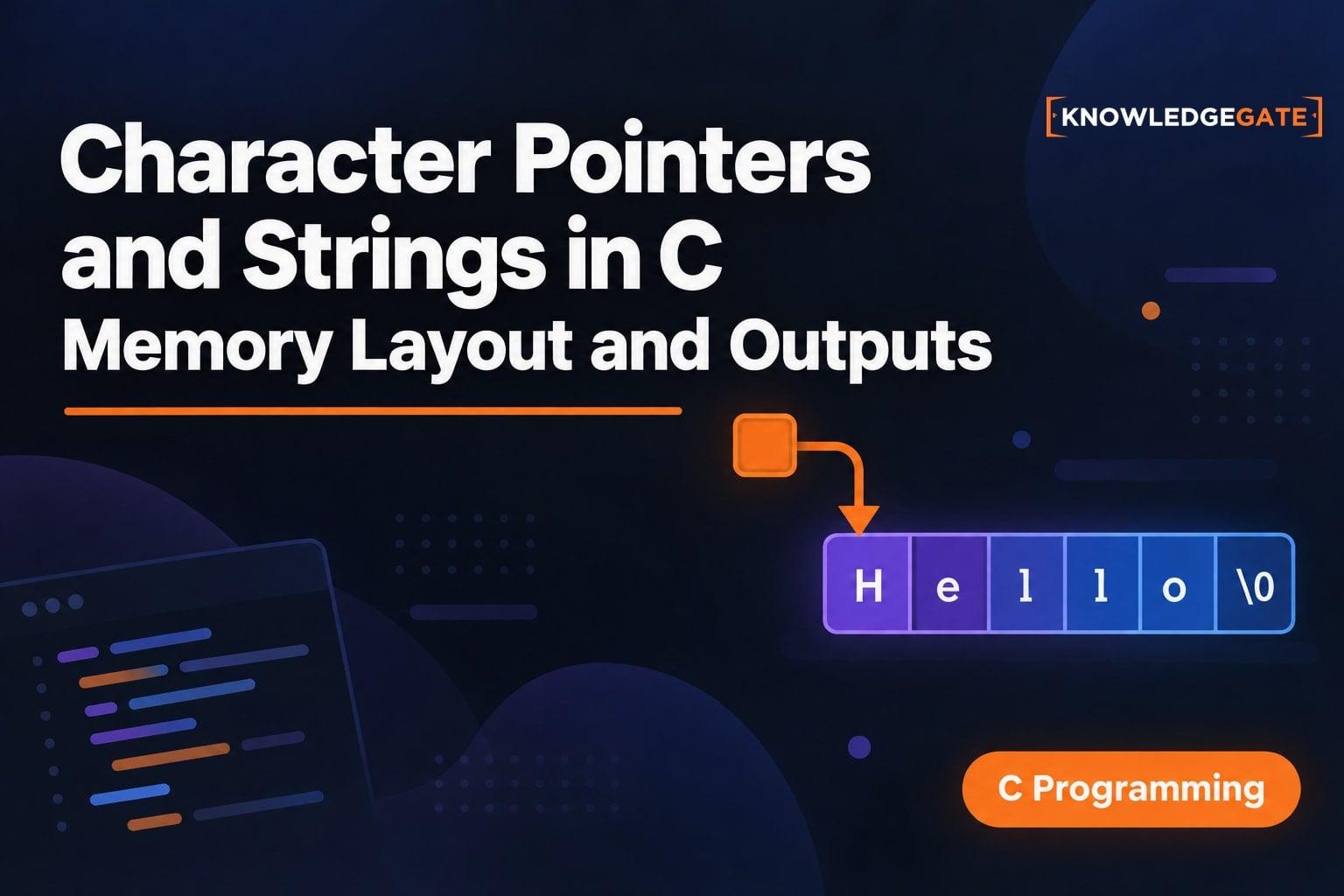
Character Pointers and Strings in C: Memory Layout, Worked Outputs and Exam Traps
Build a memory-first model for character pointers and C strings. Trace GATE to GITE and CAT to CBT, then check literals, bounds, terminators and capacity.
Updated 2 Sep 20266 min read64 viewsC Programming & Data Structures