Unary Operators (Selection and Projection) MCQs: 11 Solved Questions
Solve 11 past-paper MCQs on relational-algebra selection and projection, from recognising each operator to composing and transforming expressions safely.
KnowledgeGate Team
Exam prep & CS education
Updated 8 Aug 20267 min read
Selection and projection look like two easy symbols, but their distractors switch rows with columns, confuse SQL SELECT with relational-algebra selection, or remove an attribute before a predicate can use it. Keep one rule beside you: selection filters tuples and usually preserves degree; projection chooses attributes and can reduce degree and cardinality because duplicate projected tuples are removed. Every question below is a past-paper item from GATE, UGC NET, DSSSB, ISRO, Cognizant, Coal India, BEL or Beltron. Choose an option first, then check both the answer and the reason. More of the surrounding syllabus sits under CS Fundamentals.
1. Selection versus projection: build the row-column model first
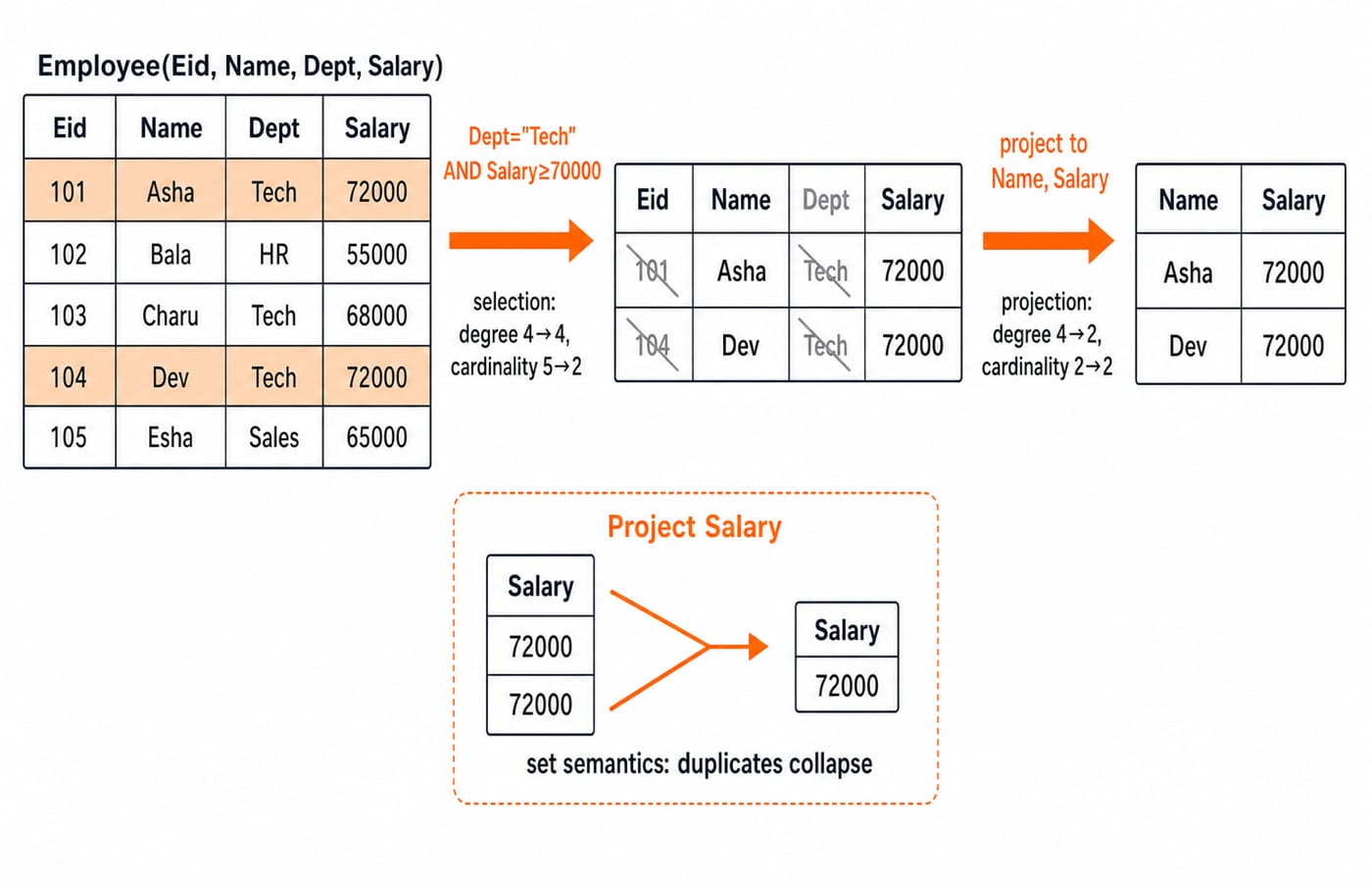
Both are unary because each takes one relation. σ_condition(R) keeps rows that satisfy a Boolean condition and retains every attribute. Degree stays unchanged; cardinality cannot increase. π_attribute-list(R) keeps named columns. Its degree is the number of projected attributes, and duplicate output tuples collapse under set semantics.
Use this relation as the reference:
Eid | Name | Dept | Salary |
|---|---|---|---|
101 | Asha | Tech | 72000 |
102 | Bala | HR | 55000 |
103 | Charu | Tech | 68000 |
104 | Dev | Tech | 72000 |
105 | Esha | Sales | 65000 |
For σ_{Dept="Tech" ∧ Salary≥70000}(Employee), only (101, Asha, Tech, 72000) and (104, Dev, Tech, 72000) pass. Degree is 4 → 4; cardinality is 5 → 2. Charu sits in Tech too, but 68000 misses the 70000 floor, so both conjuncts do real work.
Apply π_{Name,Salary}. The result is (Asha, 72000) and (Dev, 72000): degree 4 → 2, cardinality 2 → 2. With π_{Salary}, both rows produce (72000), so the duplicate collapses to one tuple.
2. Recognise the unary operator and the job of selection
Question 1 (Coal India 2020)
Which of the following is a unary operation?
A. Intersection
B. Projection
C. Join
D. Cartesian Product
Correct answer: B. Projection. Projection reads one relation. Intersection, join and Cartesian product require two. Unary describes the number of inputs, not output columns. Open the solved question.
Question 2 (BEL 2023)
In context of Relational Algebra of Database Management System, SELECT operation is used to select a subset of the tuples from a relation that satisfy a _____ .
A. Attribute Criteria
B. Block Criteria
C. Selection Criteria
D. Relation Criteria
Correct answer: C. Selection Criteria. Selection evaluates a Boolean predicate tuple by tuple. For Salary ≥ 70000, Asha and Dev pass; Bala, Charu and Esha fail. The complete Boolean test is the selection criterion. Open the solved question.
Question 3 (Beltron Programmer 2025)
In relational algebra, what is the main purpose of the selection (σ) operator when applied to a relation?
A. It eliminates duplicate tuples from the relation.
B. It filters tuples based on a given condition.
C. It merges two relations based on a common attribute.
D. It sorts the attributes of the relation in increasing sequence.
Correct answer: B. It filters tuples based on a given condition. Selection is horizontal filtering. Projection exposes duplicate removal, merging belongs to join, and basic relational algebra does not promise display order. Open the solved question.
3. Read projection notation and distinguish it from selection
Question 4 (Beltron Programmer 2025)
How is π{A, C}(R) interpreted if relation R(A, B, C) contains tuples?
A. Output only columns A and C, discarding B
B. Compute a new attribute from A and C
C. Select tuples where attribute A or C is non-null
D. Join columns A and C
Correct answer: A. Output only columns A and C, discarding B. For (1, x, 9), (2, y, 8) and (1, z, 9), projection gives (1,9), (2,8), (1,9). Removing the duplicate leaves (1,9) and (2,8). Open the solved question.
Question 5 (DSSSB 2021)
Write the name of the relational algebra operation as per the given order of their notation.
Notation:
Π , X , σ
A. Projection, Cartesian product, division
B. Projection, Cartesian product, select
C. Intersection join, outer join, select
D. Projection, outer join, select
Correct answer: B. Projection, Cartesian product, select. In order, Π or π is projection, X or × is Cartesian product, and σ is selection. Only the middle operation is binary. Open the solved question.
Question 6 (ISRO 2007)
Which operation is used to extract specified columns from a table?
A. Project
B. Join
C. Extract
D. Substitute
Correct answer: A. Project. “Specified columns” points to projection. Extract is ordinary English, join combines relations, and substitute is not a core operator. Open the solved question.
4. Translate English conditions into selection expressions
Question 7 (DSSSB 2021)
Consider the following relation schema of students.
STUDENT (Rollno, Name, DOB, Marks, Gender)
Which of the given query is equivalent to this query in English?
“Find the tuples of student having marks above 80”.
A. σ Marks > 80 (STUDENT)
B. π Marks > 80 (STUDENT)
C. σ Marks < 80 (STUDENT)
D. π Marks < 80 (STUDENT)
Correct answer: A. σ Marks > 80 (STUDENT). “Find the tuples” requires σ; “above 80” means strict Marks > 80. With no projection, all five STUDENT attributes remain. Open the solved question.
Question 8 (Cognizant 2024)
How to retrieve data from relation ‘Professor’ where department name is ‘Mathematics’ and salary is greater than ’65,000’?
A. σdept_name = “Mathematics” ⋀ salary>65000 (Professor)
B. σ “Mathematics” ⋀ salary>65000 (Professor)
C. σdept_name = “Mathematics” and salary>65000 (Professor)
D. σ salary>65000 (Professor) ⋀ dept_name = “Mathematics”
Correct answer: A. σdept_name = “Mathematics” ⋀ salary>65000 (Professor). The predicate is dept_name = "Mathematics" ∧ salary > 65000. Meera at 68000 passes; Nitin at 65000 fails the strict comparison. B omits an attribute, C uses prose, and D leaves a condition outside σ. Open the solved question.
5. Compose selection and projection in the right order
Question 9 (UGC NET 2013)
Consider the following schemas: (NET-DEC-2013)
Branch = (Branch-name, Assets, Branch-city)
Customer = (Customer-name, Bank name, Customer-city)
Borrow = (Branch-name, loan number, customer account-number)
Deposit = (Branch-name, Account-number, Customer-name, Balance)
Using relational Algebra, the Query that finds customers who have balance more than 10,000 is ________
A. π customer-name (σ balance > 10000 (Deposit))
B. σ customer-name (σ balance > 10000 (Deposit))
C. π customer-name (σ balance > 10000 (Borrow))
D. σ customer-name (π balance > 10000 (Borrow))
Correct answer: A. π customer-name (σ balance > 10000 (Deposit)). Read inside out. Kavya at 12500 and Ritu at 18000 pass; Mohan at 9000 fails. Projecting Customer-name gives Kavya and Ritu. Borrow has no Balance attribute. Open the solved question.
6. Optimise cascaded selections and projections safely
Question 10 (GATE 2014)
What is the optimized version of the relation algebra expression π A₁ (π A₂ (σ F₁ (σ F₂ (r)))) where A₁, A₂ are sets of attributes in r with A₁ ⊂ A₂ and F₁, F₂ are Boolean expressions based on the attributes in r?
A. π A₁ (σ (F₁ ∧ F₂) (r))
B. π A₁ (σ (F₁ ∨ F₂) (r))
C. π A₂ (σ (F₁ ∧ F₂) (r))
D. π A₂ (σ (F₁ ∨ F₂) (r))
Correct answer: A. π A₁ (σ (F₁ ∧ F₂) (r)). Successive selections combine as F₁ ∧ F₂. Since A₁ ⊂ A₂, the final projection can go directly to A₁. With the reference predicates Dept="Tech" and Salary≥70000, projecting {Eid,Salary} gives (101,72000) and (104,72000). Open the solved question.
Question 11 (GATE 1998)
Which of the following query transformations (i.e., replacing the l.h.s. expression by the r.h.s. expression) is incorrect?
R₁ and R₂ are relations. C₁, C₂ are selection conditions and A₁, A₂ are attributes of R₁.
A. σ C₁ (σ C₂ R₁) → σ C₂ (σ C₁ (R₁))
B. σ C₁ (π A₁ R₁) → π A₁ (σ C₁ (R₁))
C. σ C₁ (R₁ ∪ R₂) → σ C₁ (R₁) ∪ σ C₁ (R₂)
D. π A₁ (σ C₁ (R₁)) → σ C₁ (π A₁ (R₁))
Correct answer: D. π A₁ (σ C₁ (R₁)) → σ C₁ (π A₁ (R₁)). Let R₁(Eid,Dept,Salary), A₁={Eid,Salary} and C₁: Dept="Tech". The left side filters before projecting. The right side deletes Dept before testing it. A pushed projection must retain every predicate and final-output attribute. Open the solved question.
7. Score the set and choose the next drill
Treat this as a diagnostic. With 9 to 11 correct, move to mixed SQL and relational-algebra translation. With 6 to 8, redo Questions 4, 8, 9 and 11 while marking rows versus columns. With 0 to 5, rebuild the Employee result first.
The short version:
σfilters rows.πchooses columns.Read compositions from the inside out.
Never push projection past a predicate unless every predicate attribute survives.
Next, solve SQL Query MCQs: 12 Solved (SELECT, Joins, Subqueries), then use SQL Queries and Joins in DBMS: sublanguages, joins and GROUP BY worked out to repair a gap. For a semester-oriented CS route, see the ZERO TO HERO complete CS course. For placement revision, use Computer Science Fundamentals for Placements by Sanchit Sir. Neither is required for these answers; first redo every miss without the options.
Keep learning
SQL Library Functions MCQs: 12 Solved Math, Aggregate, String and Date Questions
Practise 12 solved SQL library function MCQs with inside-out calculations, exact intermediate values and clear explanations of the common traps.
Updated 3 Oct 20268 min readDBMS MCQs
SQL Introduction, Components & Structure MCQs: 12 Solved Questions
Test your SQL foundations with 12 explained MCQs covering terminology, query behaviour, metadata, dynamic SQL, database models and QBE.
28 Sep 20267 min readDBMS MCQs
GROUP BY Clause MCQs: 10 Solved SQL Questions with Explanations
Solve ten published GROUP BY questions, then check each answer with row-level and group-level reasoning. Two full traces make the common SQL traps visible.
Updated 25 Sep 20268 min readDBMS MCQs
Third Normal Form (3NF) MCQs: 12 Solved Questions with Explanations
Solve 12 real 3NF exam MCQs with clear explanations, candidate-key closures, a raw-row decomposition, and the prime-attribute exception that separates 3NF from BCNF.
Updated 24 Sep 20267 min readDBMS MCQs