Transmission and Propagation Delay for GATE
Separate the time needed to put a packet on a link from the time needed for its bits to travel. Then solve delay, pipe-capacity and utilisation questions without unit mistakes.
KnowledgeGate Team
Exam prep & CS education
Updated 29 Jul 20266 min read145 views
Delay questions rarely fail because the formula is difficult. They fail because packet length, bandwidth, distance and propagation speed arrive in different units, or because transmission delay gets confused with propagation delay. Keep those two ideas separate and the arithmetic becomes routine.
Related reading: TCP/IP packet trace and GATE networking syllabus areas.
The four delays, and the two that matter most
A packet can experience four kinds of delay at a node or across a link:
Processing delay: time taken to inspect the header and decide where the packet goes.
Queuing delay: time spent waiting behind other packets. This depends on traffic and is not fixed unless the question supplies it.
Transmission delay: time needed to push all packet bits onto the link.
Propagation delay: time needed for a bit to travel from sender to receiver.
Transmission and propagation delay are the two that matter most, because they are the two the question always pins down: they follow from packet size, bandwidth, distance and propagation speed, and every one of those is given. Processing and queuing delay are taken as zero unless the question states a value for them.
For a packet of length L bits on a link of bandwidth B bits/s,
Tt = L / B
For link length d metres and propagation speed v metres/s,
Tp = d / v
Transmission delay depends on packet size and bandwidth, not distance. Propagation delay depends on distance and signal speed, not packet size. A very long, high-bandwidth fibre can therefore have tiny Tt but noticeable Tp. A slow, short link carrying a large packet can have the opposite balance.
Worked delay and bandwidth-delay product numericals
Worked numerical 1: one packet over one link
A 1,500-byte packet crosses a 10 Mbps link that is 1,000 km long. The propagation speed is 2 x 10^8 m/s. Ignore processing and queuing delays.
First put every value into base units:
L = 1,500 x 8 = 12,000 bits
B = 10 Mbps = 10 x 10^6 bits/s
d = 1,000 km = 1,000 x 10^3 = 10^6 m
v = 2 x 10^8 m/s
Now calculate transmission delay:
Tt = 12,000 / (10 x 10^6) = 0.0012 s = 1.2 ms
Calculate propagation delay:
Tp = 10^6 / (2 x 10^8) = 0.005 s = 5 ms
The first bit reaches the receiver after 5 ms. The sender finishes transmitting the packet after 1.2 ms, and the last bit reaches the receiver after:
Tt + Tp = 1.2 + 5 = 6.2 ms
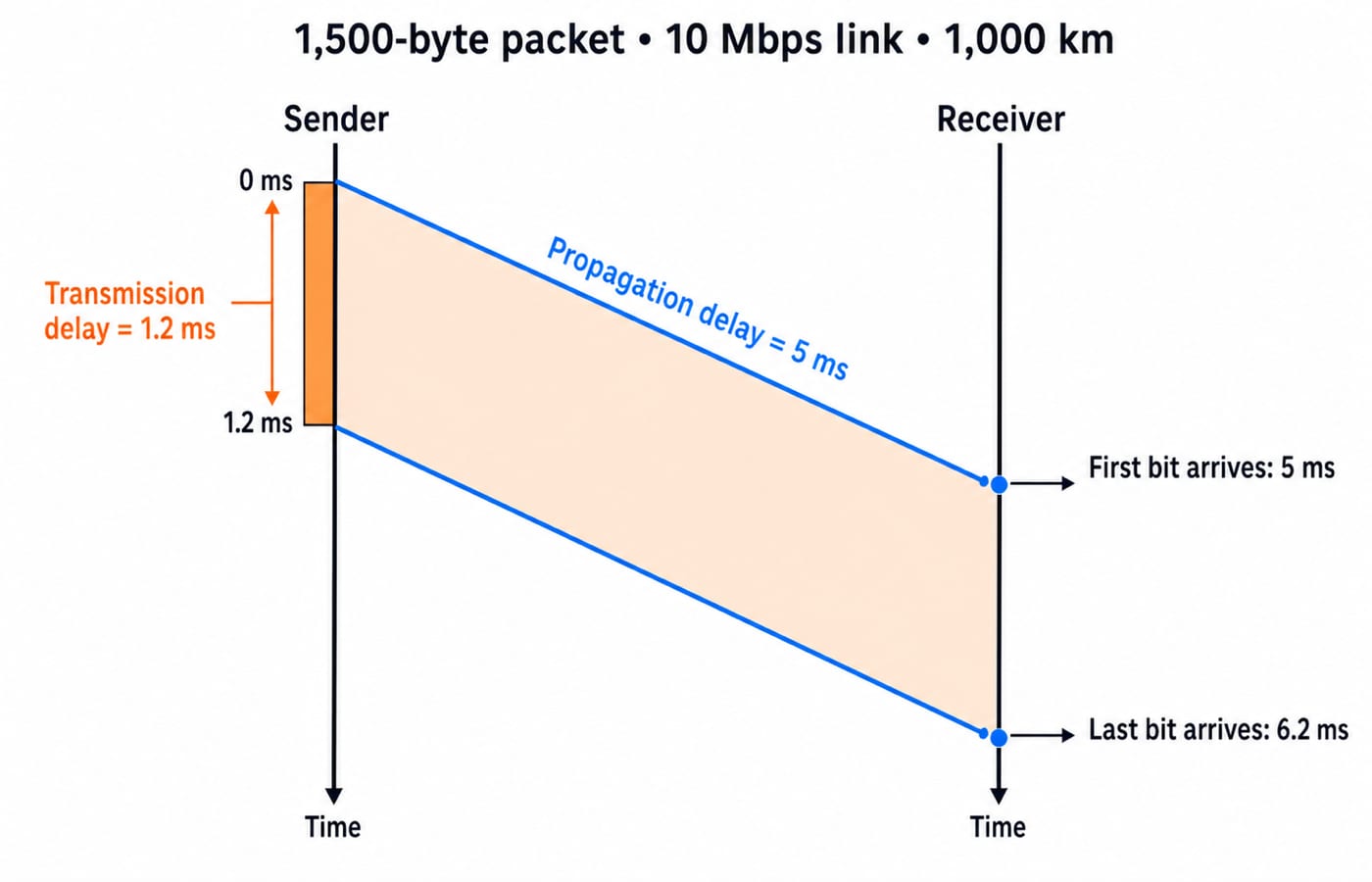
Notice the wording. If the question asks when the first bit arrives, use Tp. If it asks when the complete packet arrives on an empty single link, use Tt + Tp.
Worked numerical 2: bits in flight
The bandwidth-delay product is the number of bits that can occupy a link while the first bit travels one way:
BDP = B x Tp
For the same link,
BDP = 10 x 10^6 x 0.005 = 50,000 bits
That is 50,000 / 8 = 6,250 bytes in flight. This is the link's one-way pipe capacity. If a sender can keep transmitting continuously, 50,000 bits can be on this physical path before the first bit reaches the receiver.
Do not automatically multiply by RTT. A question asking for the one-way bandwidth-delay product uses B x Tp. A question asking how much unacknowledged data is needed to fill a round-trip control loop may use B x RTT, according to its stated assumptions.
RTT and link utilisation
Suppose Stop-and-Wait sends the packet from the first example and waits for an acknowledgement. If acknowledgement transmission time and all other delays are ignored, one cycle takes:
Tt + 2Tp = 1.2 + 2(5) = 11.2 ms
Only 1.2 ms of that cycle is used to transmit data. The utilisation is:
U = Tt / (Tt + 2Tp) = 1.2 / 11.2 = 0.1071, or about 10.7%
That 10.7% is why sliding-window protocols let several frames stay unacknowledged: the sender is idle for 10 ms of every 11.2 ms cycle, and a window keeps that pipe full. The window arithmetic itself, including Go-Back-N and Selective Repeat sequence-number bounds, is worked out in Sliding Window Protocols for GATE: Stop-and-Wait, GBN, SR. The point here is narrower: utilisation falls out of Tt and Tp alone, so getting those two numbers right settles the protocol question before you reach it. For another set of networking calculations where prefixes and bit boundaries matter, revise IP Addressing and Subnetting Explained. TCP vs UDP: Transport Layer Explained then places these link-level delays inside end-to-end transport behaviour.
Unit traps that change the answer
Write units beside every number before substituting. These are the common traps:
Kbps is not KBps. Lowercase b means bits; uppercase B means bytes. Since one byte is eight bits, confusing them creates an eightfold error.
Decimal and binary prefixes differ. In networking, 1 Mbps normally means 10^6 bits/s. A MiB is 2^20 bytes. Use the definition supplied in the question.
Kilometres must become metres before using a propagation speed in metres per second.
RTT is not one-way propagation delay. With symmetric paths and negligible other delays, RTT contributes 2Tp.
The same file and the same link produce three different numbers depending on how the units are read. Send a 1 MB file over an 8 Mbps link and ignore every delay except transmission. If the question defines 1 MB as 10^6 bytes:
L = 10^6 x 8 = 8 x 10^6 bits
Tt = (8 x 10^6) / (8 x 10^6) = 1 s
If it instead specifies 1 MiB, then L = 8 x 2^20 bits and:
Tt = (8 x 2^20) / (8 x 10^6) = 1.048576 s
Treating 8 Mbps as 8 MB/s would incorrectly produce 0.125 s for the decimal file. The formula did not change. Only the units did.
How GATE tests delay numericals
Typical questions ask for end-to-end delay over one or more links, the arrival time of the first or last bit, bandwidth-delay product, or Stop-and-Wait utilisation. On a store-and-forward path, each link must receive the full packet before forwarding it, so transmission delay is paid on every link. Propagation delay is also added for every link.
Put a router in the middle of the first example and the arithmetic follows directly. Two 1,000 km, 10 Mbps hops carry the same 1,500-byte packet, so each hop costs Tt = 1.2 ms and Tp = 5 ms, and the last bit reaches the destination after 2(1.2) + 2(5) = 12.4 ms. For n identical store-and-forward links the total is n(Tt + Tp). That is why one extra hop costs 6.2 ms while one extra kilometre on an existing hop costs 5 microseconds.
Read the assumptions before adding processing, queuing or acknowledgement time. For the current syllabus and any official exam-specific instructions, check the official GATE portal of the organising IIT. GATE CS Exam Preparation Courses & Test Series keeps the wider subject path together.
The short version and next step
Convert bytes to bits and kilometres to metres first. Then calculate Tt = L/B and Tp = d/v separately. Use Tp for first-bit arrival, Tt + Tp for complete-packet arrival on one empty link, and B x Tp for one-way bits in flight.
After hand-solving these two examples, use the GATE Test Series to practise mixed questions where delay formulas are hidden inside protocol wording. The goal is not to memorise another formula. It is to recognise which clock the question is asking you to measure.
Keep learning
ISRO Scientist/Engineer CS Syllabus vs GATE CS: The Subject Overlap Map
See which core CS subjects transfer directly from GATE to ISRO, what drops out, how the question texture changes and where an ISRO-specific polish helps.
Updated 5 Oct 20264 min readGATE Strategy & Roadmap

Union-Find for GATE: Union by Rank, Path Compression and the Near-Constant Bound
Trace seven unions, inspect the final ranks, then compress the deepest path by hand. The worked forest makes the inverse-Ackermann bound much less mysterious.
Updated 1 Oct 20265 min readGATE Strategy & Roadmap

RAID Levels for GATE: Striping, Mirroring, Parity and the Two Capacity Formulas
Stop memorising RAID names in isolation. Tie each level to usable capacity, failure tolerance and write cost, then test the formulas on one eight-disk array.
Updated 26 Sep 20265 min read58 viewsGATE Strategy & Roadmap

Memory Interfacing for GATE: Chip-Count and Address-Decoding Numericals, Fully Worked
Separate words from bits, split the address correctly, and verify the result with a gap-free hexadecimal map. This guide works through depth and width expansion step by step.
Updated 24 Sep 20265 min read55 viewsGATE Strategy & Roadmap