RAID Levels for GATE: Striping, Mirroring, Parity and the Two Capacity Formulas
Stop memorising RAID names in isolation. Tie each level to usable capacity, failure tolerance and write cost, then test the formulas on one eight-disk array.
KnowledgeGate Team
Exam prep & CS education
Updated 26 Sep 20265 min read58 views
RAID questions usually reduce to two answers: how much usable capacity remains, and how many disk failures the array can survive. Memorising level names without those formulas is why a small RAID 6 numerical feels harder than it is. Attach each level to its redundancy cost, and the arithmetic becomes direct.
What the question really wants: usable capacity and fault tolerance
Let an array contain N disks, each with capacity C. Its raw capacity is always N x C. Usable capacity is the part available for data after mirrors or parity consume their share.
The second quantity is fault tolerance: how many simultaneous disk failures can occur without losing the array's data. Capacity and tolerance answer different questions. RAID 0 has all its raw capacity available but survives no disk failure. A redundant level gives up capacity to survive failure.
Unless the question says capacities differ, assume equal-sized disks. Real arrays built from unequal disks are constrained by the smallest participating disk, but that is normally outside the basic numerical.
The three underlying ideas
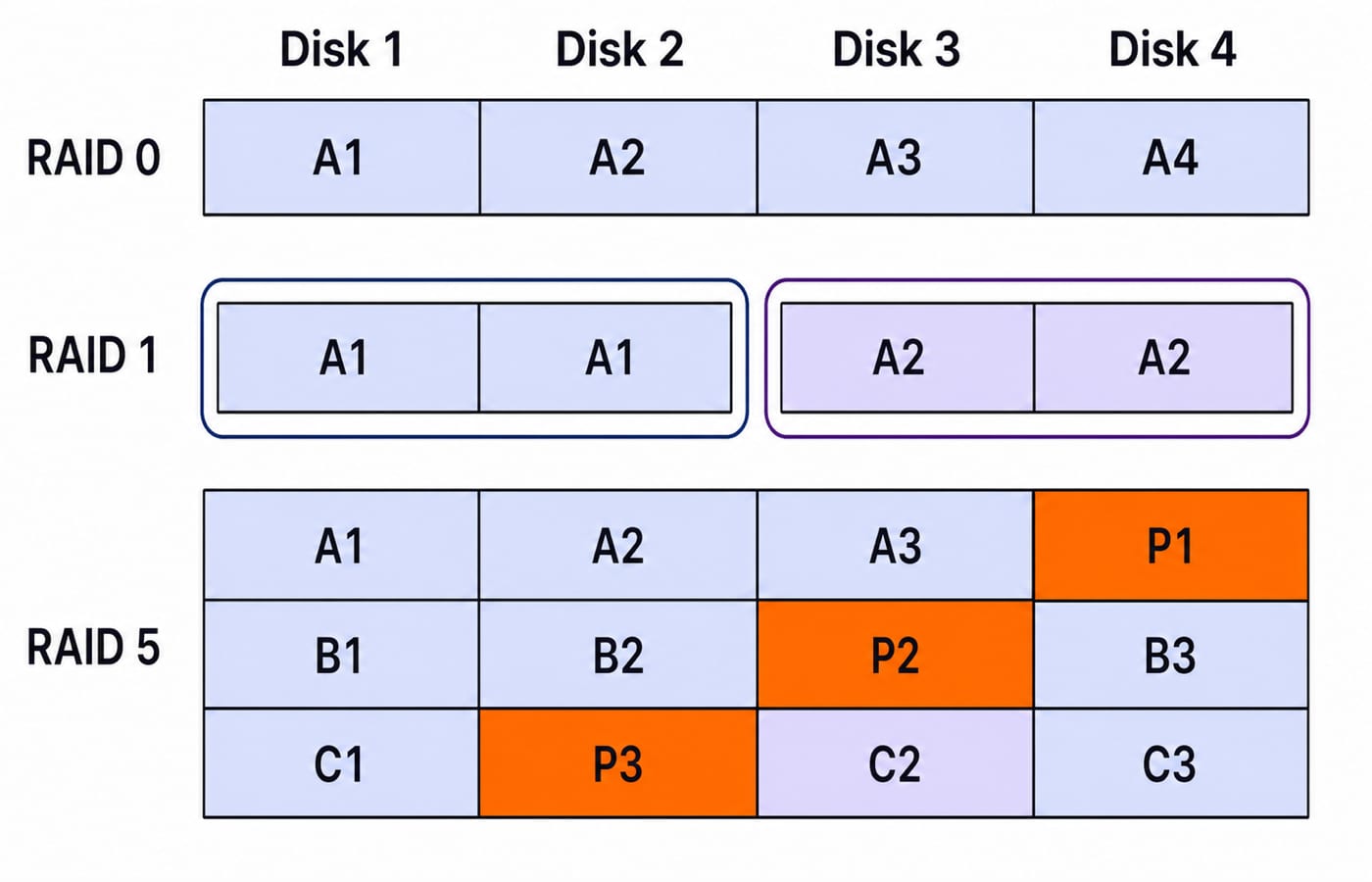
Striping spreads consecutive data blocks across disks. Several disks can serve different blocks in parallel, improving throughput. Striping alone provides no recovery information.
Mirroring stores a complete second copy. If one disk in a two-disk mirror fails, its partner still has the data. The trade-off is simple: half of the raw capacity stores duplicates.
Parity stores calculated recovery information. With single parity, the missing value can be reconstructed from the surviving data and parity blocks. Distributed parity rotates the parity position so one fixed disk does not handle every parity update.
These ideas combine differently at each RAID level.
RAID level formulas and failure tolerance
Level | Main idea | Usable capacity | Failure tolerance |
|---|---|---|---|
RAID 0 | Striping only | N x C | 0 |
RAID 1 | Two-disk mirror | C | 1 |
RAID 3/4 | Dedicated single parity | (N - 1) x C | 1 |
RAID 5 | Distributed single parity | (N - 1) x C | 1 |
RAID 6 | Distributed dual parity | (N - 2) x C | 2 |
RAID 10 | Mirrored pairs, then striped | (N / 2) x C | At least 1 |
RAID 0 maximises usable capacity and parallelism, but the loss of any member disk loses part of the striped data. RAID 1 is the standard two-disk mirror. RAID 10 requires an even disk count because it stripes across mirror pairs.
RAID 3 uses byte-level striping with a dedicated parity disk, while RAID 4 uses block-level striping with a dedicated parity disk. Both pay one disk of capacity. RAID 5 distributes that single parity across the disks, removing the dedicated parity disk as a fixed bottleneck. RAID 6 distributes two independent parity values and survives any two disk failures.
RAID 2 uses bit-level striping with Hamming-code error correction and is largely historical. Its number of check disks depends on the Hamming-code arrangement, so (N - 1) x C is not a universal RAID 2 capacity formula.
Example: eight disks, each 2 TB
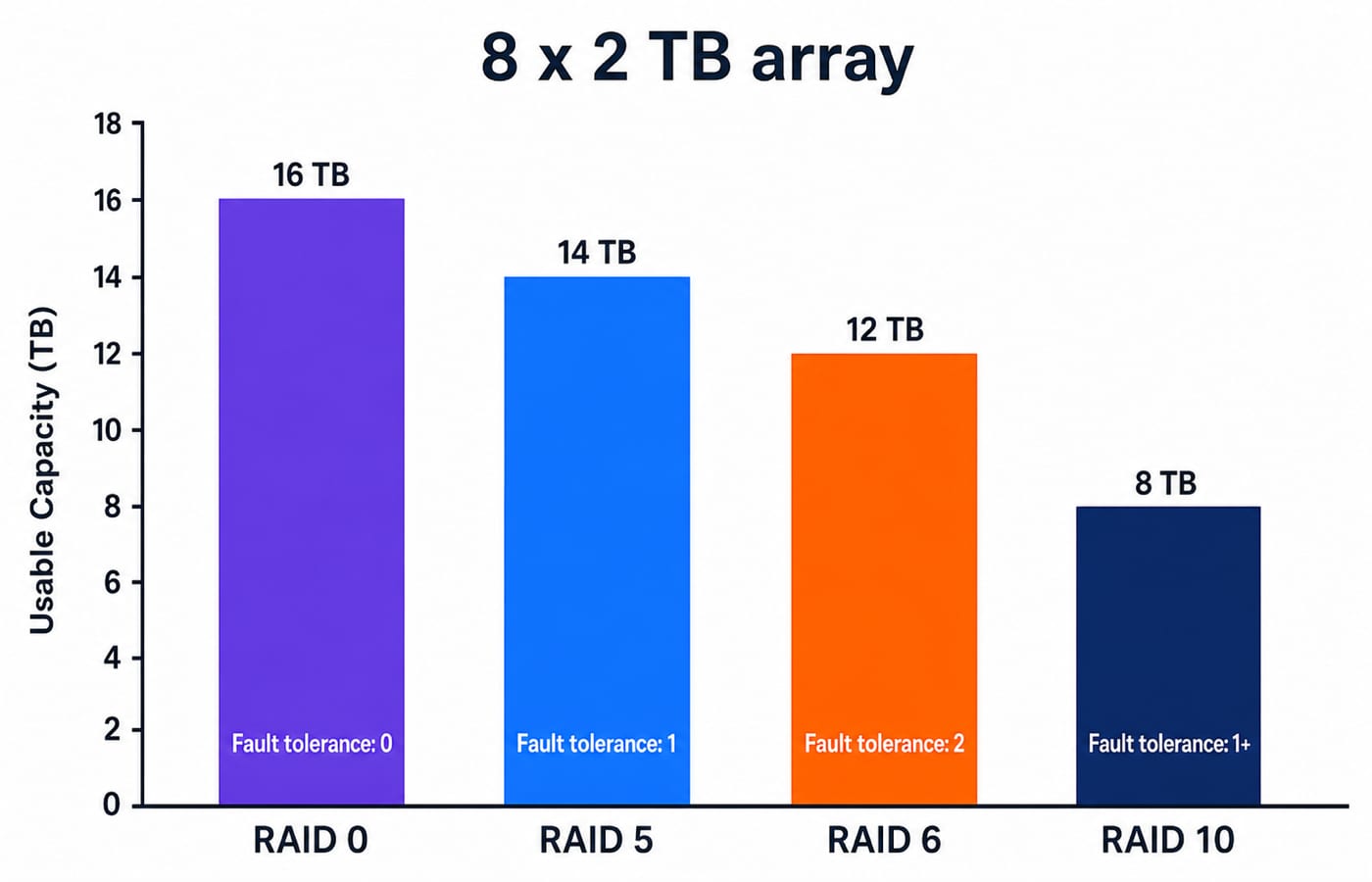
Here N = 8 and C = 2 TB.
First find raw capacity:
raw = N x C = 8 x 2 TB = 16 TB
Now apply each level's redundancy cost.
RAID 0:
usable = 8 x 2 TB = 16 TB
All eight disks carry data. Failures tolerated = 0.
RAID 5:
usable = (8 - 1) x 2 TB = 7 x 2 TB = 14 TB
One disk-equivalent stores distributed parity. Failures tolerated = 1.
RAID 6:
usable = (8 - 2) x 2 TB = 6 x 2 TB = 12 TB
Two disk-equivalents store dual parity. Failures tolerated = 2.
RAID 10:
Eight disks form 8 / 2 = 4 mirror pairs.
usable = 4 x 2 TB = 8 TB
It always survives one disk failure. It can survive as many as four if each failed disk belongs to a different mirror pair. It loses data if both members of any one pair fail, so four arbitrary failures are not guaranteed to be safe.
As a cross-check, capacity plus redundancy must equal 16 TB. RAID 5 gives 14 + 2 = 16 TB. RAID 6 gives 12 + 4 = 16 TB. RAID 10 gives 8 + 8 = 16 TB.
Storage efficiency and the write penalty
Storage efficiency is usable / raw.
RAID 0: 16 / 16 = 100%
RAID 5: 14 / 16 = 7 / 8 = 87.5%
RAID 6: 12 / 16 = 3 / 4 = 75%
RAID 10: 8 / 16 = 1 / 2 = 50%
Capacity is not the only cost. A small RAID 5 update commonly uses read-modify-write: read old data, read old parity, write new data, and write new parity. That is 2 reads + 2 writes = 4 disk I/O operations.
RAID 6 updates two parity values. Read old data and both old parity blocks, then write new data and both new parity blocks. That is 3 reads + 3 writes = 6 disk I/O operations. These counts describe the standard small-write penalty, not every possible full-stripe write.
How GATE tests RAID and where it sets traps
Common asks include usable capacity, efficiency, tolerated failures, minimum disk count and the I/O cost of a small write. RAID 5 needs at least three disks, while RAID 6 needs at least four. RAID 10 needs at least four disks and an even count.
Do not read the 6 in RAID 6 as a speed multiplier. Do not call RAID 0 redundant. Also remember that mirroring is not a backup: accidental deletion or corruption can be reproduced on the mirror.
Check current Operating Systems syllabus and weightage details on the official GATE portal of the organising IIT. To connect RAID with the rest of secondary storage, study File systems and disk scheduling in OS: allocation, directories and seek time and then practise the access-time side through Disk Scheduling MCQs: 12 solved questions (FCFS, SSTF, SCAN).
RAID formulas to remember
RAID 5 keeps (N - 1) x C and survives one failure. RAID 6 keeps (N - 2) x C and survives two. RAID 0 keeps all capacity and survives none. RAID 1 and RAID 10 normally keep half the raw capacity through mirroring.
Use the GATE Test Series to time these short numericals, and use GATE Guidance by Sanchit Sir to place them within storage and file systems. The GATE CS preparation catalogue is the route to the full subject sequence.
Keep learning
ISRO Scientist/Engineer CS Syllabus vs GATE CS: The Subject Overlap Map
See which core CS subjects transfer directly from GATE to ISRO, what drops out, how the question texture changes and where an ISRO-specific polish helps.
Updated 5 Oct 20264 min readGATE Strategy & Roadmap

Union-Find for GATE: Union by Rank, Path Compression and the Near-Constant Bound
Trace seven unions, inspect the final ranks, then compress the deepest path by hand. The worked forest makes the inverse-Ackermann bound much less mysterious.
Updated 1 Oct 20265 min readGATE Strategy & Roadmap

Memory Interfacing for GATE: Chip-Count and Address-Decoding Numericals, Fully Worked
Separate words from bits, split the address correctly, and verify the result with a gap-free hexadecimal map. This guide works through depth and width expansion step by step.
Updated 24 Sep 20265 min read55 viewsGATE Strategy & Roadmap
KMP and Rabin-Karp for GATE: The Failure Function and Rolling Hash, Fully Solved
Build the LPS array without guessing, trace a KMP fallback that never moves the text index back, and calculate every Rabin-Karp window hash by hand.
Updated 23 Sep 20266 min readGATE Strategy & Roadmap