

Tech Mahindra Aptitude Questions: 5 High-Yield Topics With Worked Solutions
Build a reliable method for mixed placement aptitude with worked examples in arithmetic, rates, data interpretation, reasoning, and verbal accuracy.
KnowledgeGate Team
Exam prep & CS education
Updated 31 Oct 20266 min read

“Aptitude” looks like one label, but a mixed placement set can demand arithmetic translation, rates, data reading, logical elimination, and grammar. Use five transferable topic families with fully worked values and a timed practice method. The current assessment details belong to your live invitation and on-screen instructions. Check that you can reproduce 70%, 480, 7 minutes 12 seconds, 48 km/h, 80%, 96, and 48.
Tech Mahindra aptitude questions: build a safe topic map first
Here, “high-yield” means high transfer value across placement practice, not an official Tech Mahindra weightage claim. The five families are percentages, ratios and averages; time, speed and work; data interpretation and basic algebra; logical reasoning; and verbal accuracy. KnowledgeGate’s placement catalogue groups quantitative aptitude, logical reasoning and verbal ability. Prepare them if your current Tech Mahindra instructions include them.
Start with a self-made diagnostic of 24 questions: 8 quantitative, 8 reasoning and 8 verbal. Suppose you answer 5 + 6 + 7 = 18 correctly. Overall accuracy is 18/24 x 100 = 75%. Section accuracy is 5/8 = 62.5% quantitative, 6/8 = 75% reasoning and 7/8 = 87.5% verbal. Quantitative aptitude is the first repair priority. Use Aptitude for Placements: Section Topics and Weekly Plan to turn that diagnosis into a study map.
Percentages, ratios and averages: normalise before calculating
Recognise the language first. A change from a base calls for a percentage factor. Parts of one whole call for a ratio multiplier. Replacing or combining groups calls for total first, average second. Keep percentage points separate from relative percentage change.
Take two equal 80-question practice sets. If correct answers rise from 52 to 56, accuracy moves from 52/80 = 65% to 56/80 = 70%. That is a rise of 5 percentage points. The relative rise is different: (56 - 52)/52 x 100 = 7.69%.
Successive changes also use the current base. Start with 500, increase it by 20% to get 500 x 1.20 = 600, then decrease the new value by 20% to get 600 x 0.80 = 480. The result is 20 below the start, so the net change is -20/500 x 100 = -4%, not zero.
For a ratio check, red and blue tokens are in the ratio 3:5, with 64 tokens in total. Eight parts equal 64, so one part is 8 and the counts are 24 and 40. Move 8 blue tokens to red and they become 32:32 = 1:1.
Time, speed and work: convert every statement into a rate
If a person completes one job in t minutes, the rate is 1/t job per minute. Compatible rates add, but completion times do not. For speed, divide total distance by total time and keep the units consistent.
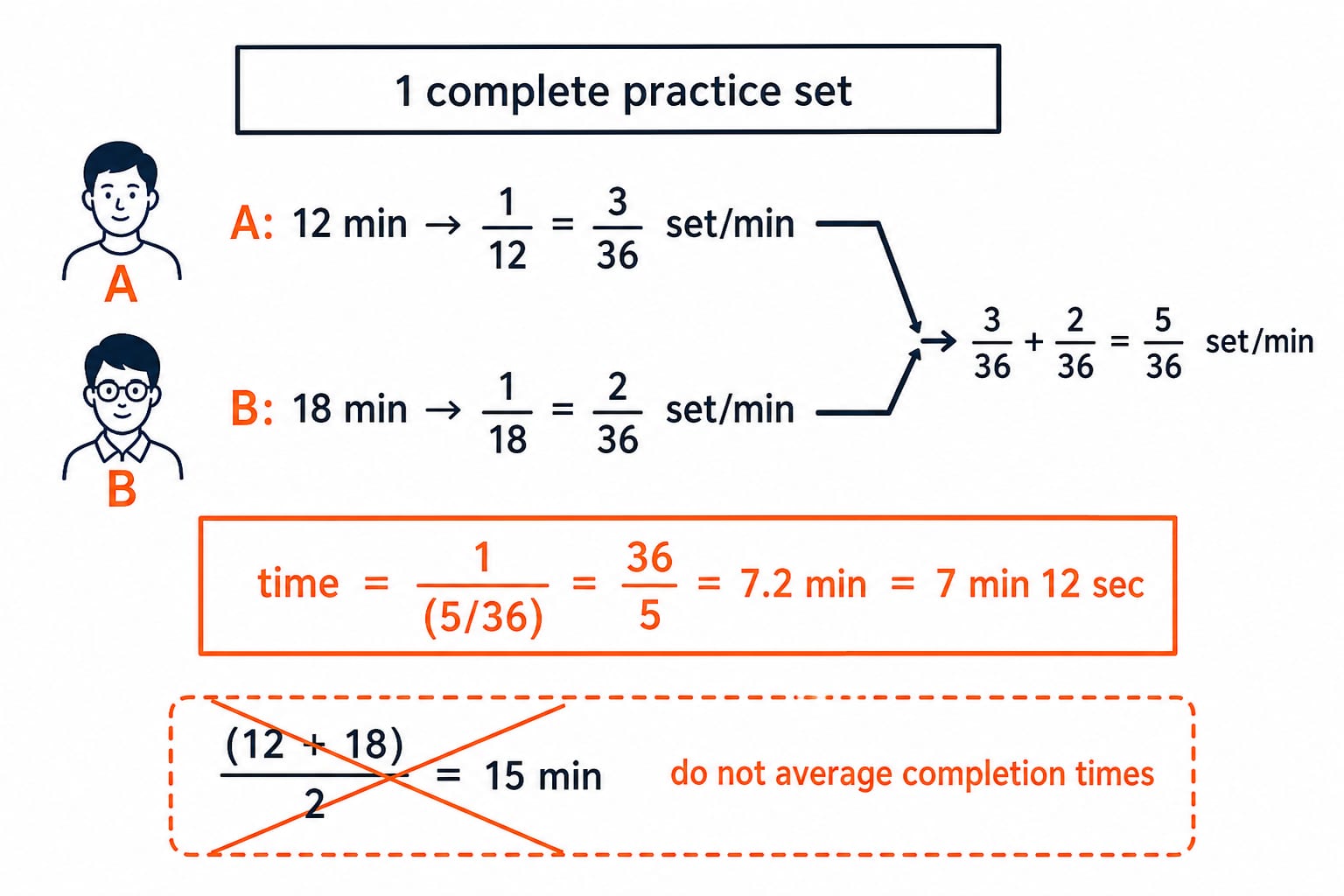
Suppose A completes one practice set in 12 minutes and B in 18 minutes. Using LCM 36, their rates are 3/36 and 2/36 set per minute. The combined rate is 5/36. Taking the reciprocal converts that joint rate into the time for one set: 1 / (5/36) = 36/5 = 7.2 minutes. This reciprocal step matters because the question asks for completion time. The decimal part is 0.2 x 60 = 12 seconds, giving 7 minutes 12 seconds. Averaging 12 and 18 would wrongly give 15 minutes.
For equal-distance travel, suppose a vehicle covers 120 km at 40 km/h and another 120 km at 60 km/h. The times are 3 hours and 2 hours. Total distance is 240 km and total time is 5 hours, so average speed is 240/5 = 48 km/h, not (40 + 60)/2 = 50 km/h.
Data interpretation and algebra: translate before touching options
For data interpretation, write the denominator beside every percentage before comparing rows.
Section | Attempted | Correct | Accuracy |
|---|---|---|---|
Quantitative | 25 | 20 |
|
Reasoning | 18 | 15 |
|
Verbal | 12 | 9 |
|
Total | 55 | 44 |
|
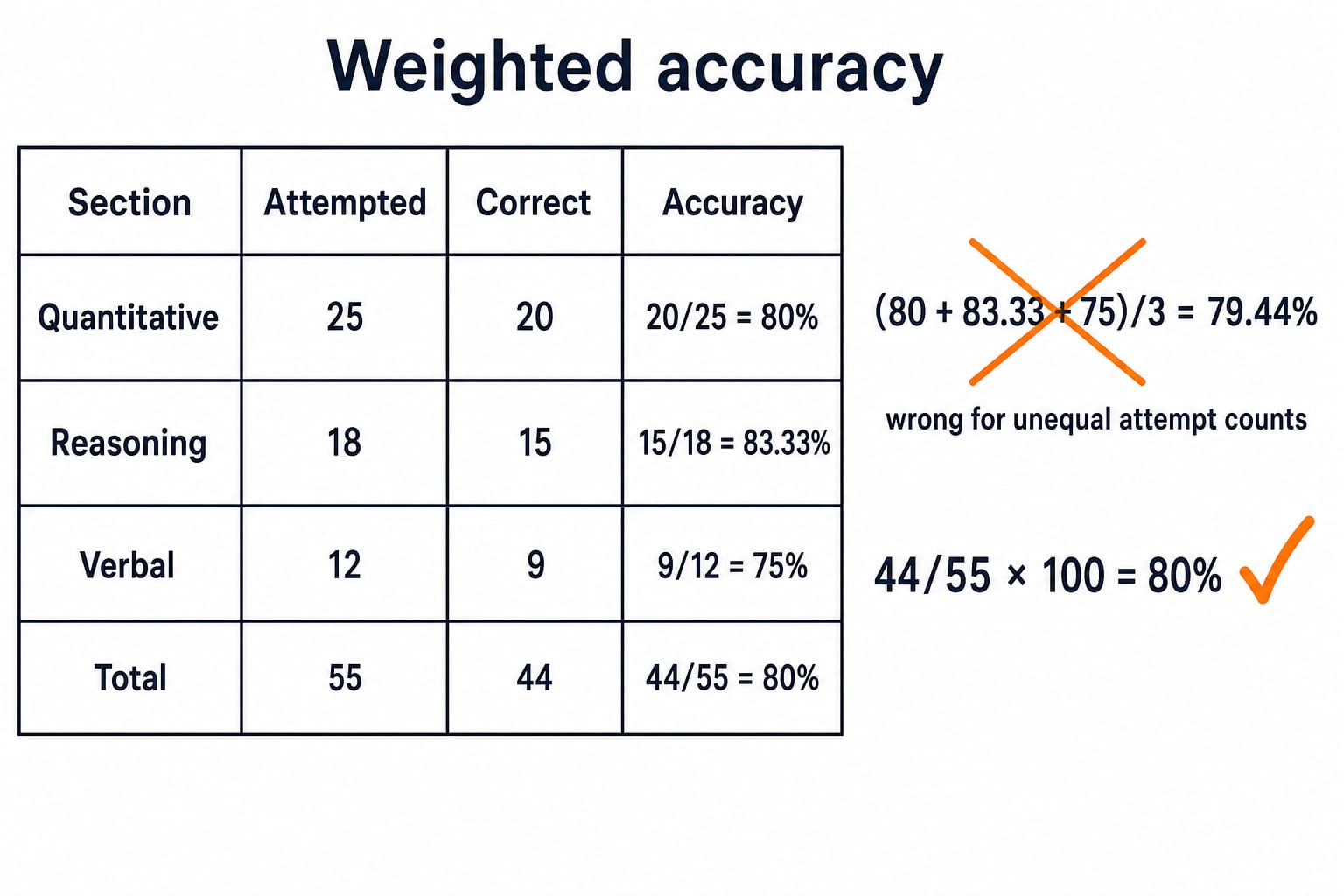
Combined attempts are 25 + 18 + 12 = 55, and combined correct answers are 20 + 15 + 9 = 44. Therefore, weighted overall accuracy is 44/55 x 100 = 80%. The unweighted mean, (80 + 83.33 + 75)/3 = 79.44%, is not overall accuracy because the attempt counts differ. This total-first method correctly preserves the different weight carried by each section.
For an algebra translation, two numbers are in the ratio 3:5 and differ by 24. Write them as 3k and 5k. Then 5k - 3k = 24, so 2k = 24 and k = 12. The numbers are 36 and 60, and their sum is 96. Check both conditions: 60 - 36 = 24 and 36:60 = 3:5.
Logical reasoning and verbal ability: prove, then eliminate
For patterns, generate the simplest rule that fits every supplied value, then verify the series before choosing. In 3, 8, 15, 24, 35, the first differences are 5, 7, 9, 11. The next difference is 13, so the next term is 35 + 13 = 48. A rule that fits only the final pair is not enough.
Now consider: All analysts are coders. Some coders are interns. A small set sketch places every analyst inside the coder set and at least one intern inside it. It does not force the analyst and intern subsets to overlap, so “Some analysts are interns” does not follow.
For verbal accuracy, change Neither the project lead nor the trainees was ready for the mock to Neither the project lead nor the trainees were ready for the mock. The nearer subject, “trainees”, is plural. Locate the grammatical controller instead of trusting how a sentence sounds. These habits help when a mixed set switches from a pattern to a grammar decision.
Speed strategy for a mixed aptitude practice set
Use a 30-minute, 30-question rehearsal, not as a Tech Mahindra timing claim. Split it into 3 minutes scan + 18 minutes first pass + 6 minutes second pass + 3 minutes verification. During the scan, label 18 questions sure, 6 medium and 6 long without solving.
Take the 18 sure questions at one minute each. In the second pass, attempt the 6 medium questions after writing the first equation, table or elimination rule. Use the last 3 minutes to recheck units, denominators, signs and marked answers. Follow the current on-screen scoring rules when deciding whether to attempt unresolved items.
Your error log matters more than raw attempt count. If 24 attempts produce 18 correct and 6 wrong, attempted accuracy is 18/24 = 75%. Classify the six errors as 2 concept + 1 translation + 2 arithmetic + 1 rushed guess. Repair the two concept errors first, then test the same method with fresh values.
How Tech Mahindra tests aptitude: separate instructions from practice
Tech Mahindra’s Careers page is its official role entry point, while its candidate manual provides candidate-assessment guidance. Neither establishes one universal aptitude blueprint.
Before an assessment, copy five fields from your current job post, invitation and on-screen instructions: role or job reference; listed sections; timer structure; navigation and permitted tools; and scoring or negative-marking rule. Treat those five fields as your verification card. Write “not stated” for anything absent instead of borrowing details from an old blog or another candidate’s drive. The exact split, timings and cutoffs belong to the current employer materials.
Use Infosys Aptitude Questions: Solved Quant, DI and Reasoning for Infosys-specific examples and Cognizant Aptitude Questions for Cognizant-specific examples. For Tech Mahindra, apply the methods above only after checking the current invitation card; neither sibling establishes Tech Mahindra’s sections, timings or cutoffs.
Tech Mahindra aptitude questions: the short version and next step
Topic | Reliable move |
|---|---|
Percentages and ratios | Preserve the base |
Time, speed and work | Add rates or total time |
Data interpretation and algebra | Write denominators and variables |
Logical reasoning | Verify every premise or term |
Verbal ability | Identify the grammatical controller |
Keep these worked results available while you practise: 70%, 480, 7 min 12 sec, 48 km/h, 80%, 96, 48. Use Aptitude for Placement to repair verified gaps, or explore Placement Preparation & Coding: Exams, Eligibility & Courses for broader preparation.
Keep learning

Cognizant Aptitude Questions: High-Yield Topics with Worked Solutions
Learn how to classify and solve representative mixed aptitude problems, then use a 30-minute drill and five-session plan to turn methods into speed.
Updated 20 Sep 20266 min readCompany-Specific Prep

Infosys Aptitude Questions: High-Yield Quant, Reasoning and Verbal Problems Solved
Build dependable placement aptitude skills through fully worked quant, data interpretation, reasoning and verbal problems. Then use a timed drill and error log to target weak steps.
Updated 30 Aug 20267 min read394 viewsCompany-Specific Prep

TCS Aptitude Questions: High-Yield Quant and Reasoning Topics, Solved Step by Step
Learn the first move for common quant and reasoning question families through solved examples on ratios, work, trains, data, remainders, and seating.
Updated 30 Oct 20266 min read184 viewsAptitude & Reasoning

SSC CGL Quantitative Aptitude: high-yield topics and a strategy to master them
SSC CGL Quantitative Aptitude strategy: high-yield topics from arithmetic to data interpretation, a weekly practice cadence, and trade-offs to master quant.
Updated 30 Oct 20265 min read70 viewsAptitude & Reasoning