SSC CGL Tier 2 Pattern: Paper-I Sections, Timers and Qualifying Tests
Map every Paper-I section, timer and qualifying gate in the SSC CGL 2026 notice. Then use the worked score and DEST pacing examples to plan a realistic full-session rehearsal.
KnowledgeGate Team
Exam prep & CS education
Updated 6 Aug 20266 min read
Older explainers often describe SSC CGL Tier 2 Paper-I as a set of “modules”. The SSC CGL 2026 notice instead presents four Sections, with Parts A and B inside Sections I and II. Only Sections I and II carry marks into the 390-mark aggregate that decides your rank for the general run of posts. Sections III and IV, the Computer Knowledge Test and the Data Entry Speed Test, are qualifying only, and failing either one ends your Paper-I however strong that aggregate looks.
Paper-I is compulsory, but older “module” language needs an update
According to the SSC CGL 2026 notice, every candidate who clears Tier 1 sits all four Sections of Paper-I. Paper-II is set only for Junior Statistical Officer and Statistical Investigator Grade-II candidates, and Paper-III only for Assistant Audit Officer and Assistant Accounts Officer candidates.
Section III is the Computer Knowledge Test and Section IV is the Data Entry Speed Test (DEST). So Paper-I is four Sections rather than one flat module list, and the Parts inside Sections I and II are where the timers bite. See how Tier 1 and Tier 2 fit together for the wider exam map.
SSC CGL Tier 2 Paper-I pattern at a glance
Every figure in this scheme comes from the SSC CGL 2026 notice.
Paper-I component | Questions or task | Maximum marks | Locked time |
|---|---|---|---|
Section I, Part A, Mathematical Abilities | 30 questions | 90 | 30 minutes |
Section I, Part B, Reasoning and General Intelligence | 30 questions | 90 | 30 minutes |
Section I total | 60 questions | 180 | 60 minutes |
Section II, Part A, English Language and Comprehension | 45 questions | 135 | 40 minutes |
Section II, Part B, General Awareness | 25 questions | 75 | 20 minutes |
Section II total | 70 questions | 210 | 60 minutes |
Section III, Computer Knowledge Test | 20 questions | 60 | 15 minutes |
Section IV, Data Entry Speed Test | One data-entry task | No marks shown in scheme | 15 minutes |
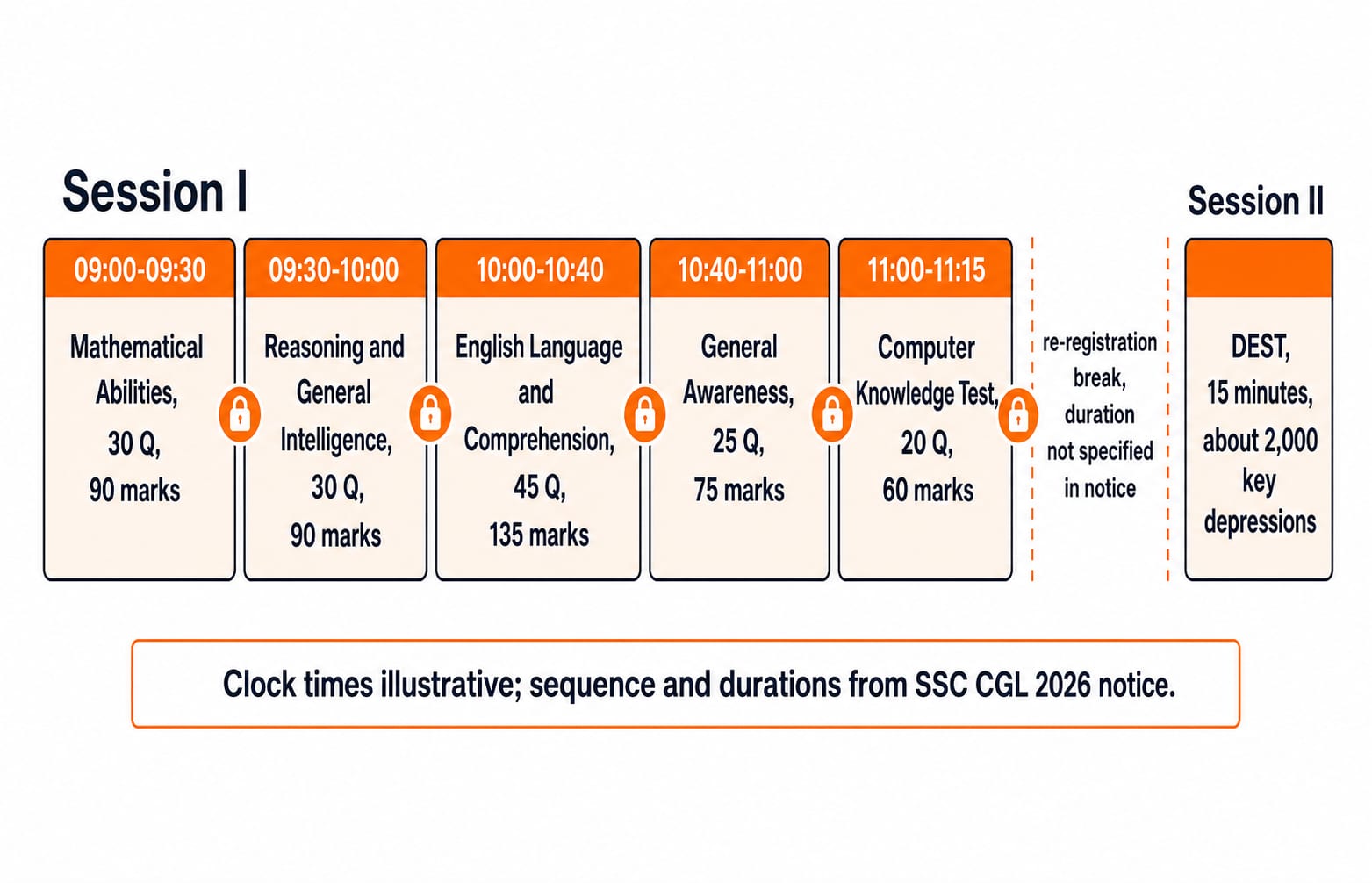
Session I therefore contains 150 objective questions for 450 maximum marks across Sections I, II and III: 60 + 70 + 20 = 150 questions and 180 + 210 + 60 = 450 marks. Its locked times add to 135 minutes, or 2 hours 15 minutes. Session II is the 15-minute DEST, so active test time is 2 hours 30 minutes, excluding the re-registration break whose duration the notice does not specify.
The section timers decide the order for you
Suppose Session I starts at 09:00. The notice's order and durations produce this illustrative sequence: Mathematics from 09:00 to 09:30, Reasoning from 09:30 to 10:00, English from 10:00 to 10:40, General Awareness from 10:40 to 11:00, and Computer Knowledge from 11:00 to 11:15. An unspecified re-registration break then separates Session I from the 15-minute DEST session.
Each timed Part closes at its boundary. You cannot carry unused Mathematics minutes into Reasoning or unused English minutes into General Awareness, and you cannot choose a different order.
Candidates eligible for a scribe under the notice's Para 7.1 to 7.3 provisions get longer locks: 40 minutes for each Part of Section I, 55 for English, 25 for General Awareness, 20 for Computer Knowledge, and five extra minutes in DEST.
Worked scoring example: correct, wrong and blank answers
The SSC CGL 2026 notice gives 3 marks for each correct objective response, deducts 1 mark for each wrong response, and gives zero for a blank response in Sections I, II and III.
Mathematics: 24 correct, 3 wrong and 3 blank.
24 x 3 - 3 = 72 - 3 = 69/90.Reasoning: 22 correct, 5 wrong and 3 blank.
22 x 3 - 5 = 66 - 5 = 61/90.Section I:
69 + 61 = 130/180.English: 34 correct, 6 wrong and 5 blank.
34 x 3 - 6 = 102 - 6 = 96/135.General Awareness: 17 correct, 5 wrong and 3 blank.
17 x 3 - 5 = 51 - 5 = 46/75.Section II:
96 + 46 = 142/210.Computer Knowledge: 15 correct, 3 wrong and 2 blank.
15 x 3 - 3 = 45 - 3 = 42/60.
The candidate has 130 + 142 = 272/390 across Sections I and II. For the general run of posts the notice builds merit from that Sections I and II aggregate, so the 42/60 in Computer Knowledge clears its gate without adding a single mark to the 272.
Qualifying floors are not the same as result cutoffs
The notice's mode-of-selection section specifies these minimum qualifying percentages and their score equivalents:
Category | Percentage | Section I /180 | Section II /210 | Section III /60 |
|---|---|---|---|---|
UR | 30% | 54 | 63 | 18 |
OBC and EWS | 25% | 45 | 52.5 | 15 |
All other categories | 20% | 36 | 42 | 12 |
Now take an UR candidate with 130/180 in Section I and 142/210 in Section II. In Computer Knowledge, 7 correct, 4 wrong and 9 blank give 7 x 3 - 4 = 21 - 4 = 17/60. Seventeen is below the normal UR floor of 18, so the strong Sections I and II aggregate cannot rescue the Paper-I result.
These are minimum qualifying floors, not final selection cutoffs. The notice also fixes separate higher standards where computer proficiency or data entry is prescribed, naming posts such as Assistant Section Officer in CSS, Inspector and Executive Assistant in CBIC, Postal Assistant in the Department of Posts, and Tax Assistant in CBIC and CBDT. If one of those tops your preference list, both Sections need a real margin rather than a bare pass.
Computer Knowledge and DEST are qualifying, but neither is optional
Under the SSC CGL 2026 notice, Section III is mandatory for all posts and qualifying in nature. Section IV is mandatory and qualifying too. Its one exemption is for PwBD-OH candidates who file a Civil Surgeon's certificate of permanent unfitness for the typing test, and even that does not extend to the computer-proficiency and DEST posts, apart from Tax Assistant in CBDT.
Use the Computer Knowledge topic and preparation map for the syllabus, then work through the twelve solved MCQs in the SSC CGL Tier 2 Computer Knowledge practice guide, which follow the four areas the notice lists: computer basics and keyboard shortcuts, MS Office, internet and e-mail, and networking with cyber security. Fifteen correct out of twenty leaves 40/60 even when the other five are all wrong, comfortably clear of the 18-mark UR floor.
For DEST, the notice describes a passage of about 2,000 key depressions in 15 minutes, which works out to about 133 key depressions per minute (2,000 / 15 = 133.3). The notice sets no per-minute rule of its own, so use that figure as a rehearsal pace.
The notice sets maximum error percentages at 20% for UR, 25% for OBC/EWS and 30% for all other categories, so practice-tool accuracy targets of 80%, 75% and 70% match those ceilings. SSC's own evaluation instructions define how an error is counted, so treat an accuracy target as a practice setting, not a fixed allowance of wrong keystrokes.
The short version and the next sensible step
Keep four points in view: Paper-I is compulsory; the objective work is locked into 30, 30, 40, 20 and 15-minute blocks; every wrong objective answer costs 1 mark; and both Computer Knowledge and DEST must be cleared.
Rehearse one complete 2-hour-15-minute Session I with those exact locks, then do a separate 15-minute DEST drill. Use the SSC CGL Tier 2 course for your next preparation step and the SSC CGL exam hub for the broader pathway. Check ssc.gov.in for any later notice or corrigendum before you build a plan around this pattern.
Keep learning
SSC MTS Eligibility and Selection Process: Age, Qualification and Stages
Check your qualification date and birth-date window before planning preparation. This dated SSC MTS example explains age relaxation, the two CBE sessions and Havaldar's additional physical tests.
Updated 5 Oct 20264 min readSSC CGL
SSC CHSL Cutoff Trends: Compare Results and Set a Target Score
Compare the right CHSL result rows before choosing a practice target. Work through a historical benchmark, a personal buffer and two mock-test blocks to decide what to improve next.
Updated 30 Sep 20264 min readSSC CGL
SSC CGL Cutoffs Explained: Compare Tiers, Posts and Categories
A practical test for deciding whether two SSC CGL cutoff figures are genuinely comparable, with completed-result examples and a worksheet for rejecting mismatched rows.
Updated 19 Aug 20265 min readSSC CGL
SSC CGL Mock Analysis: Build an Error Ledger That Guides Every Revision
Turn each useful mock error or delay into evidence, a focused drill, a retest date, and a clear decision to close or reopen the row.
Updated 17 Aug 20265 min readSSC CGL