SSC CGL Computer Module: A 6-Week Accuracy Plan
A contained 24-hour plan for turning Computer Knowledge gaps into reliable recall, timed control and a compact final revision ledger.
KnowledgeGate Team
Exam prep & CS education
Updated 30 Jul 20265 min read
Candidates often leave qualifying Computer Knowledge for the last week. Recall gaps, similar options and careless clicks then create risk.
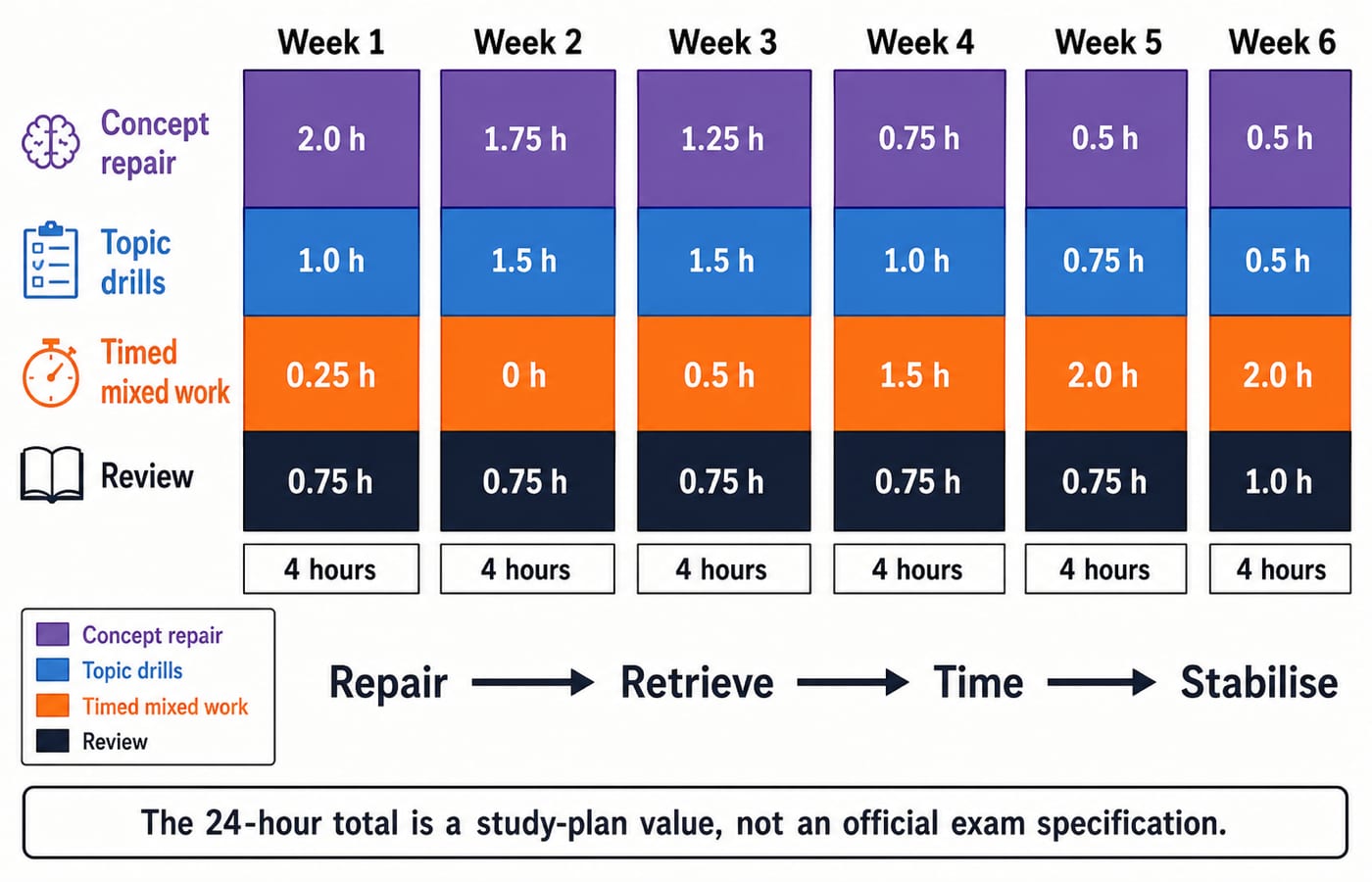
The plan protects four hours weekly, 24 across six weeks, while preserving merit-section time. Move sessions, but keep the sequence: repair, retrieve, time, stabilise.
1. Fix the boundary and take a measurable baseline
Four 45-minute sessions plus one 60-minute session give 4 x 45 + 60 = 240 minutes, or 4 hours. That is also the ceiling.
Start from the SSC CGL Tier 2 Computer Knowledge module explainer for the topic map. The current syllabus, qualifying standard, timing and marking rules live in the applicable notice on ssc.gov.in. Every hour budget and accuracy gate in this plan is a study control you set for yourself, never an SSC requirement.
In a 30-question baseline, suppose 24 are attempted, 18 correct, 6 incorrect and 6 unattempted.
Attempted accuracy = 18 / 24 x 100 = 75%.
Coverage = 24 / 30 x 100 = 80%.
Error tags = 3 knowledge gaps + 2 option-confusion errors + 1 haste error = 6 errors.
Track attempted accuracy and coverage rather than a predicted exam score, since the marking rules come from the notice and not from your practice sheet.
2. Week 1: repair foundations behind repeat mistakes
Session 1 covers the baseline and error tags. Sessions 2 and 3 cover hardware versus software, memory and storage, input/output devices, and operating-system functions. Session 4 has 20 untimed questions. Split the final hour into 30 minutes correcting, 20 recalling closed-book and 10 updating the ledger.
Keep each ledger row short:
concept | my wrong choice | correct rule/fact | next retest date
RAM vs ROM | marked ROM as volatile | RAM is volatile; ROM is non-volatile | Week 2 Session 1
Set your own gate at 17 correct out of 20, with at most two unsupported guesses. If you miss it, carry only two weak concepts forward.
3. Week 2: build an Office, Internet and safety grid
Cover word processing and spreadsheets, presentations and shortcuts, Internet and email, networking, and cyber safety. Each 45-minute session uses 20 minutes learning, 15 recalling and 10 answering 8 fresh questions. Use the final hour for a mixed 25-question drill and review.
Classify these items:
Bucket | Items |
|---|---|
Shortcut | Ctrl+C, Ctrl+V |
Internet/email | HTTPS, BCC |
Networking | LAN |
Security | phishing, firewall |
File format | .xlsx |
A miss needs one correction line, not a copied page. KnowledgeGate carries over 900 questions across information and communication technology, wider than this module needs, so drill only the ones sitting on the current SSC syllabus. To rebuild several weak blocks at once, work through the taught lessons in the SSC CGL course category.
4. Week 3: convert recognition into retrieval
Retest Week 1 errors in Session 1 and Week 2 errors in Session 2. Session 3 has 15 mixed questions. Session 4 rebuilds failed facts. The final hour has a 12-minute brain dump, 15-minute set of 18 questions and 33-minute correction: 12 + 15 + 33 = 60.
Pass A writes 12 facts in 6 minutes. Pass B labels each correct, incomplete or wrong in 3 minutes. Pass C rewrites weak facts in 3 minutes. With 8 correct, 3 incomplete and 1 wrong, only 3 + 1 = 4 facts enter the next retest.
Promote a topic after two fresh sets at 85% attempted accuracy or better, at least one day apart.
5. Week 4: add timing without rewarding blind attempts
Run three 15-question mini-sets at 12 minutes each, followed by at least 12 minutes of review. Repair the two most frequent error tags. Apply the post-set discipline of an SSC CGL mock-test strategy. A mini-set trains control, while a full mock tests switching and stamina.
Suppose Set A has 13 attempts, 11 correct answers, 2 wrong answers and 2 skips.
Attempted accuracy = 11 / 13 x 100 = 84.6% after rounding.
Coverage = 13 / 15 x 100 = 86.7% after rounding.
If both errors came from haste, pause five seconds before finalising an option containing NOT, incorrect or two similar choices. Never chase 100% coverage by guessing.
6. Week 5: integrate the module into larger practice days
Keep the four-hour ceiling. Insert a 25-minute computer block into each of two larger practice days, placed after the merit sections, so that switching back into recall while already tired is the thing you rehearse.
In a separate 30-question mixed set, suppose 27 are attempted, 24 correct, 3 wrong and 3 skipped. Attempted accuracy is 24 / 27 x 100 = 88.9%, and coverage is 27 / 30 x 100 = 90%. Week 1 had 75% accuracy and 80% coverage.
Tag the errors as 2 knowledge gaps and 1 haste error. Correct for 15 minutes, then take a fresh 10-question retest after 48 hours. Two fresh sets at 90% move a topic to one 10-minute Week 6 check. Below 80% earns one 45-minute repair, without extra hours.
7. Week 6: stabilise accuracy and taper the notes
Schedule two mixed sets, one repair, one current-pattern full practice and one ledger review. Add no notebook pages in the final two days. Review the ledger, 10 frequent misses and current official instructions.
Your readiness signal is two consecutive fresh sets at 90% attempted accuracy, at most one repeat ledger error in either, and a one-sentence reason for every answer. Below 75% coverage, practise elimination. Below 85% accuracy, reduce risky attempts and diagnose haste.
The SSC CGL Tier 1 course covers the broader stage-wise preparation that these four hours a week deliberately leave alone.
8. Recover missed days and keep 24 hours honest
For one missed 45-minute session, move 20 minutes of concepts to the next concept session and 25 minutes of questions to review: 20 + 25 = 45. For two misses, drop note-copying, triage the ledger for 30 minutes, then complete and review one 20-question mixed set.
After a missed week, extend by seven days if possible. Otherwise, run a 60-minute diagnostic and retain two weak blocks. Never compress four hours into one sitting.
The short version
Four hours x six weeks = 24 hours. Weeks 1 and 2 repair, Week 3 retrieves, Week 4 times, Week 5 integrates and Week 6 stabilises. Use the Govt Jobs course category for the wider route, and confirm current specifics on the SSC website. Seek controlled accuracy and recoverable errors, not a larger notebook.
Keep learning
SSC MTS Eligibility and Selection Process: Age, Qualification and Stages
Check your qualification date and birth-date window before planning preparation. This dated SSC MTS example explains age relaxation, the two CBE sessions and Havaldar's additional physical tests.
Updated 5 Oct 20264 min readSSC CGL

SSC CHSL Cutoff Trends: Compare Results and Set a Target Score
Compare the right CHSL result rows before choosing a practice target. Work through a historical benchmark, a personal buffer and two mock-test blocks to decide what to improve next.
Updated 30 Sep 20264 min readSSC CGL

SSC CGL Cutoffs Explained: Compare Tiers, Posts and Categories
A practical test for deciding whether two SSC CGL cutoff figures are genuinely comparable, with completed-result examples and a worksheet for rejecting mismatched rows.
Updated 19 Aug 20265 min readSSC CGL
SSC CGL Mock Analysis: Build an Error Ledger That Guides Every Revision
Turn each useful mock error or delay into evidence, a focused drill, a retest date, and a clear decision to close or reopen the row.
Updated 17 Aug 20265 min readSSC CGL