Set Operations & Cartesian Product MCQs: 12 Solved Questions with Explanations
Solve 12 carefully explained MCQs on union, intersection, set difference, identities, counting, Cartesian products, and ordered set pairs.
KnowledgeGate Team
Exam prep & CS education
Updated 10 Aug 20268 min read57 views
Set notation looks compact, but one missed complement, reversed difference, or ignored order in a Cartesian pair changes the entire answer. The direct union and intersection questions are the easy end. The harder ones hide behind an identity you have to name before you can apply it, a count that only inclusion-exclusion cracks, or a Cartesian product where the order inside the pair is the whole question. Choose an option and write one line of working before you read the answer, because the tempting distractor is usually the correct answer to a neighbouring operation. KnowledgeGate carries over 80 practice MCQs on these set operations, so treat the twelve here as a diagnostic: whichever pattern you keep losing marks on is the one to drill next. The GATE CS Exam Preparation page is the wider route for subject-wise exam preparation.
Set operations and Cartesian products in one worked refresher
Six symbols do all the work here. A ∪ B combines members, A ∩ B keeps common members, and A - B keeps members of A that are not in B. Relative to a stated universal set, A′ contains everything outside A. Also, AΔB = (A-B) ∪ (B-A), while A × B contains ordered pairs (a,b) with a ∈ A and b ∈ B. For a fuller foundation, read Set Theory and Relations for GATE: Closures and Posets.
Read each operator as an instruction. For union, scan both sets and record each value once. For intersection, keep only values that pass both membership tests. Difference is directional: begin with the left set and delete anything found in the right set. A complement is fixed only after the universal set is known. Symmetric difference keeps the two non-overlapping regions. In a Cartesian product, the first coordinate must come from the first set.
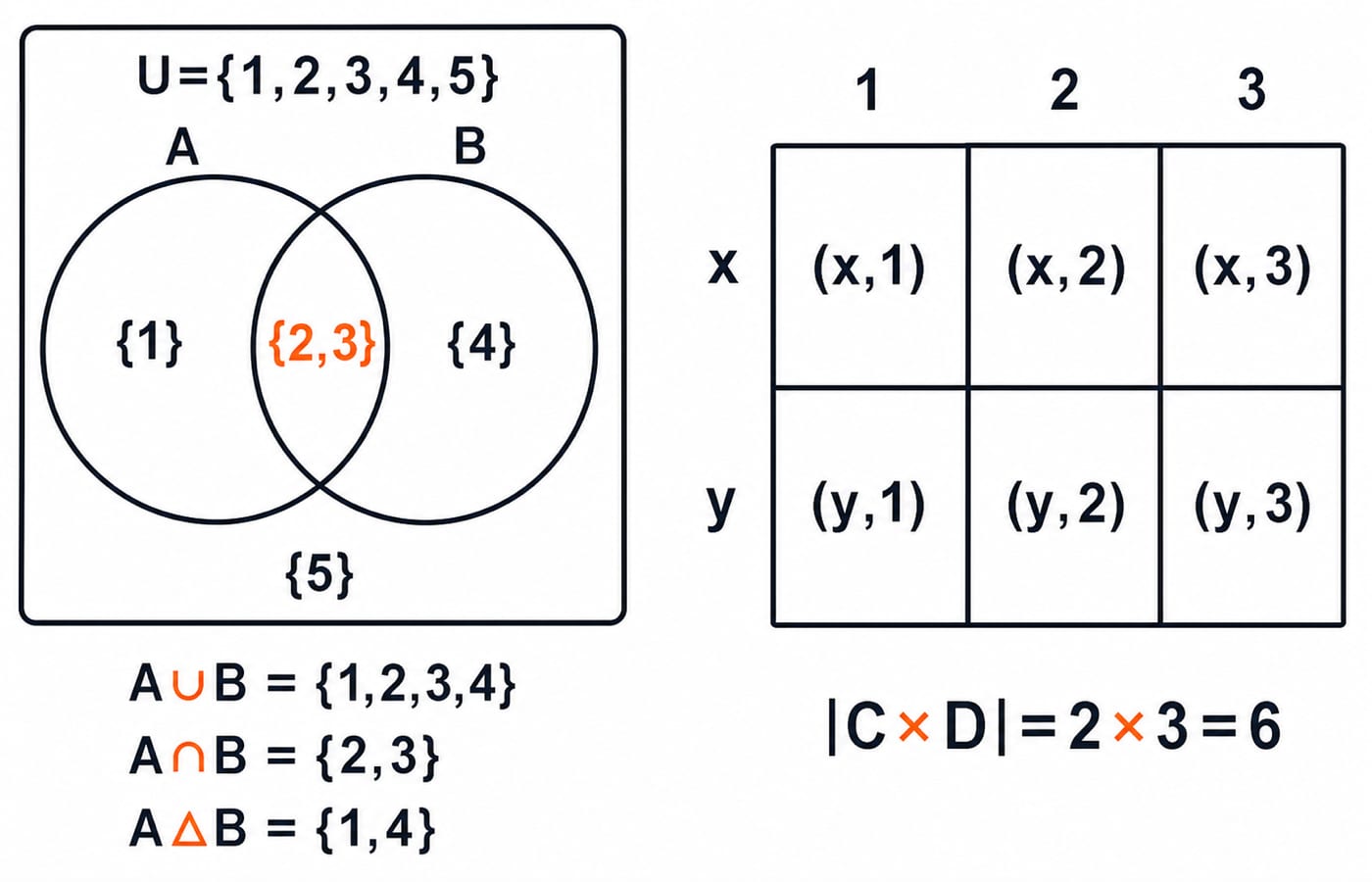
Let U={1,2,3,4,5}, A={1,2,3}, and B={2,3,4}. Then A∪B={1,2,3,4}, A∩B={2,3}, A-B={1}, and B-A={4}. Complements are A′={4,5} and B′={1,5}. Therefore, AΔB={1,4} and, explicitly, A∩B′=A-B={1}.
Now let C={x,y} and D={1,2,3}. Then C×D={(x,1),(x,2),(x,3),(y,1),(y,2),(y,3)}, so |C×D|=2×3=6. By contrast, D×C={(1,x),(1,y),(2,x),(2,y),(3,x),(3,y)}. Its cardinality is also 6, but its ordered pairs are different.
MCQs 1-3: union, complement and symmetric difference
List members, apply the operation, remove duplicates, then compare with the options.
Question 1
Given A={1,2,3} and B={3,4,5}, what is A∪B?

A. {1,2,3,4,5}
B. {3}
C. {1,2,4,5}
D. {3,4}
Answer: option A, {1,2,3,4,5}.
Write every distinct member from A or B once. The shared member 3 is not repeated, giving {1,2,3,4,5}. Option B is the intersection A∩B={3}, while option C is the symmetric difference.
Question 2
If A = {1, 2, 3} and B = {2, 3, 4}, what is A ∩ B′?

A. {2, 3}
B. {1, 4}
C. {4}
D. {1}
Answer: option D, {1}.
Use A∩B′=A-B. Remove B's members 2 and 3 from A, leaving {1}. This identity avoids guessing the universal set because the intersection is restricted to A. The set {2,3} is A∩B, not A∩B′.
Question 3
The number of elements in the symmetric difference AΔB, where A={1,2,3} and B={2,3,4}, is?

A. 1
B. 2
C. 3
D. 4
Answer: option B, 2.
Here A-B={1} and B-A={4}, so AΔB={1,4} and |AΔB|=2. Cross-check with |AΔB|=|A|+|B|-2|A∩B|=3+3-2×2=2.
MCQs 4-6: cardinality and set identities
Move from listed members to algebra: name the identity, then verify it.
Question 4
If |A|=10, |B|=12, and |A∪B|=15, what is the number of elements in A−B?

A. 3
B. 5
C. 7
D. 12
Answer: option A, 3.
Inclusion-exclusion gives 15=10+12-|A∩B|, so |A∩B|=7. Therefore, |A-B|=|A|-|A∩B|=10-7=3. Do not subtract |B| directly from |A|, since B also has members outside A.
Question 5
If A and B are non-empty subsets of a set C, then A ∪ (A ∩ B) is equal to

A. A ∩ B
B. A ∪ B
C. A
D. B
Answer: option C, A.
This is absorption: A∪(A∩B)=A. With A={1,2,3} and B={2,3,4}, A∩B={2,3} is already inside A, so the union remains {1,2,3}. Asked in UPTET 2017 (Paper 2).
Question 6
Let A and B be two sets, then (A ∪ B)′ ∪ (A′ ∩ B) is equal to

A. A
B. A'
C. B
D. B'
Answer: option B, A'.
By De Morgan's law, (A∪B)′=A′∩B′. Factor A′ to get (A′∩B′)∪(A′∩B)=A′∩(B′∪B)=A′∩U=A′.
For more practice across sets and relations, continue with Set Theory and Relations MCQs: 12 Solved (GATE).
MCQs 7-9: nested differences, counterexamples and inclusion-exclusion
Use algebra or a concrete counterexample. A Venn sketch checks the result, but is not proof.
Question 7
Let E, F and G be finite sets. Let X = (E ∩ F) - (F ∩ G) and Y = (E - (E ∩ G)) - (E - F). Which one of the following is true?

A. X ⊂ Y
B. X ⊃ Y
C. X = Y
D. X - Y ≠ φ and Y - X ≠ φ
Answer: option C, X = Y.
First, X=(E∩F)-(F∩G)=E∩F∩G′. For Y, E-(E∩G)=E∩G′ and E-F=E∩F′. Thus Y=(E∩G′)-(E∩F′)=E∩F∩G′. Both select the same region, so neither is a proper subset of the other and both differences are empty. Asked in GATE 2006 (Computer Science).
Question 8
Let P, Q and R be sets let Δ denote the symmetric difference operator defined as PΔQ = (P U Q) - (P ∩ Q). Using Venn diagrams, determine which of the following is/are TRUE?
1. PΔ (Q ∩ R) = (P Δ Q) ∩ (P Δ R)
2. P ∩ (Q ∩ R) =  (P ∩ Q) Δ (P Δ R)

A. 1 only
B. 2 only
C. Neither 1 nor 2
D. Both 1 and 2
Answer: option C, Neither 1 nor 2.
For statement 1, take P={1}, Q={1}, and R=∅. The left side is {1}, but the right side is ∅. For statement 2, take P={1}, Q=∅, and R=∅. The left side is ∅, but the right side is {1}. Note the near miss: intersection really does distribute over symmetric difference, so P∩(QΔR)=(P∩Q)Δ(P∩R) is a genuine identity. Statement 2 pairs the operators differently, and that difference is exactly what breaks it. One valid counterexample is enough to reject a claimed identity. Asked in GATE 2006 (Information Technology).
Question 9
What is the cardinality of the set of integers X defined below?  X = {n | 1 ≤ n ≤ 123, n is not divisible by either 2, 3 or 5}

A. 28
B. 33
C. 37
D. 44
Answer: option B, 33.
Count the complement. Multiples of 2, 3, and 5 contribute 61, 41, and 24. Pairwise overlaps contribute ⌊123/6⌋=20, ⌊123/10⌋=12, and ⌊123/15⌋=8; the triple overlap contributes ⌊123/30⌋=4. Therefore, 61+41+24-20-12-8+4=90 integers are divisible by at least one, leaving 123-90=33. Asked in GATE 2006 (Information Technology).
MCQs 10-12: Cartesian products and ordered set pairs
Remember two rules: |A×B|=|A||B|, and (a,b) is not interchangeable with (b,a). If |A|=m, the repeated product Aⁿ contains ordered n-tuples and has mⁿ members.
Question 10
Let R={x ∣ x∈ N,x is a multiple of 3 and x ≤ 100} and S={x ∣ x ∈ N,x is a multiple of 5 and x<100}.
What is the number of elements in  (R∩S)×(S∩R)?

A. 36
B. 33
C. 20
D. 6
Answer: option A, 36.
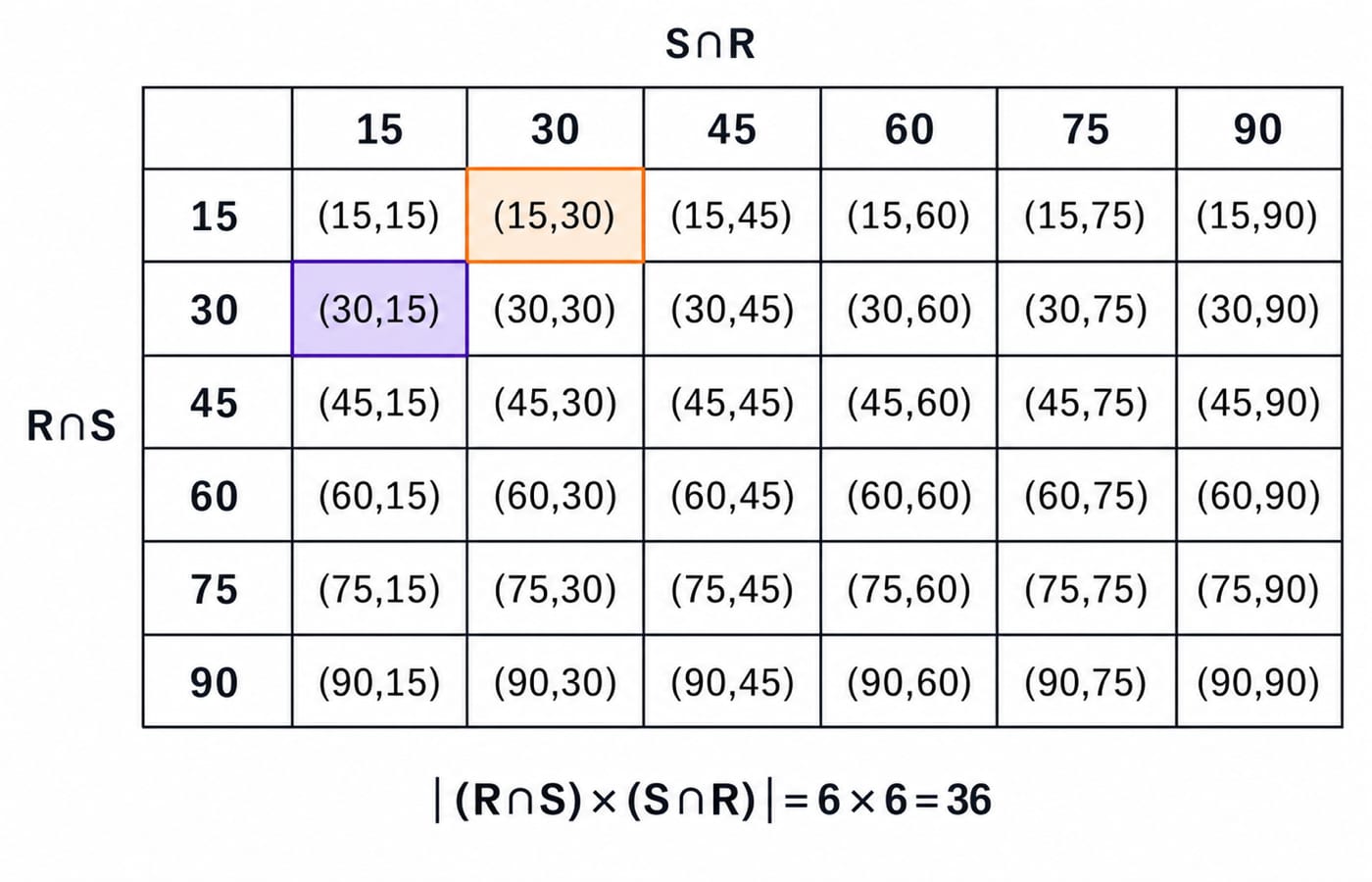
Both R∩S and S∩R are the multiples of 15 below 100: {15,30,45,60,75,90}. Each factor has six members, so the Cartesian product has 6×6=36 ordered pairs. Option D, 6, counts only one factor. Asked in UGC NET 2023.
Question 11
If A is a set with m elements and n is a positive integer, the number of different elements in Aⁿ is :

A. m * n
B. m * m
C. mⁿ
D. nᵐ
Answer: option C, mⁿ.
An element of Aⁿ is an ordered n-tuple. Each of its n positions has m independent choices, giving m×m×...×m with n factors, or mⁿ. For A={a,b,c} and n=2, the nine pairs are (a,a),(a,b),(a,c),(b,a),(b,b),(b,c),(c,a),(c,b),(c,c), matching 3²=9. Asked in ISRO 2025 (Computer Science).
Question 12
If S={a,b,c} and A1 and A2 are disjoint sets such that, A1∪A2=S. then the number of ordered solutions (A1,A2) is ____

A. 6
B. 8
C. 9
D. 12
Answer: option B, 8.
Each of a, b, and c must go to exactly one of the two disjoint sets. That gives 2×2×2=2³=8 assignments. Order matters: ({a},{b,c}) and ({b,c},{a}) are distinct solutions.
Five traps these questions are designed to expose
Repeating a member in a union. Write each distinct member once. In Question 1, the shared
3appears only once in the result.Treating difference as commutative. Usually
A-BandB-Adiffer. In the refresher, they are{1}and{4}.Taking a complement without a universe. A bare
A′needs U, butA∩B′can safely be read asA-B, as in Question 2.Trusting a plausible identity. Test one-element and empty-set cases. The two counterexamples in Question 8 reject both statements immediately.
Ignoring order in Cartesian products. The pairs
(15,30)and(30,15)differ. Likewise,A×Bneed not equalB×A, even when their cardinalities match.
These are not separate facts to memorise. They are checks to run before committing to an option: remove duplicates, read difference from left to right, identify the universe, test identities, and preserve order.
Short version and the next practice step
Translate complements into differences when useful.
Mark the exact Venn regions.
Use inclusion-exclusion for overlapping counts.
Multiply independent choices for Cartesian products, and respect order.
Revise in two passes. First redo Questions 1-6 without notes. Then redo Questions 7-12, writing the identity or counting rule before the arithmetic. Log each mistake by trap type, not only by question number. Next, try the mixed Discrete Mathematics MCQs collection. If it is a definition rather than the arithmetic that keeps slipping, work through the Discrete Mathematics course, whose Set Theory module builds these operations up from the definitions.
Keep learning
Graph Traversal MCQs: 12 Solved Questions on Walks, Paths, Trails, Circuits and Connectivity
Attempt 12 graph traversal and connectivity questions, then check each answer through definitions, reachability, degree conditions and edge-count arguments.
Updated 3 Oct 20267 min readDiscrete Mathematics MCQs
Planar Graphs MCQs: 12 Solved Questions on Kuratowski’s Theorem, Homeomorphism and Edge Bounds
Solve 12 planar graph questions, then check each answer through a forbidden-subdivision argument, a crossing-free redraw, or a short calculation.
Updated 28 Sep 20268 min readDiscrete Mathematics MCQs
Power Set and Cardinality MCQs: 12 Solved Questions with Explanations
Solve 12 power set questions, from direct enumeration and nested sets to inclusion chains, ordered pairs and recurrence-based counting.
25 Sep 20267 min readDiscrete Mathematics MCQs
Null Set, Universal Set, Subset and Proper Subset MCQs: 12 Solved Questions
Practise 12 MCQs on null sets, universal sets, subsets, proper subsets, complements and nested inclusion, with clear reasoning for every answer.
Updated 24 Sep 20267 min readDiscrete Mathematics MCQs