

Reliability in Distributed File Systems: Replication, Quorums and Worked Failure Examples
See how a distributed file system turns one pathname into metadata and replica requests, then calculate read-one and majority-quorum availability step by step.
KnowledgeGate Team
Exam prep & CS education
Updated 13 Nov 20266 min read
Here, DFS means a distributed file system, not depth-first search. The difficulty is connecting a familiar pathname to naming, remote storage, replicas, partial failures, and consistency guarantees. Distributed file-system reliability begins with the path-to-replica request, then separates service readiness, failure-free operation, and stale-data safety. Each request has a path, each failure has a consequence, and consistency choices affect availability.
1. Distributed file systems: what is distributed and what stays familiar
A distributed file system gives clients a coherent namespace and file interface for data stored across networked machines. Its logical view offers pathnames and operations such as open, read, write, and close, while metadata and data may sit on different machines.
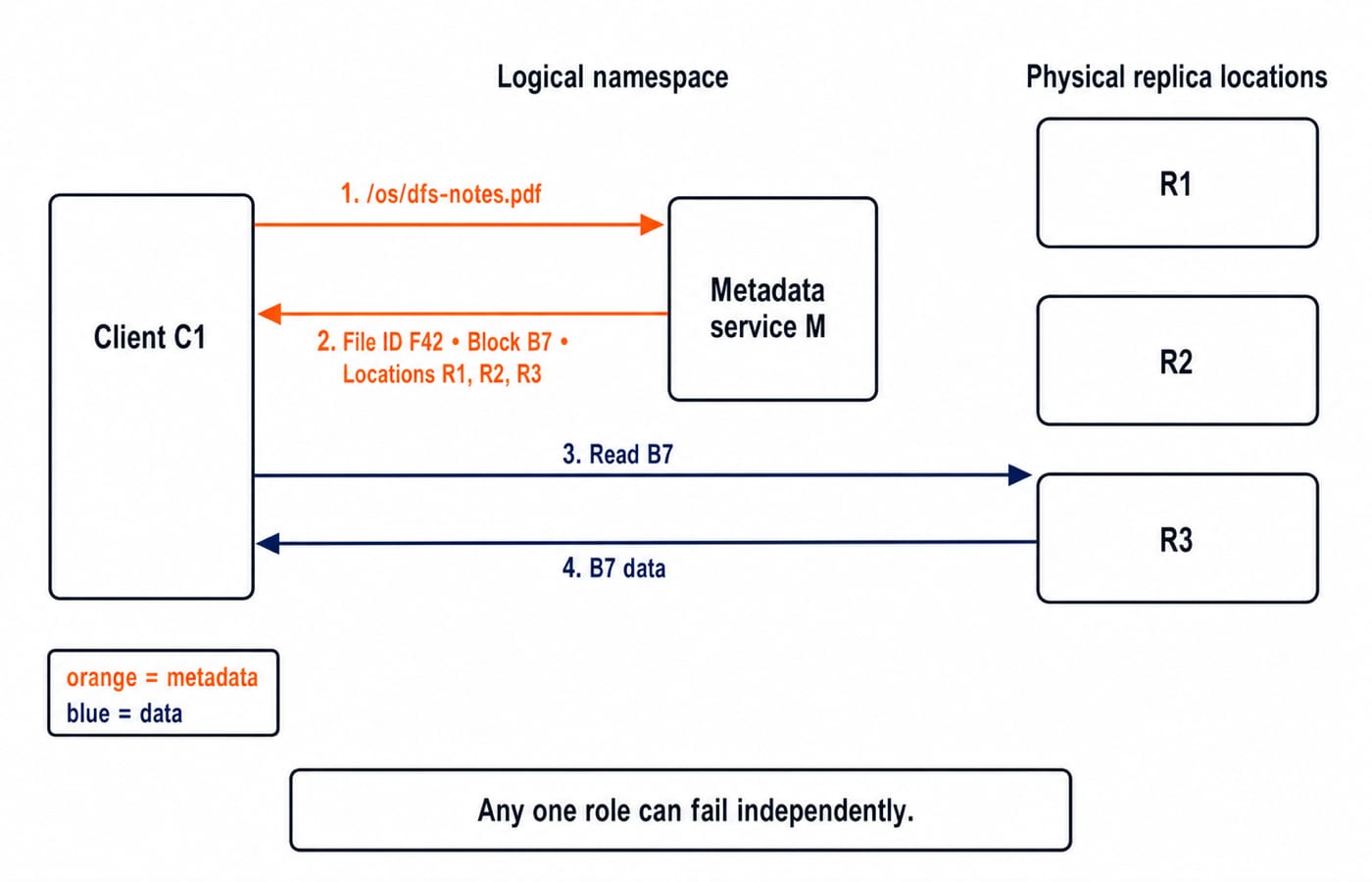
Client C1 asks metadata service M to resolve /os/dfs-notes.pdf. M returns file F42, block B7, and locations R1, R2, and R3. C1 reads B7 from one replica. Naming, metadata, and data service are logical roles that a real design may combine or replicate.
Use CS Fundamentals for Exams & Placements for the wider subject route. For the general distributed-systems map, Distributed Systems in Operating Systems owns RPC, clocks, elections, consensus, and a five-replica quorum. Distributed Systems Worked Examples develops clock tables and coordination-message counts, while Distributed Systems Basics derives the minimum safe read set for six replicas. This DFS model instead follows a pathname to a named block, computes three-replica availability, and traces stale-version repair. Disk scheduling is not a DFS reliability mechanism.
2. Reliability and availability in DFS: measure the right property
A fault is an underlying defect or event. It can create an error, an incorrect internal state. A failure is a visible departure from specification. Cases include crashes, lost messages, delay, network partitions, and corruption. Byzantine behaviour is arbitrary incorrect behaviour, which ordinary replication does not automatically tolerate.
Reliability R(t) is the probability of failure-free service throughout [0,t]. Availability is the probability of service at the observation time, so repair matters. Fast recovery can raise availability, while uninterrupted missions need reliability.
Suppose one server has mean up time 120 hours and mean repair time 3 hours. Its simplified long-run availability is:
120 / (120 + 3) = 120 / 123 = 0.9756, or about 97.56%.
This assumes alternating up and repair periods, stable averages, and no dependency failure. It is not survival probability over an arbitrary interval.
3. DFS naming and transparency: hide location without hiding every consequence
Transparency describes what the interface hides:
Access: local and remote files use the same operations.
Location: a pathname hides the physical server.
Migration: a file moves without a name change.
Replication: several copies appear as one file.
Failure: retry or failover masks some failures.
Transparency is a goal, not proof that latency or failure vanished. An unchanged name when B7 moves from R1 to R3 is migration transparency. A name that never disclosed R1 is location transparency. An unaware C1 using three copies sees replication transparency.
A stateless server gets enough context per request to work independently. A stateful server retains sessions, open-file state, locks, or cursors. Stateless recovery may be simpler, but retry still needs idempotency or request IDs. Stateful designs offer richer coordination, but lost state needs rebuilding or replication.
4. DFS replication, caching and consistency: keep the ideas separate
Replication maintains authoritative copies for availability, load sharing, or locality. Caching keeps a nearby temporary copy to reduce traffic or latency. Backup is an independently recoverable historical copy. Three replicas cannot stop deletion or corruption reaching every copy.
Suppose R1 and R2 hold committed B7:v18, while R3 holds B7:v17. Returning any copy risks stale data. One-copy-style behaviour is a strong target. Session or close-to-open guarantees may trade immediacy for performance.
For N replicas, use read quorum R and write quorum W. Reads intersect completed writes when R + W > N; writes intersect when 2W > N. This model assumes synchronous completion, committed-version metadata, and no unresolved split-brain writer.
5. DFS worked example: read-one versus a majority quorum
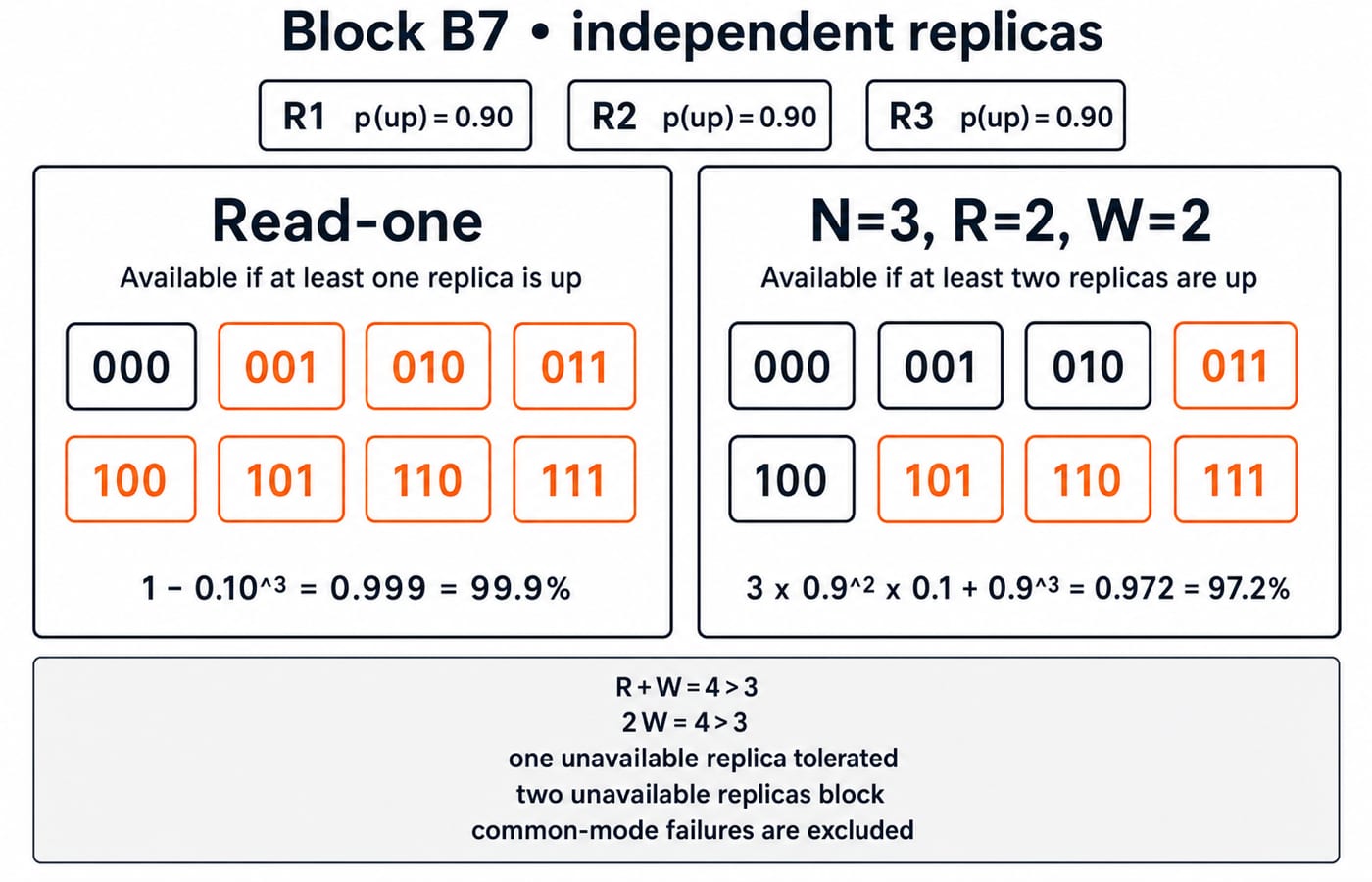
Block B7 has N = 3 independent replicas, each available with probability p = 0.90 at request time. Exclude common network, rack, metadata, and software failures.
A read-one policy succeeds if at least one replica is up:
1 - (1 - p)^3 = 1 - 0.10^3 = 1 - 0.001 = 0.999 = 99.9%.
Now choose R = 2 and W = 2. The intersection checks pass because R + W = 4 > 3 and 2W = 4 > 3. A read or write needs at least two available replicas:
C(3,2)(0.9)^2(0.1) + C(3,3)(0.9)^3
= 3 x 0.81 x 0.1 + 0.729
= 0.243 + 0.729 = 0.972 = 97.2%.
Check by subtraction. Zero replicas are up with probability 0.001. Exactly one is up with probability 3 x 0.9 x 0.1^2 = 0.027. Therefore 1 - (0.001 + 0.027) = 0.972.
Read-one is more available, but one arbitrary replica need not contain a completed W = 2 write because R + W = 1 + 2 = 3 is not greater than N = 3. Version numbers can order copies that a client compares; they cannot create the missing intersection. The 2-of-3 quorum creates read-write and write-write intersections, tolerates one unavailable replica, and blocks with two unavailable.
6. DFS failure recovery: versions, retries and traps
After a completed W = 2 write, R1 and R2 hold committed B7:v18; unreachable R3 holds B7:v17. A read quorum reaching R1 and R3 returns v18 and repairs R3. If only R3 is reachable, R = 2 blocks.
C1 sends req-731 to change byte 40 from A to B. The server commits, but its acknowledgement is lost. On retry, it recognises the ID and returns the stored result without reapplying. Retrying “append one record” without an ID can create a duplicate.
Five common traps are worth correcting:
Wrong move | Consequence | Correction |
|---|---|---|
Equate availability with reliability | Repair gets misread | Separate observation-time and interval definitions |
Treat replication as backup | A mistake destroys all live copies | Keep an independent recovery copy |
Timeout means no commit | A write may repeat | Check commit or request status |
Retry means exactly once | Work may run twice | Use idempotency and deduplication |
Assume independence | Shared faults vanish from the model | Analyse dependencies and common modes |
7. Distributed file-system exam patterns: classify, calculate and trace
Questions may classify transparency, contrast server state, calculate k-of-n availability, test quorum inequalities, or trace a missed write.
Answer checks: a hidden server name tests location transparency; 120 up hours and 3 repair hours give 97.56%; read-one across three independent 0.90 replicas gives 99.9%; N = 3, R = 2, W = 2 gives 97.2% and passes both intersections; committed v18 beats v17 under the stated rule.
Write the success condition, dependencies, qualifying states, calculation, and interpretation. For traces, label path, file ID, versions, request ID, and commit point.
8. Distributed file-system reliability: the short version and next step
Resolve a logical name, identify replicas, classify failure, choose consistency, write quorum conditions, and calculate under explicit assumptions. Trace recovery using versions and request IDs. Here F42, B7, v18/v17, and req-731 connect the model; 99.9% and 97.2% expose the trade-off.
Try one final check with N = 3 and independent p = 0.80. Read-one gives 1 - 0.20^3 = 0.992 = 99.2%. A 2-of-3 policy gives 3 x 0.80^2 x 0.20 + 0.80^3 = 0.384 + 0.512 = 0.896 = 89.6%. Explain why the quorum blocks more often under these assumptions.
GATE Guidance by Sanchit Sir is an optional structured next step if you are building a broader GATE study plan.
Go deeper with the full courseOperating System
Keep learning

Distributed Systems Basics Explained: Clocks, Quorums and Worked Examples
Learn how messages, replicas, quorums and logical clocks make distributed systems predictable. Two worked examples show how to calculate overlap and event order.
Updated 11 Nov 20266 min readOperating Systems
Communication Protocols in Operating Systems and Distributed Systems: IPC, RPC and a Worked Reliability Trace
Separate OS communication mechanisms from protocol guarantees, then trace how a lost reply, a retry, and request-ID deduplication affect server state.
Updated 9 Nov 20266 min readOperating Systems

Distributed Systems in Operating Systems: Worked Examples for GATE and Interviews
Learn how distributed operating systems reason about messages, causality, coordination, consistency, replication, and partial failure. Follow exact RPC, clock, quorum, and file-replication examples built for exam and interview practice.
Updated 10 Sep 20266 min readOperating Systems
Distributed Systems in Operating Systems: Clocks, Consistency and Worked Examples
Build a connected understanding of distributed systems through exact examples of duplicate RPC calls, logical clocks, leader election, replica quorums and block recovery.
Updated 4 Sep 20266 min readOperating Systems