LOOK and C-LOOK Algorithm MCQs: 10 Solved Questions with Explanations
Solve 10 LOOK and C-LOOK MCQs, from core definitions to complete service-order and seek-distance calculations, with a fresh explanation for every answer.
KnowledgeGate Team
Exam prep & CS education
Updated 22 Sep 20267 min read
LOOK, C-LOOK, SCAN and C-SCAN differ by only two decisions: where the head turns, and whether it services requests after a wrap. That makes a familiar-looking queue surprisingly easy to solve in the wrong order.
Definitions alone are not enough: recognise the graph, construct the request order and calculate full head movement. Write the service order before reading each explanation, then use CS Fundamentals for exams and placements.
Use a mechanical method: separate requests around the head, write the order, then calculate. Guessing from an algorithm name is where errors begin.
LOOK versus C-LOOK before the MCQs
LOOK moves in its current direction only as far as the last pending request. It then reverses and services requests on the return path. C-LOOK also stops at the last pending request, but wraps to the request at the other extreme without servicing during the wrap, then continues in the same direction. SCAN and C-SCAN instead continue to a physical end cylinder before reversing or wrapping.
Suppose the head starts at 50, moves right, and the queue is [10, 20, 35, 55, 70, 90].
LOOK order:
55 -> 70 -> 90 -> 35 -> 20 -> 10Movement:
5 + 15 + 20 + 55 + 15 + 10 = 120C-LOOK order:
55 -> 70 -> 90 -> 10 -> 20 -> 35Movement, including the wrap:
5 + 15 + 20 + 80 + 10 + 15 = 145
These totals depend on the queue and starting direction. Split around the head, sort each set, follow the direction, write the visit order, then add absolute differences. For cross-family selection across FCFS, SSTF and SCAN, use Disk Scheduling MCQs: FCFS, SSTF, SCAN. Here, every queue is judged by one narrower distinction: LOOK reverses at the last request, while C-LOOK wraps between extreme requests.
LOOK and C-LOOK MCQs 1-3: identify the rule
Question 1
What is the LOOK Disk Scheduling Algorithm?
A. It is a variant of SCAN which only goes as far as the final request in each direction
B. It is a variant of FCFS which looks ahead to prioritize requests
C. It is a variant of SSTF which looks at all the pending requests before deciding the next request to service
D. It is a variant of C-SCAN which looks at requests in a circular manner
Correct answer: A.
LOOK keeps SCAN's sweep and reversal, but turns at the furthest pending request instead of an unused boundary. FCFS uses arrival order, SSTF uses proximity, and circular movement identifies C-LOOK or C-SCAN.
Question 2
What is C-LOOK scheduling?
A. A variant of LOOK that only considers the closest requests
B. A circular version of LOOK
C. A variant of LOOK that handles requests in the order they arrive
D. None of the above
Correct answer: B.
C-LOOK keeps LOOK's request-bounded sweep but replaces reversal with a wrap. It jumps from one extreme request to the other and continues in the same direction. That is neither SSTF nor FCFS.
Question 3
In __________ disk scheduling algorithm, the disk head moves from one end to other end of the disk, serving the requests along the way. When the head reaches the other end, it immediately returns to the beginning of the disk without serving any requests on the return trip.
A. LOOK
B. SCAN
C. C - LOOK
D. C - SCAN
Correct answer: D.
The UGC NET 2017 stem says the head moves between physical ends, identifying C-SCAN. C-LOOK is circular too, but wraps after the last queued request.
LOOK and C-LOOK MCQs 4-6: optimisation and graph recognition
Question 4
Which Disk Scheduling Algorithm is an optimized version of SCAN, stopping the head movement where the last request exists?
A. FCFS
B. LOOK
C. SSTF
D. C-LOOK
Correct answer: B.
LOOK removes SCAN's travel between the furthest pending request and an unused boundary. It still reverses; C-LOOK instead wraps and continues in one direction.
Question 5
Which among the following is true for C-LOOK Scheduling?
A. It completely eliminates starvation
B. It causes more starvation compared to SCAN
C. It serves requests in the order they arrive
D. It is a more efficient version of C-SCAN
Correct answer: D.
C-LOOK preserves C-SCAN's circular service order while avoiding unused end cylinders. This does not mean it always minimises seek time or eliminates starvation. It is not FCFS.
Question 6
Consider the following Graph of disk scheduling and identify the disk scheduling algorithm represented by this graph.
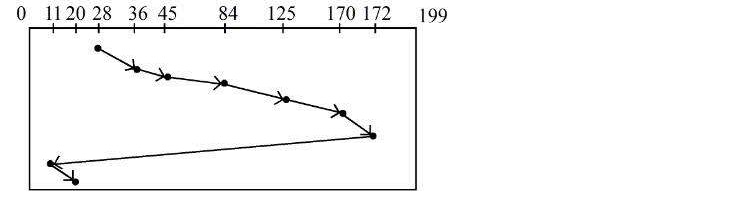
Queue: 84, 125, 11, 36, 170, 20, 172, 45
A. SSTF
B. SCAN
C. C-SCAN
D. C-LOOK
Correct answer: D.
In this UGC NET 2025 graph, the head starts at 28, services 36 -> 45 -> 84 -> 125 -> 170 -> 172, wraps to 11, then visits 20. It never reaches 199 or serves on the wrap, so this is C-LOOK.
LOOK and C-LOOK MCQs 7-10: calculate order and seek distance
Question 7
Consider the following disk queue with I/O requests for cylinders: 45, 81, 185, 33, 175, 99, 150, 77.
The head starts at cylinder 58.
What is the second request processed by C-LOOK moving right?
A. 81
B. 45
C. 77
D. 33
Correct answer: A.
For this UGC NET 2025 question, the sorted right side is [77, 81, 99, 150, 175, 185]. C-LOOK (Right) begins 77 -> 81; [33, 45] wait for the wrap. The second request is 81.
Question 8
Suppose a disk has 200 cylinders, numbered from 0 to 199.
The disk arm is at cylinder 100, and the request queue is 23, 89, 132, 42, 187.
If C-LOOK is used, what is the total arm movement?
A. 300
B. 317
C. 296
D. 285
Correct answer: B.
Increasing order gives 100 -> 132 -> 187 -> 23 -> 42 -> 89. Including the wrap, movement is 32 + 55 + 164 + 19 + 47 = 317 cylinders. C-LOOK skips 199 because no request is there.
Question 9
Consider a disk with 50 tracks, numbered from 0 to 49. The request queue contains these track:sector requests:
[11:9], [22:23], [20:21], [24:25], [3:8], [40:45], [5:7], [38:9]
The disk head is at track 20 and moves upward. What is the absolute difference in total head movement between SCAN and C-LOOK?
A. 0
B. 5
C. 10
D. 15
Correct answer: C.
Use tracks, not sectors; the request at 20 costs zero. SCAN goes up to 49, then down to 3: (49-20) + (49-3) = 75. C-LOOK reaches 40, wraps to 3, then ends at 11: (40-20) + (40-3) + (11-3) = 65. Difference: |75-65| = 10.
Question 10
Consider these I/O requests to a disk with 200 tracks:
Serial number: 1 | 2 | 3 | 4 | 5
Track number: 12 | 85 | 40 | 100 | 75
Arrival time (ms): 65 | 80 | 110 | 100 | 175
The current head position is track 65, the last movement was toward higher tracks, the current time is 160 ms, and movement takes 1 ms per track.
LOOK reverses only when no pending request remains in the current direction. What are the seek times under SSTF and LOOK, respectively?
A. 144 and 123 milliseconds
B. 143 and 123 milliseconds
C. 149 and 124 milliseconds
D. 256 and 186 milliseconds
E. None
Correct answer: B.
At t=160, tracks 12, 85, 40 and 100 are pending. SSTF takes 20 ms from 65 -> 85; track 75 then exists, so continue 75 -> 100 -> 40 -> 12. Total: 20 + 10 + 25 + 60 + 28 = 143 ms.
LOOK uses 65 -> 85 -> 100 -> 75 -> 40 -> 12: 20 + 15 + 25 + 35 + 28 = 123 ms. This UGC NET 2013 question requires updating arrivals after each movement.
A head-movement audit that catches arithmetic errors
Question | Start and direction | Service order | Movement |
|---|---|---|---|
Q7 |
| first two: | not requested |
Q8 |
|
|
|
Q9 |
| SCAN versus C-LOOK |
|
Q10 |
| SSTF versus LOOK |
|
Check four things: a request under the head costs zero; a boundary differs from the furthest request; a circular jump counts; and arrival-time queues change after every seek. Operating Systems for GATE: Deadlocks, Scheduling, Memory supplies broader context.
Traps these LOOK and C-LOOK MCQs expose
Trap | Questions that expose it |
|---|---|
Physical boundary versus last request | Q1, Q3, Q4 |
Reverse versus circular wrap | Q2, Q6 |
Efficiency without an always-optimal claim | Q5 |
Service order before arithmetic | Q7, Q8, Q9 |
Dynamic arrival set | Q10 |
A C-LOOK wrap is not a reversal. It visits an end only when requested, but the wrap counts. For track:sector, use the track. Arrivals can change SSTF.
Sanity check: LOOK changes direction once. C-LOOK points one way around a long wrap. If that shape is wrong, stop adding.
LOOK and C-LOOK: the short version and next practice step
Redo Questions 3, 6, 8, 9 and 10 without the answers. The retest covers physical boundaries, graph recognition, circular-wrap arithmetic, SCAN comparison and time-dependent scheduling.
On the retest, write every visit before one subtraction and circle any physical boundary. Mark any wrap before you total its distance. Use GATE Guidance by Sanchit Sir for a sequenced GATE route through Operating Systems, or ZERO TO HERO for a broader core-CS route. Then use the Operating System MCQs collection for wider practice. Remember: LOOK reverses at the last request; C-LOOK wraps at the last request; SCAN-family algorithms go to the disk boundary.
Keep learning
Segmentation and Hybrid MCQs: 10 Solved OS Questions with Explanations
Solve ten memory-management MCQs, then check the keyed answers, short reasoning paths, distractor traps, and worked address calculations.
Updated 3 Oct 20267 min readOperating System MCQs
Paging and TLB MCQs: 12 Solved Questions with Step-by-Step Explanations
Solve 12 Paging and TLB MCQs in a sequence that builds from page-table basics to address splits, TLB coverage, timing and fragmentation.
Updated 28 Sep 20268 min readOperating System MCQs
OS Types & Evolution MCQs: 12 Solved Questions with Explanations
Solve 12 published OS Types & Evolution questions. Each answer identifies the clue that separates batch, multiprogramming, time sharing and other OS models.
Updated 25 Sep 20268 min read83 viewsOperating System MCQs
Multilevel Paging MCQs: 12 Solved Questions with Explanations
Solve 10 MCQs and two NATs on multilevel paging. Each answer works through the address bits, table capacity or access-time path that decides the result.
Updated 24 Sep 20268 min readOperating System MCQs