

Rust Learning Roadmap: An 8-Week Path from Borrow Checker to Real Projects
Stop restarting Rust tutorials when ownership gets difficult. Build one tested command-line project through eight weekly milestones and finish with evidence.
KnowledgeGate Team
Exam prep & CS education
Updated 30 Oct 20265 min read
Many Rust learners finish a syntax video, meet an ownership error, switch tutorials, and repeat the cycle. The missing piece is usually not another playlist. It is keeping one project alive long enough for the compiler's feedback to become useful. Practice Rust through a bounded eight-week plan at seven hours per week, or 56 planned hours in total. Every new concept goes into the same growing codebase. Progress means you can explain a change, test it, and make it work from a blank editor, not that you watched every lesson in a course.
1. Commit to an 8-week, 56-hour practice loop
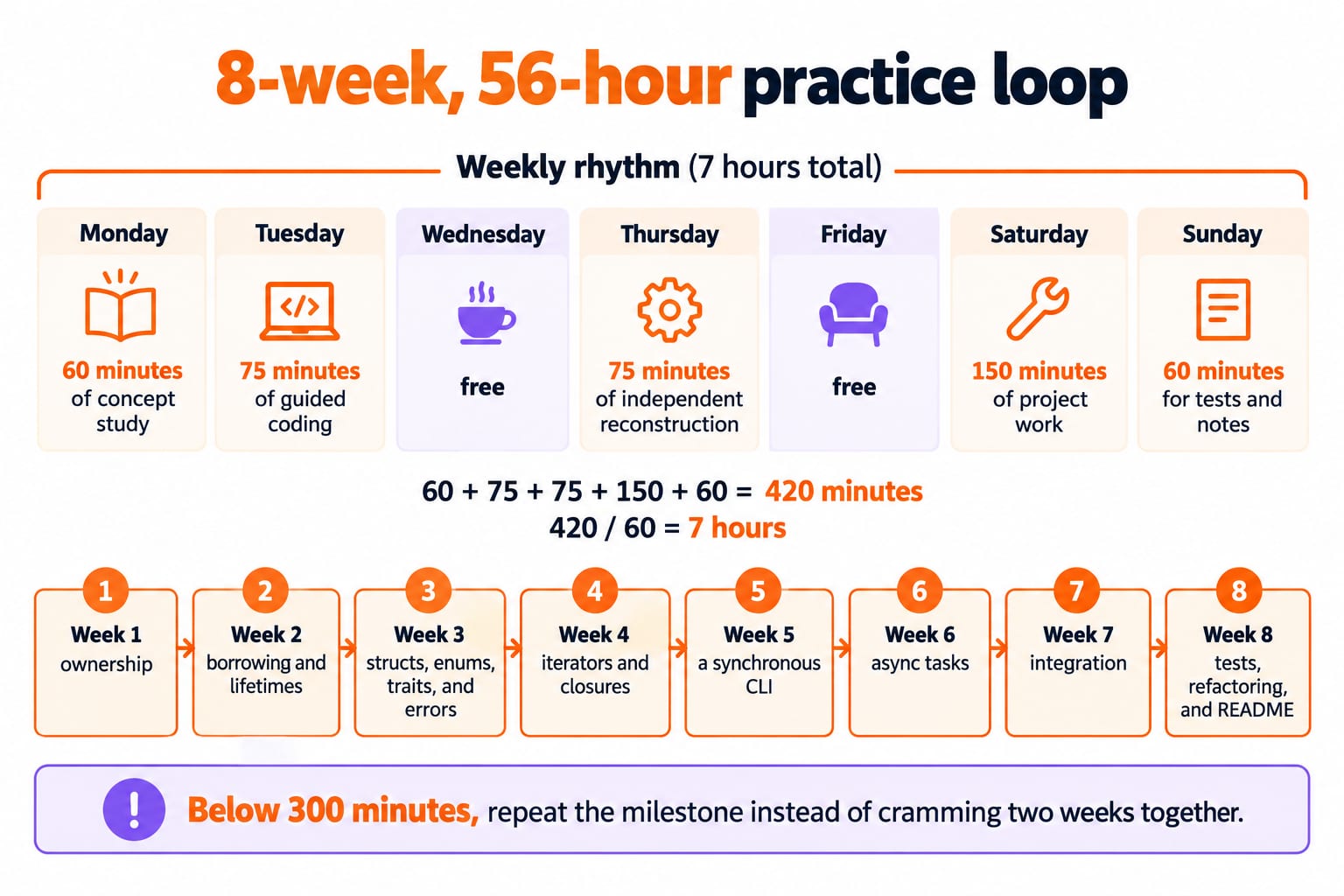
Follow one rhythm: Monday, 60 minutes of concept study; Tuesday, 75 minutes of guided coding; Thursday, 75 minutes of independent reconstruction; Saturday, 150 minutes of project work; Sunday, 60 minutes for tests and notes. That is 60 + 75 + 75 + 150 + 60 = 420 minutes, or 420 / 60 = 7 hours. Keep Wednesday and Friday free so a difficult session does not break the week.
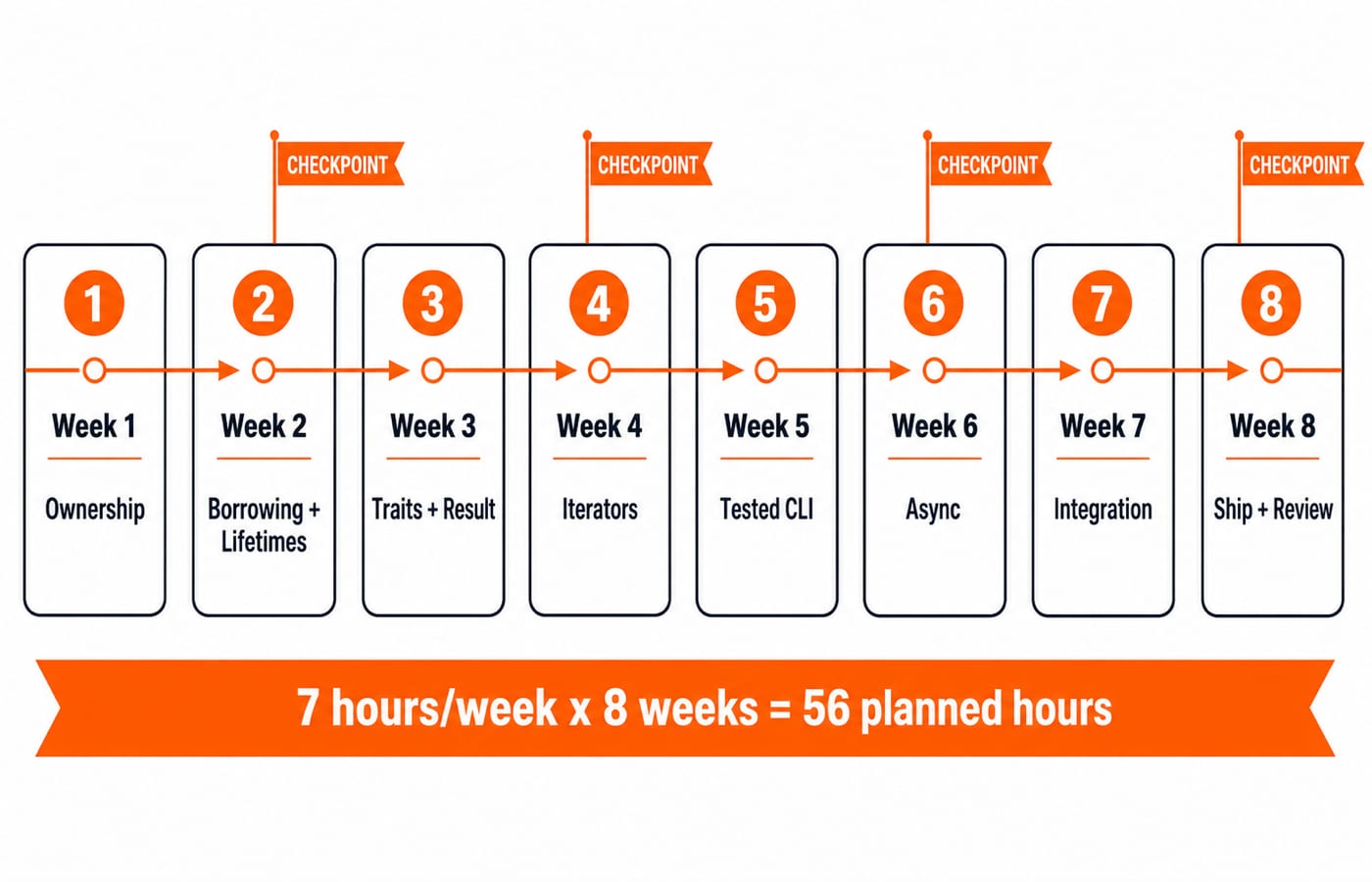
Milestones are: Week 1 ownership; Week 2 borrowing and lifetimes; Week 3 structs, enums, traits, and errors; Week 4 iterators and closures; Week 5 a synchronous CLI; Week 6 async tasks; Week 7 integration; Week 8 tests, refactoring, and README. The earlier Kotlin Learning Roadmap owns JVM null safety and coroutine cancellation. This Rust roadmap instead keeps one CLI alive through ownership, borrowing, iterators, errors, and async.
Miss a 60-minute or 75-minute session? Use Sunday for the essential exercise and drop the optional extension. Below 300 minutes, repeat the milestone instead of cramming two weeks together.
2. Weeks 1 and 2: Make ownership and borrowing visible
Start with vec!["borrow", "build", "ship"] as Vec<String>. Write fn total_bytes(words: &[String]) -> usize. It gives 6 + 5 + 4 = 15 bytes. Afterwards, backlog.len() remains 3 because the function borrowed a slice.
Now call fn consume(words: Vec<String>) with backlog, followed by println!("{}", backlog.len()). This is a move error because ownership entered consume. Repair the boundary to borrow read-only data. Do not add .clone() by reflex.
Next, add_task(&mut backlog, "test") changes the length from 3 to 4. When the exclusive borrow ends, an immutable read is legal again. Explain the three states: one owner, temporary shared access, or temporary exclusive access.
The earlier Rust Tutorial for Beginners owns bindings, types, Result, moves, borrows, and string slices. This roadmap applies that base to one tested CLI and link checker. The adjacent C++ Programming course compares manual memory habits; it is not Rust instruction.
3. Week 3: Turn data into types, traits, and recoverable errors
Grow the backlog into Task { title: String, minutes: u32 } and Plan { tasks: Vec<Task> }. Parse these three lines:
borrow,45
traits,30
tests,25
The result has 3 tasks and 45 + 30 + 25 = 100 minutes. Define a local Summary trait whose summary(&self) implementation for Plan returns exactly "3 tasks / 100 min".
Represent parse failures with an enum. In a two-line malformed fixture, put borrow,45 first and async,xx second. The second line returns Err(ParseTaskError::InvalidMinutes { line: 2, value: "xx" }). Never use unwrap() on file or user input. Test the valid count 3 and total 100, plus the typed line-2 error. Traits describe behaviour; Result keeps failure in the contract.
4. Week 4: Replace mechanical loops with iterator pipelines
First write an imperative solution. Then filter tasks where minutes >= 30, map their titles to uppercase, and collect vec!["BORROW", "TRAITS"]. A second pipeline sums 45 + 30 = 75 selected minutes.
Trace the stages: source 3, filter 2, map 2 strings. Test the titles and 75-minute sum. The value is composable, testable transformations, not automatic speed. Rebuild the pipeline from a blank file and explain what each adaptor consumes or borrows.
5. Week 5: Convert the exercises into a tested CLI
Add the command plan report tasks.csv --min 30. With the valid fixture, stdout must be:
BORROW 45
TRAITS 30
selected=2 minutes=75
For that two-line malformed fixture, stderr must say line 2: invalid minutes 'xx', and the process must exit with code 2.
Split the repository into model.rs, parse.rs, report.rs, and main.rs. Keep parsing and selection testable without starting a process. Carry four unit tests for valid parsing, invalid parsing, filtering, and summary, then add two integration tests for successful and malformed-input commands. End with 4 + 2 = 6 passing tests. Extend the existing repository even when compiler messages feel unfamiliar.
6. Week 6: Learn async through one measured scheduling exercise
Create three independent simulated jobs: borrow waits 120 ms, traits waits 80 ms, and tests waits 40 ms. Sequential waiting costs 120 + 80 + 40 = 240 ms. Concurrent waiting has an ideal critical path of max(120, 80, 40) = 120 ms, excluding executor and system overhead.
With Tokio, implement each job as an async fn returning Result<JobResult, JobError>, and run all three with tokio::join!. Sort records into input order so completion order does not leak into output. Configure one job to return a typed error while still accounting for the other two results. Async helps independent waiting because their idle periods can overlap; it does not make CPU work free.
7. Weeks 7 and 8: Ship a production-shaped link checker
Evolve the CLI into roadcheck urls.txt --concurrency 2 --format json. Inject a fake fetcher with four input-ordered outcomes: ok returns HTTP 200 after 40 ms, slow returns HTTP 200 after 120 ms, missing returns HTTP 404 after 80 ms, and broken returns a transport error. Expect checked=4 success=2 http_error=1 transport_error=1.
Use ownership for URL and result records, borrowed slices for reporting, a Reporter trait for text and JSON, error enums for input and network failures, iterators for summary counts, async with a concurrency limit of 2, and deterministic ordering before output. Put a real HTTP client and the fake fetcher behind the same interface, so the command checks live URLs while tests retain fixed results.
Retain six tests and add three for all-success, mixed-status, and transport-error cases, giving 6 + 3 = 9. Done means the README command runs, malformed input fails without panic, the four-result fixture matches, formatting and lint pass, and the README explains one trade-off.
8. Use checkpoints, not motivation, to decide the next step
Use four evidence checks. After Week 2, fix the moved vector without cloning. After Week 4, reproduce the 3-to-2 pipeline and total 75. After Week 6, explain 240 ms sequential against the 120 ms ideal critical path. After Week 8, demo four results and all 9 tests.
After three unproductive sessions, remove an optional feature such as JSON output. Keep the text reporter and tests, then finish. Return to variables and loops only if a checkpoint proves the foundation is missing.
For broader practice, use the Coding & DSA category. Once the Rust project is stable, the adjacent Coding for Placements course can support multi-language DSA and coding-round practice, but it is not a Rust course. Finish the smallest working version and let passing tests decide what comes next.
Keep learning
Data Abstraction Explained: Hide Implementation Details with a Worked Java Example
See how a stable Account contract protects its invariant while the Java implementation changes from a running balance to a transaction ledger.
Updated 16 Nov 20265 min readProgramming Languages Survey

Programming Paradigms Explained: Concepts, Classifications and Worked Examples
Learn how imperative, procedural, object-oriented, functional and declarative styles organise the same computation, and how to classify code from visible evidence.
Updated 15 Nov 20265 min readProgramming Languages Survey
Introduction to Visual Basic (VB): Concepts, Worked Code and Exam Patterns
Learn how a VB.NET form turns text-box input and a button click into a traced result. Then practise operators, loops, procedures, scope and debugging.
Updated 14 Nov 20266 min readProgramming Languages Survey
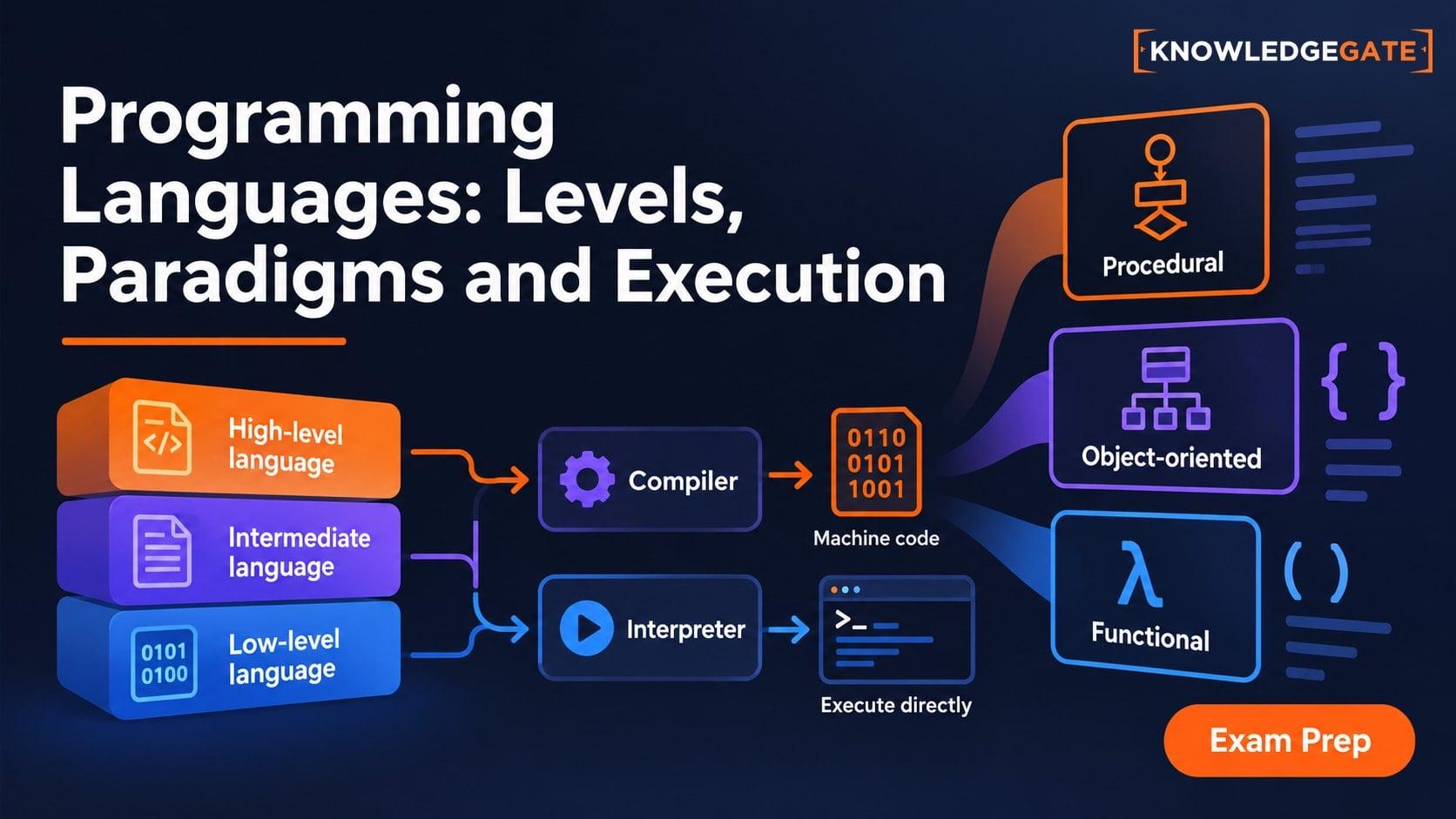
Types of Programming Languages: Levels, Paradigms and Execution Models
Learn why low-level, object-oriented, compiled and dynamically typed describe different axes. Build a clear classification map through one result expressed three ways.
Updated 13 Nov 20266 min readProgramming Languages Survey