Register & Bus Organization MCQs: 12 Solved Questions with Explanations
Work through 12 Register and Bus Organization PYQs on CPU registers, micro-operations, common-bus multiplexers, tri-state drivers and register windows.
KnowledgeGate Team
Exam prep & CS education
24 Oct 20267 min read
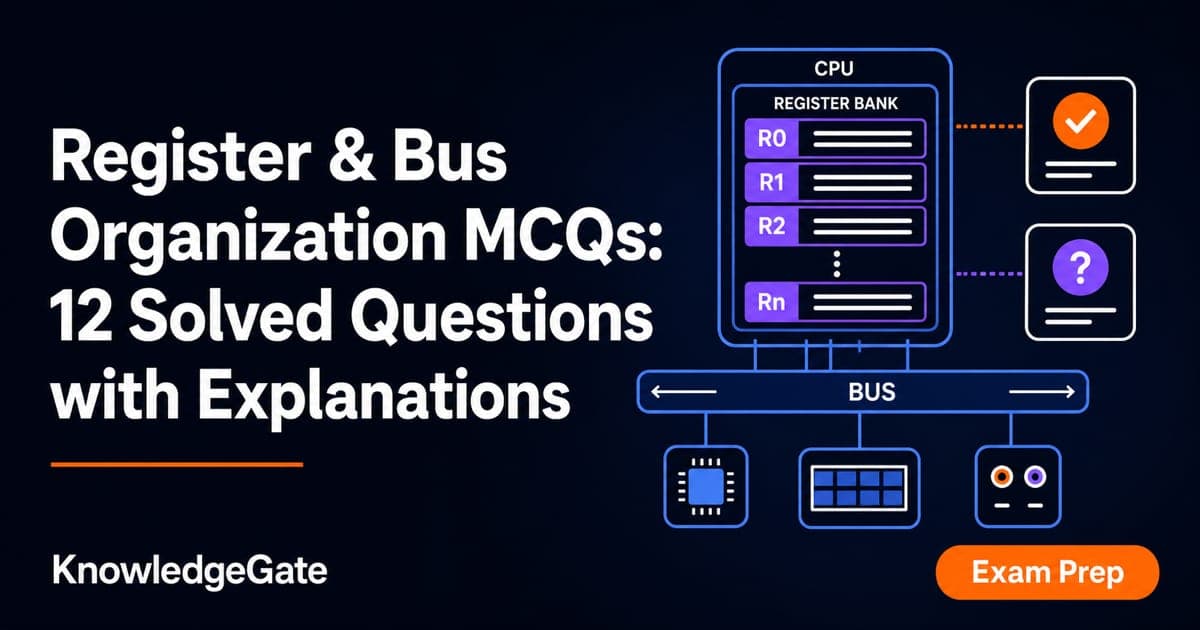
Register questions can look like simple recall, but their distractors blur storage location, register role, bus width, bus implementation and transfer control. Separate five cues before choosing: what is stored, which register owns the role, how many bits move in parallel, how one bus source is selected, and which control signal enables the transfer. Use the wider GATE CS Exam Preparation page to place register transfers within the full subject plan. Commit to an option and state the governing idea before reading each explanation.
Register and bus organization: the working model before the MCQs
Registers are fast storage inside the CPU. The Program Counter (PC) identifies the next instruction address, the Instruction Register (IR) holds the instruction being executed, the Memory Address Register (MAR) holds a memory address, and the Memory Buffer Register or Memory Data Register (MBR or MDR) holds a transferred memory word. A bus is a shared set of signal lines; its width is the number of parallel data lines. A disabled tri-state driver presents high impedance, an effectively disconnected output.
Now build a common bus for eight 16-bit registers, R0 to R7. Each of the 16 bus bit positions must select one corresponding bit from eight sources, so the circuit needs 16 parallel 8-to-1 multiplexers. The selector needs three lines because log2(8) = 3. If R5 = 0x3A6C and S2S1S0 = 101, binary 101 selects register 5, so the bus carries 0x3A6C. When LOAD R2 is asserted, the active clock edge stores 0x3A6C in R2.
Register & Bus Organization MCQs 1-3: storage and micro-operations
Question 1
UPLT 2018, Computer Science
Which of the following is not true regarding registers?
A. Internal storage of CPU
B. Can hold either data or instruction
C. Made up of flip-flop
D. Cannot store intermediate results
Answer: D.
Registers are internal CPU storage built from flip-flop circuits. They can hold data, instructions, addresses and intermediate results, so A, B and C are true while D is not.
Question 2
MPPSC 2025, Computer Science
Some operations require the control unit to store data temporarily. _____ are some temporary storage location in the CPU that are designed for this purpose.
A. RAMs
B. ROMs
C. Registers
D. Hard Drives
Answer: C.
Registers sit inside the CPU and retain values needed during execution. RAM and ROM are memory components, while a hard drive is secondary storage. The stated location therefore identifies a register.
Question 3
ISRO 2023, Computer Science
The operation executed on data stored in registers is called
A. Macro-operation
B. Micro-operation
C. Bit-operation
D. Byte-operation
Answer: B.
A micro-operation is an elementary operation on information stored in registers, such as transfer, addition, shifting or logic. Bit-operation and byte-operation may describe granularity, but neither is the standard computer-organisation term.
Register & Bus Organization MCQs 4-6: IR, PC and IBR roles
Question 4
DSSSB 2024, TGT, Computer Science
In CPU, which of the following type of register is required by the control unit and contains the instruction currently being executed?
A. Instruction register
B. Accumulator
C. Program register
D. Memory data register
Answer: A.
The IR holds the current instruction while the control unit decodes it. An accumulator holds arithmetic values, while the memory data register buffers a transferred word. "Currently being executed" identifies the IR.
Question 4 solution.
Question 5
DSSSB 2021, PGT, Computer Science
What is the function of the program counter register?
A. It holds the operand address
B. It holds the address of current instruction
C. It holds the address of previous instruction
D. It holds the address of next instruction
Answer: D.
The PC identifies the next instruction address. It advances sequentially or receives a branch target, while the current instruction belongs in the IR. That separates D from B.
Question 5 solution.
Question 6
UPPSC Polytechnic Lecturer 2022, Computer Science
Which of the following register is employed to hold temporarily the right-hand instruction from a word in memory?
A. Instruction Register (IR)
B. MAR
C. AC and MQ
D. IBR
Answer: D.
In the packed two-instruction word organisation assumed here, the IBR holds the right-hand instruction while the left-hand one executes. IR holds the current instruction, MAR holds an address, and AC and MQ have arithmetic roles.
Question 6 solution.
Register & Bus Organization MCQs 7-9: bus structure, width and multiplexers
Question 7
HPSC 2021, Computer Science
The main virtue for using single Bus structure is
A. fast data transfers
B. cost effective connectivity and speed
C. cost effective connectivity and ease of attaching peripheral devices
D. cheaper in price
Answer: C.
A single bus reduces interconnection hardware and gives devices a common attachment path. Competing transfers are serialised, so speed is not its main virtue. C captures the connectivity advantage without a false speed claim.
Question 8
DSSSB 2018, Computer Science
The number of lines used in a data bus is referred to as the ____ of the data bus.
A. length
B. density
C. width
D. volatility
Answer: C.
Bus width is the number of bits carried in parallel, so a data bus with 16 lines is 16 bits wide. Length, density and volatility do not name the line count.
Question 8 solution.
Question 9
UGC NET 2021, Computer Science
A digital computer has a common bus system for 8 registers 16 bits each. How many multiplexers are required to implement common bus? What size of multiplexers is required?
A. 16, 8x1
B. 8, 16x1
C. 8, 8x1
D. 16, 16x1
Answer: A.
The 16 bus positions need 16 multiplexers, one per bit. Each selects the corresponding bit from eight registers, so its size is 8x1. Three selector lines suffice because 2^3 = 8, giving A.
Register & Bus Organization MCQs 10-12: tri-state control, serial buses and register windows
Question 10
ISRO 2014, Computer Science
The output of a tristate buffer when the enable input is 0 is:
A. Always 0
B. Always 1
C. Retains the last value when enable input was high
D. Disconnected state
Answer: D.
A disabled tri-state buffer produces high impedance, written Z. It is disconnected, allowing another source to drive the bus. It is neither logic 0 nor logic 1 and retains no value.
Question 11
CDAC CCAT 2017
Which one is correct about serial versus parallel bus?
A. Parallel bus would be faster than serial bus
B. Serial bus can be clocked considerably faster than parallel bus, as there is no issue of clock skew between different lines of the bus
C. Serial bus would be slower than parallel bus
D. None of the above
Answer: B.
At high rates, parallel lines can deliver bits at different times, limiting the safe clock. A serial stream has no lane-to-lane skew, so it can be clocked faster. This does not guarantee lower latency.
Question 11 solution.
Question 12
ISRO 2009, Computer Science
The use of multiple register windows with overlap causes a reduction in the number of memory accesses for:
I. Function locals and parameters
II. Register saves and restores
III. Instruction fetches
A. I only
B. II only
C. III only
D. I and II only
Answer: D.
Overlapping windows let a caller's output registers become the callee's input registers, reducing memory traffic for parameters and locals. Window switching also reduces saves and restores. Instruction fetching is unaffected, so III is excluded.
The traps these 12 register and bus questions expose
Distinction to make | Questions | What to check |
|---|---|---|
Register versus memory | 1-2 | Look for "inside the CPU" and immediate working storage. |
Operation versus storage, then PC versus IR versus IBR | 3-6 | Separate the action from its storage location, then expand each name. |
Single-bus benefit versus speed | 7 | Shared connectivity saves hardware; competing transfers are serialised. |
Bus width versus multiplexer count | 8-9 | Count output lines, then selectable sources per line. |
Electrical disconnection and serial clocking | 10-11 | High impedance is not stored logic; serial avoids inter-line skew. |
Data-register traffic versus instruction fetch | 12 | Windows reduce call-related transfers, not instruction fetches. |
Circle whether the stem asks for a component, role, width or implementation count. Expand each register name before choosing. For a bus numerical, calculate output lines first and source choices second. In a negative stem such as Question 1, mark "not" before reading the options.
For the complete instruction path plus clock and address-line numericals, use CPU Organization Basics MCQs. Register and bus practice here instead concentrates on register roles, micro-operations, common-bus selection and driver control. Next, connect PC, IR and address hardware to Addressing Modes and Instruction Formats. Once those roles are secure, Pipelining in Computer Architecture Explained shows how registers later become pipeline-stage boundaries.
Register & Bus Organization: the next practice step
Retest Questions 4, 6, 9, 10 and 12 without looking. The questions test current-instruction storage, a buffered instruction half, multiplexer construction, high-impedance bus control and overlapping register windows. Write a one-line reason beside every answer, not only the option letter, then retry any item whose reason was vague. If you want a sequenced Computer Organization route that places register transfers beside micro-operations, CPU organisation, memory and pipelining, use GATE Guidance by Sanchit Sir. The short version is simple: first identify what must be stored or transferred, then name the register, count the bus lines, and only after that inspect the distractors.
Keep learning
General Hardware Terms MCQs: 12 Solved Questions on Memory, Storage and I/O
Solve 12 hardware MCQs covering data units, BIOS, RAM, ROM, storage, I/O devices and network hardware, with concise explanations and a checked GB-to-GiB conversion.
25 Oct 20267 min readComputer Organization MCQs
Data Manipulation Micro-Operations MCQs: 10 Solved Questions with Explanations
Solve 10 micro-operations MCQs with step-by-step explanations of shifts, ALU behaviour, register logic, Booth recoding and control width.
Updated 20 Oct 20267 min readComputer Organization MCQs
Performance & Speedup MCQs: 12 Solved Pipelining Questions
Work through 12 solved pipelining questions step by step, from finite pipeline time and latch overhead to bubbles, MIPS, CPI and bottleneck splitting.
Updated 16 Oct 20268 min readComputer Organization MCQs
Multiprocessor Classification MCQs: 8 Solved MCQs and 2 Concept Checks
Work through the complete mapped pool: eight objective items plus two optionless concept checks. Explanations cover Flynn's taxonomy, coupling, bus facts, and parallel efficiency.
12 Oct 20267 min readComputer Organization MCQs