

IBPS RRB Clerk Exam Pattern: Sections, Timings and Marking Scheme
Decode the Office Assistant route, calculate penalties for questions with different values, and turn the two exam stages into a measured practice week.
KnowledgeGate Team
Exam prep & CS education
Updated 3 Nov 20265 min read

Aspirants commonly search for "IBPS RRB Clerk", while the official post name is Office Assistants (Multipurpose). In the 2025 CRP RRBs XIV notice, Prelims and Mains had different jobs, Mains questions carried different assigned values, and each wrong-answer penalty followed that value. Compare these reference figures with your cycle's notice before planning, and use the wider Banking & Insurance exam preparation context when comparing related recruitments.
1. First decode the two-stage Office Assistant route
The updated CRP RRBs XIV notification dated 27 September 2025 gave Office Assistants a two-tier online route: Prelims, then Mains for shortlisted candidates. Candidates had to qualify in both Prelims tests, but only Main marks counted for final merit. This route had no officer interview stage. The earlier IBPS RRB PO exam pattern and marking scheme owns the Officer Scale I interview route; this post stays with Office Assistant scoring and its no-interview merit path.
Prelims screens, but neither test can be ignored. For Office Assistants, provisional allotment is restricted to participating RRBs in the state selected in the application. IBPS then matches merit and stated RRB preferences to that state's actual vacancies under the applicable reservation category; it reports each cycle's cutoffs by state and category. The earlier IBPS RRB Clerk eligibility and selection process owns the eligibility, language, document and allotment evidence; this post owns the pattern, timing and penalty calculations.
These CRP RRBs XIV figures are dated references. IBPS could modify the structure and duration. Confirm the current CRP RRB notice and handout through the official hub on ibps.in.
2. Prelims pattern: 80 questions in 45 minutes
The dated notification listed separately timed tests:
Test | Questions | Maximum marks | Duration |
|---|---|---|---|
Reasoning | 40 | 40 | 25 minutes |
Numerical Ability | 40 | 40 | 20 minutes |
Total | 80 | 80 | 45 minutes |
Across 40 questions, Reasoning averages 25 x 60 / 40 = 37.5 seconds each and Numerical Ability 20 x 60 / 40 = 30 seconds. These are averages, not caps. A puzzle may use time saved on faster items. Practise separate budgets, and check the current handout rather than assuming time can move.
3. Mains pattern: five tests, unequal marks per question
Test | Questions | Maximum marks | Duration |
|---|---|---|---|
Reasoning | 40 | 50 | 30 minutes |
Computer Knowledge | 40 | 20 | 15 minutes |
General Awareness | 40 | 40 | 15 minutes |
English or Hindi Language | 40 | 40 | 30 minutes |
Numerical Ability | 40 | 50 | 30 minutes |
Total | 200 | 200 | 120 minutes |
Candidates chose English or Hindi. Despite 200 questions = 200 marks, values differed: Reasoning and Numerical Ability 50 / 40 = 1.25, Computer Knowledge 20 / 40 = 0.50, and General Awareness and language 40 / 40 = 1.00. The two 1.25-mark tests supplied 100 of 200 marks, but every test retained a required minimum.
4. Negative marking: calculate one fourth of assigned marks
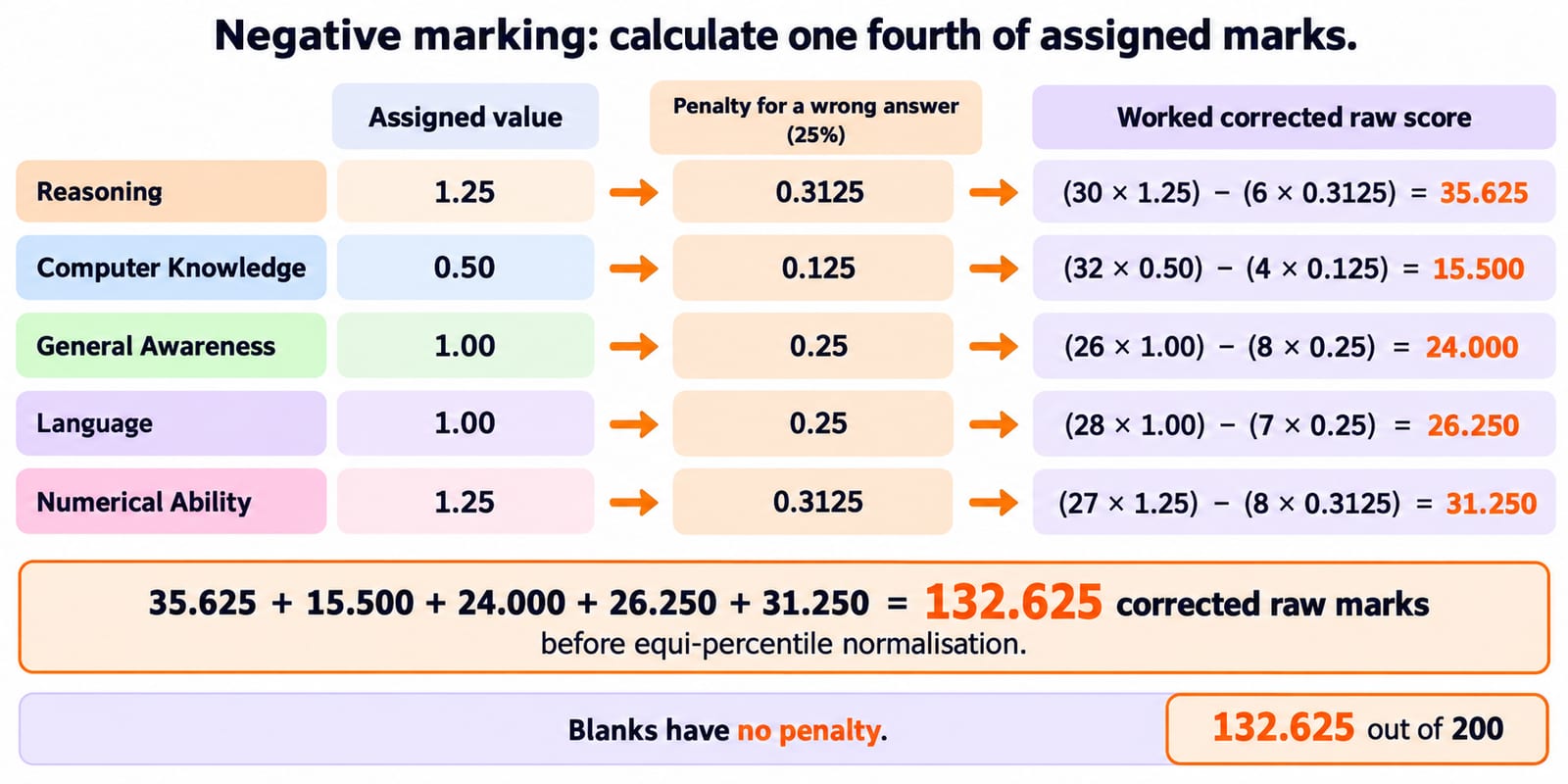
The notification deducted one fourth, or 0.25, of a question's assigned marks for a wrong objective answer. Blanks had no penalty, and the deduction was not always 0.25 mark:
Test | Penalty per wrong answer |
|---|---|
Prelims Reasoning and Numerical Ability |
|
Mains Reasoning and Numerical Ability |
|
Mains Computer Knowledge |
|
Mains General Awareness and language |
|
One illustrative Mains attempt gives:
Reasoning, 30 correct, 6 wrong, 4 blank:
(30 x 1.25) - (6 x 0.3125) = 37.5 - 1.875 = 35.625.Computer Knowledge, 32 correct, 4 wrong, 4 blank:
(32 x 0.50) - (4 x 0.125) = 16 - 0.5 = 15.5.General Awareness, 26 correct, 8 wrong, 6 blank:
26 - (8 x 0.25) = 24.Language, 28 correct, 7 wrong, 5 blank:
28 - (7 x 0.25) = 26.25.Numerical Ability, 27 correct, 8 wrong, 5 blank:
(27 x 1.25) - (8 x 0.3125) = 33.75 - 2.5 = 31.25.
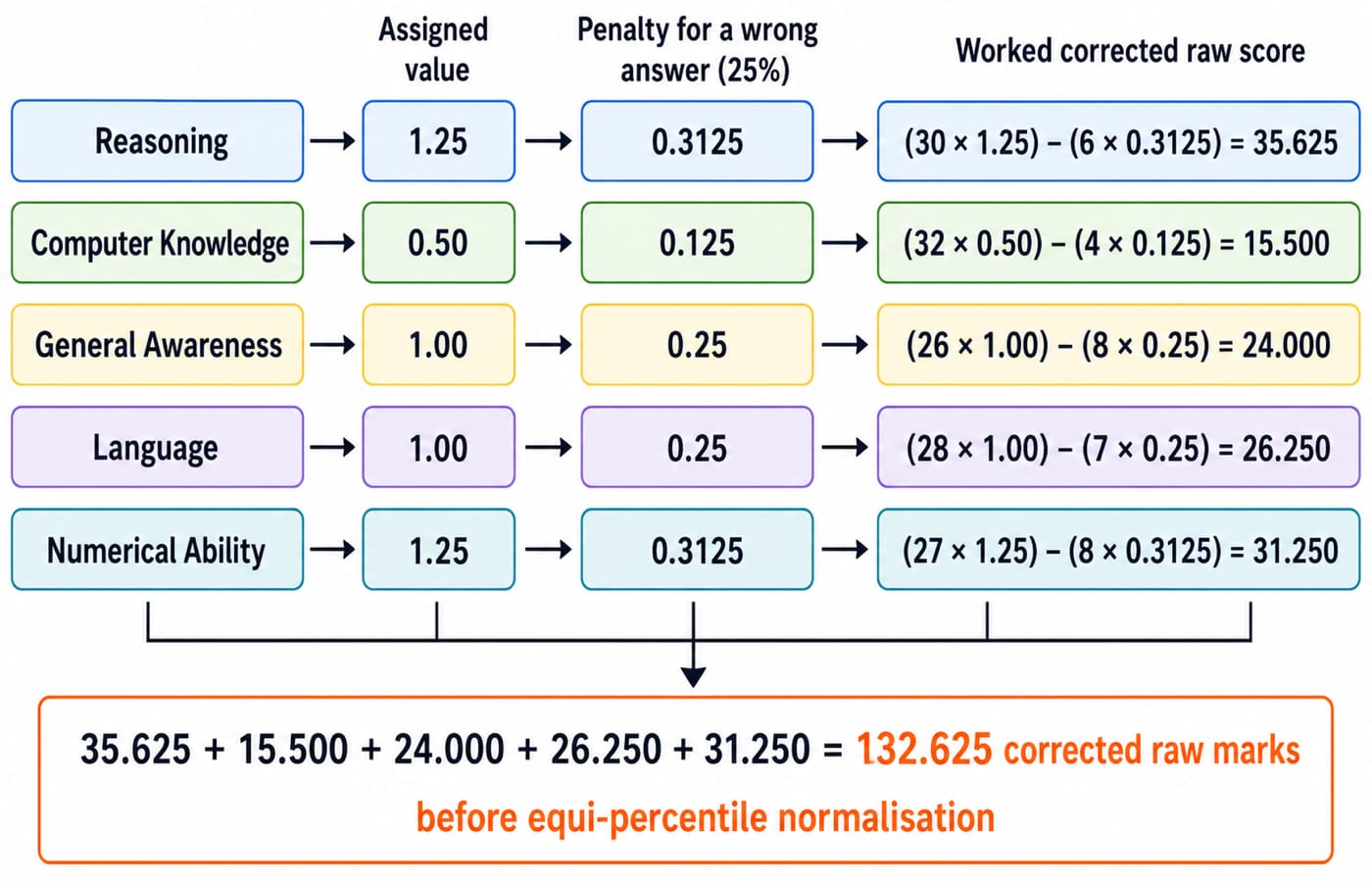
Thus, 35.625 + 15.5 + 24 + 26.25 + 31.25 = 132.625 out of 200. This is an arithmetic illustration, not a target score.
5. Cutoffs, normalisation and final merit are different
A sectional minimum applies to one test. Shortlisting applies category and official requirements. Final merit in this notice used only Main marks.
The cited notification said corrected scores across sessions were normalised by the equi-percentile method, using up to two decimals. The worked 132.625 is the corrected raw total before that process, not the normalised score IBPS uses for merit and reports to the candidate.
6. Turn the pattern into a realistic practice allocation
One editorial 10-hour drill, not an IBPS rule: 2 hours each for Reasoning and Numerical Ability; 45 minutes each for Computer Knowledge, General Awareness and language; 1 hour 45 minutes for sectionals; and 2 hours for full-test review. Check: 2 + 2 + 0.75 + 0.75 + 0.75 + 1.75 + 2 = 10 hours.
Log test, question value, correct, wrong, blank, penalty, and corrected raw score. With 55 correct, 13 wrong and 12 blank, 55 - (13 x 0.25) = 51.75. Then 59 correct, 9 wrong and 12 blank gives 59 - (9 x 0.25) = 56.75, up 5.00 marks. Review accuracy and time, not attempts.
For an RRB aspirant, the IBPS Clerk CSA Prelims course and IBPS Clerk CSA Mains course provide structured practice in shared bank-exam skills, while the question bank adds drills across Reasoning, Mathematics and Aptitude, General Awareness, and Verbal Ability (English). Use them to build speed, accuracy and review habits around topics that overlap with the current RRB syllabus.
7. Short version: what to verify before the exam
Check five items for the current cycle:
Official post name.
Number of selection stages.
Section names and language choice.
Questions, marks and durations.
Penalty, cutoffs, normalisation and merit rules.
Verify them in the current notice and handout. Download the current notification, copy both tables, recalculate each penalty, then take one timed diagnostic before choosing a study sequence.
Download the current notification, copy both tables, recalculate each penalty, then take one timed diagnostic before choosing a study sequence.
Go deeper with the full courseIBPS PO Prelims
Keep learning
IBPS RRB Clerk Paper Analysis Method: Recurrence, Difficulty Drift and Attempt Priorities
Learn how to separate the official RRB Office Assistants pattern from memory-based evidence, count recurring formats correctly, measure workload and build a 12-hour plan.
Updated 12 Nov 20265 min readIBPS Exams
IBPS RRB Clerk Syllabus: Prelims and Mains Topic Map
Separate RRB Office Assistants from the IBPS CSA exam, then turn each Prelims and Mains section into a clear study and self-testing plan.
Updated 4 Nov 20264 min readIBPS Exams
IBPS RRB Clerk Eligibility and Selection Process: Who Can Apply and How Selection Works
Check whether you can apply for IBPS RRB Office Assistant (Multipurpose), then follow the path from prelims screening to mains-based merit and provisional allotment.
Updated 2 Nov 20264 min readIBPS Exams
IBPS RRB PO Preparation Mistakes: 6 Costly Errors and Their Fixes
Hard work helps only when each mock changes the next week's plan. Use six measurable corrections to control weak areas, accuracy, revision and resources.
Updated 10 Nov 20265 min readIBPS Exams