C++ Programming: Complete Guide to Core Concepts with Worked Examples
Build a connected mental model of C++ through exact traces for references, pointers, virtual dispatch and STL operations, then learn how to check common traps.
KnowledgeGate Team
Exam prep & CS education
Updated 29 Jul 20267 min read
Many learners can write isolated C++ syntax but lose marks when references, lifetime, overload resolution and virtual dispatch interact. The real skill is tracing state, aliases, and compile-time versus runtime decisions. Three traces make that concrete: an aliased array rewritten through a pointer, a virtual call reached through a base reference, and an STL sort, search and accumulate sequence priced by its complexity.
For a structured path with graded practice alongside these traces, use the C++ Programming Course: Concepts, MCQs & Coding.
1. C++ programming mental model: source code, types and execution
C++ is compiled, statically typed and multi-paradigm. Its path is source file -> preprocessing -> compilation -> object code -> linking -> executable. Overload resolution and template instantiation happen at compile time; virtual dispatch through a base reference or pointer happens at runtime.
Tokens include identifiers, keywords and operators. Expressions compute values; statements direct execution; scope controls visibility; storage duration controls how long storage exists; and type defines valid values and operations. That first idea is also where a compiler begins: lexical analysis splits a source file into tokens and lexemes before a single C++ rule is applied.
Unlike C, C++ includes references, classes, constructors, destructors, overloading, templates, and a standard library. Calling it "C with classes" understates the difference: the type, lifetime and abstraction rules are what actually change.
2. C++ data types, control flow and functions
Types decide what an operation means, not what you were hoping for. With int n = 9;, n / 2 is 4 and n % 2 is 1 because both operands are integers; write n / 2.0 and n converts to double, giving 4.5. auto takes whatever type the initialiser deduced. Never assume a fixed byte width for int: the width is implementation-defined, so use what sizeof reports or what the question states.
Control flow is just as literal. In int s = 0; for (int i = 1; i <= 4; ++i) if (i % 2) s += i; the guard passes only for i = 1 and i = 3, so s ends at 1 + 3 = 4. Functions package such behaviour behind a name, which is where parameter passing starts to matter.
Pass by value and pass by reference differ in what a parameter denotes:
void bump(int x, int& y) { x += 2; y += 2; }

int a = 5, b = 5;
bump(a, b);
The call copies a into local x, so x becomes 5 + 2 = 7 and disappears. Since y aliases b, b becomes 5 + 2 = 7. The caller has a = 5, b = 7. A const reference prevents modification through the alias.
A declaration introduces a function and its type; a definition supplies the body. Default arguments fill omitted trailing arguments. From an overload set, the compiler must find one best viable function. Runtime overriding is different.
3. C++ references, pointers and lifetime: a worked memory trace
An object occupies storage, an address identifies it, a pointer stores an address, and a reference aliases an object. Locals have automatic storage duration; dynamic objects need explicit or smart-pointer management. Lifetime decides whether an access means anything: the array in the next program lives until its enclosing block ends, so the alias and the pointer stay valid throughout, while a reference bound to a local inside a function dies the moment that function returns. Null, uninitialised or dangling pointers have no defined result when dereferenced.
Consider this exact program:
int a[]{2, 4, 6};
int& ref = a[1];
int* p = a;
ref += *p;
*(p + 2) = ref + 3;
std::cout << a[0] << ' ' << a[1] << ' ' << a[2];
Initially, ref aliases a[1] = 4, while p points to a[0] = 2. Thus ref += *p gives 4 + 2 = 6 and {2, 6, 6}. Pointer arithmetic advances by elements, so p + 2 points to a[2]. The next assignment gives 6 + 3 = 9 and {2, 6, 9}. The only correct output is 2 6 9.
![Three adjacent stack cells labelled a[0] = 2, a[1] = 6, and a[2] = 9; an arrow p points to a[0], an alias arrow ref points to a[1], and an arrow p + 2 points to a[2], with the two updates annotated 4 + 2 = 6 and 6 + 3 = 9 and final output 2 6 9.](https://cdn.knowledgegate.ai/blog-assets/blog_asset_1784176680008_5fpgtw.jpg)
4. C++ classes and object lifecycle
A class combines data and member functions, with public and private enforcing an interface. In class Meter { int value; public: explicit Meter(int v) : value(v) {} void add(int d) { value += d; } int read() const { return value; } };, the constructor uses a member-initialiser list. After Meter m{10}; m.add(7);, m.read() is 10 + 7 = 17. Its const prevents modification through this.
For a local object, storage is obtained, members are initialised, the constructor runs, and the destructor runs at scope end. Prefer the rule of zero: std::string, std::vector and smart pointers manage copy, move and destruction.
Copy or move construction creates a new object; copy or move assignment replaces an existing object's state. Moving may transfer resources when the type permits. Some copies are elided by the standard itself and others only optionally, so the exact number of constructor calls is not something to guess in an answer.
5. C++ inheritance and virtual functions: a worked dispatch trace
Inheritance lets a derived class extend a base. Overriding supplies its virtual operation, selected at runtime by dynamic dispatch.
class Account {
protected:
    int balance;
public:
    explicit Account(int b) : balance(b) {}
    virtual int fee() const { return 10; }
    int net() const { return balance - fee(); }
    virtual ~Account() = default;
};

class Premium final : public Account {
public:
    using Account::Account;
    int fee() const override { return 4; }
};

Premium premium{100};
Account& view = premium;
std::cout << view.fee() << ' ' << view.net();
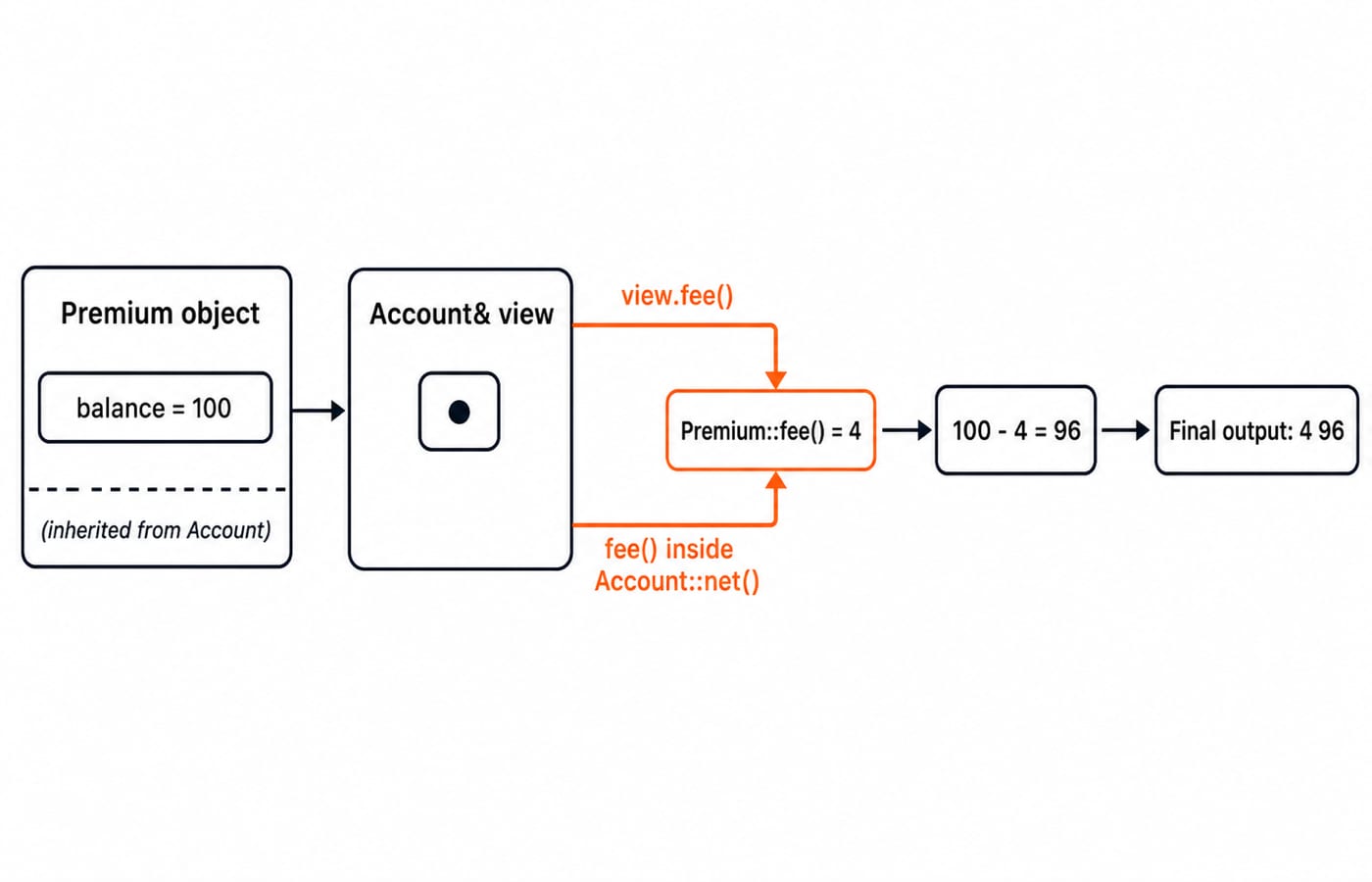
view.fee() dispatches to Premium::fee() and returns 4. view.net() enters Account::net(), where virtual fee() again selects Premium::fee(). Therefore 100 - 4 = 96, and the exact output is 4 96.
override catches signature mismatches. A polymorphic base needs a virtual destructor for deletion through a base pointer. Overloading is compile-time selection; overriding enables runtime dispatch. Copying a derived object into a base value slices its derived part.
6. C++ templates and STL: generic code with measurable costs
A function template is a compile-time pattern. For template<class T> T twice(T x) { return x + x; }, twice(7) is 14, and twice(2.5) is 5.0. The substituted T must support the required + operation.
The STL connects containers, iterators and algorithms. Sorting std::vector<int> v{4, 1, 4, 2} produces {1, 2, 4, 4}. Then std::lower_bound(v.begin(), v.end(), 4) - v.begin() is index 2, and std::accumulate(v.begin(), v.end(), 0) is 1 + 2 + 4 + 4 = 11.
Sorting has an O(n log n) comparison bound, binary search on this sorted random-access range uses O(log n) comparisons, and accumulation is O(n). std::vector is contiguous, std::map and std::set provide ordered access, and std::unordered_map provides hash-based access.
7. C++ questions in GATE-style tests and technical interviews
Questions fall into four buckets: output traces, compile-time diagnosis, lifetime or undefined-behaviour diagnosis, and design explanations covering encapsulation, inheritance, polymorphism, templates, STL and complexity. The answer format changes what a wrong trace costs, so check MCQ, MSQ or NAT? GATE Question Types Explained before deciding how long a single output question deserves. Our question bank carries more than 350 C++ questions, from tokens and data types through classes, constructors, overloading, templates and virtual functions, so each bucket can be drilled on its own.
Trap | Why it happens | What goes wrong | What to do instead |
|---|---|---|---|
| Types select integer or floating division | Expecting | Track types: results are |
Reference to a returned local | The local dies on return | The reference dangles | Return by value or use longer-lived storage |
Non-virtual base destructor | Deletion uses a base pointer | Derived cleanup is unsafe | Use a virtual destructor |
Derived object copied to base | Only the base part is copied | The derived part is sliced | Use a reference or smart pointer |
Uninitialised local read | No value was established | No deterministic output exists | Initialise before use |
Predict compile status and output, mark every alias and lifetime, then compile with warnings and explain mismatches. GATE Guidance by Sanchit Sir places this inside a broader subject sequence.
8. C++ programming short version and next step
Types and functions establish meaning; references and pointers establish access; lifetime determines validity; classes bind state and behaviour; virtual functions choose runtime behaviour; templates and STL generalise operations. Carry that dependency chain into every trace.
Rerun each trace with one change. For array {3, 5, 8}, 5 + 3 = 8, then 8 + 3 = 11, giving {3, 8, 11}. With Premium::fee() set to 6, the output is 6 94 because 100 - 6 = 94. With STL search key 3, lower_bound(3) in {1, 2, 4, 4} returns insertion index 2. Compute before compiling.
For a focused language path, the C++ Programming Course sequences these topics with graded practice at each step. If C++ must fit inside a wider GATE plan, browse the GATE CS Exam Preparation Courses & Test Series.
Keep learning
TypeScript vs C# Typing: Structural Compatibility, Nominal Identity, Generics and Runtime Checks
Follow one User/Admin example through TypeScript and C# to predict assignments, generic conversions, branded IDs, and JSON behaviour at runtime.
Updated 3 Oct 20266 min readProgramming Languages Survey
TypeScript Learning Roadmap: 20 Weeks from Everyday Types to a Full-Stack App
Follow a dependency-led TypeScript plan through BudgetLens, IssueBoard and TaskBoard, with exact weekly gates, strict checks and tested API boundaries.
Updated 28 Sep 20265 min readProgramming Languages Survey
Static vs Dynamic Typing: Errors, Feedback Loops and Refactoring Flexibility
Follow one OrderLine model from an integer price to an INR Money value. See what Java catches during checking, what Python reveals during execution, and what both still need tests to prove.
Updated 25 Sep 20265 min readProgramming Languages Survey
Kotlin vs C#: Compare Null Safety, Async Models, Ecosystems and Platform Fit
Compare Kotlin and C# by building the same packing model in both. See how their managed runtimes, null checks, async behaviour and ecosystems differ.
Updated 24 Sep 20266 min readProgramming Languages Survey