Planar Graphs and Kuratowski's Theorem: Homeomorphism, K5 and K3,3 Worked Examples
Learn why crossings and edge bounds can mislead, then expose a hidden K3,3 by suppressing degree-two vertices in a complete worked example.
KnowledgeGate Team
Exam prep & CS education
Updated 1 Sep 20266 min read61 views
A crossing in a sketch can mislead you: it may disappear after a redraw. The reverse trap is subtler. A graph can pass the usual edge-count test and still contain a forbidden nonplanar structure. For GATE CS preparation, you need a method that separates the drawing from the graph itself. Redrawing, arithmetic screens and Kuratowski's theorem expose whether a hidden obstruction is present.
Related reading: graph theory fundamentals and degree sequences and graph isomorphism.
Planar graph, plane graph and crossing: fix the language first
A planar graph is an abstract graph that has at least one drawing in the plane where edges meet only at common endpoints. A plane graph is one particular crossing-free embedding of a planar graph. Its regions, including the outer region, are faces. Planarity therefore belongs to the graph, not to the first picture you see.
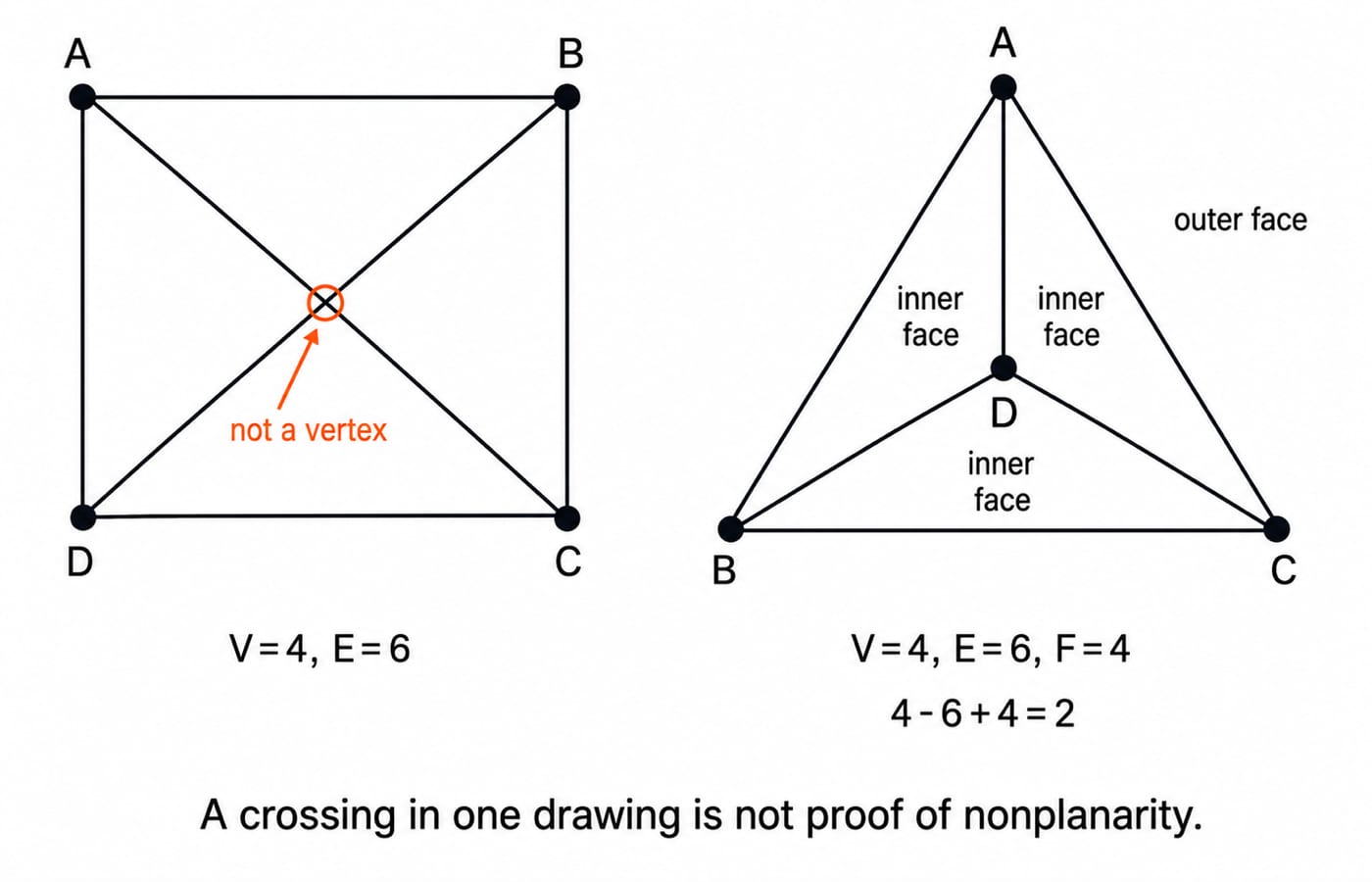
Take K4 with vertices {A,B,C,D} and edges {AB,AC,AD,BC,BD,CD}. Draw the cycle A-B-C-D-A as a square and add diagonals AC and BD. The diagonals cross, but that crossing is not a vertex. Now draw A,B,C as an outer triangle, put D inside, and join D to all three outer vertices. There are no crossings. Here V=4, E=6 and F=4, so V-E+F=4-6+4=2. From this language, move on to the wider properties in Graph Theory: Euler, Hamiltonian, Coloring for GATE CS, without assuming that Eulerian or Hamiltonian implies planar.
Use Euler and edge bounds as screens, not complete tests
For a connected plane graph, Euler's formula is V-E+F=2. Counting edge appearances around faces gives two useful necessary conditions for a simple connected planar graph with V>=3. In general, E<=3V-6. If the graph is bipartite, every facial boundary has length at least four, so the sharper condition is E<=2V-4.
Violating a bound proves nonplanarity. Satisfying one proves nothing by itself. For K5, V=5 and E=10, while 3V-6=3(5)-6=9. Since 10>9, K5 is nonplanar. For K3,3, V=6 and E=9. The general check gives 9<=3(6)-6=12, which is inconclusive. Because K3,3 is bipartite, use the sharper bound: 2V-4=2(6)-4=8, and 9>8 proves nonplanarity. If you want a wider mathematics route alongside this topic, Engineering Mathematics for GATE covers broader GATE mathematics preparation.
Kuratowski's theorem and what homeomorphism means
Kuratowski's theorem says that a finite graph is planar if and only if it contains no subgraph that is a subdivision of K5 or K3,3. Here K5 is the complete graph on five vertices, so every vertex has degree four. K3,3 is the complete bipartite graph with two parts of three vertices each, so every branch vertex has degree three.
A subdivision replaces an edge uv by a path such as u-x-v, where the new vertex x has degree two. Repeating that local move produces a graph homeomorphic to the original. Suppressing a degree-two subdivision vertex reverses the move. The forbidden structure needs to be only a subgraph, so you may first delete unused vertices and edges.
The word is homeomorphism, not homomorphism. A graph homomorphism is an adjacency-preserving map between vertex sets, and it is not Kuratowski's planarity test. Edge contraction appears in the minor characterisation of planarity, but contraction is not the homeomorphism operation used in this theorem.
Worked example: suppress a hidden subdivision and recover K3,3
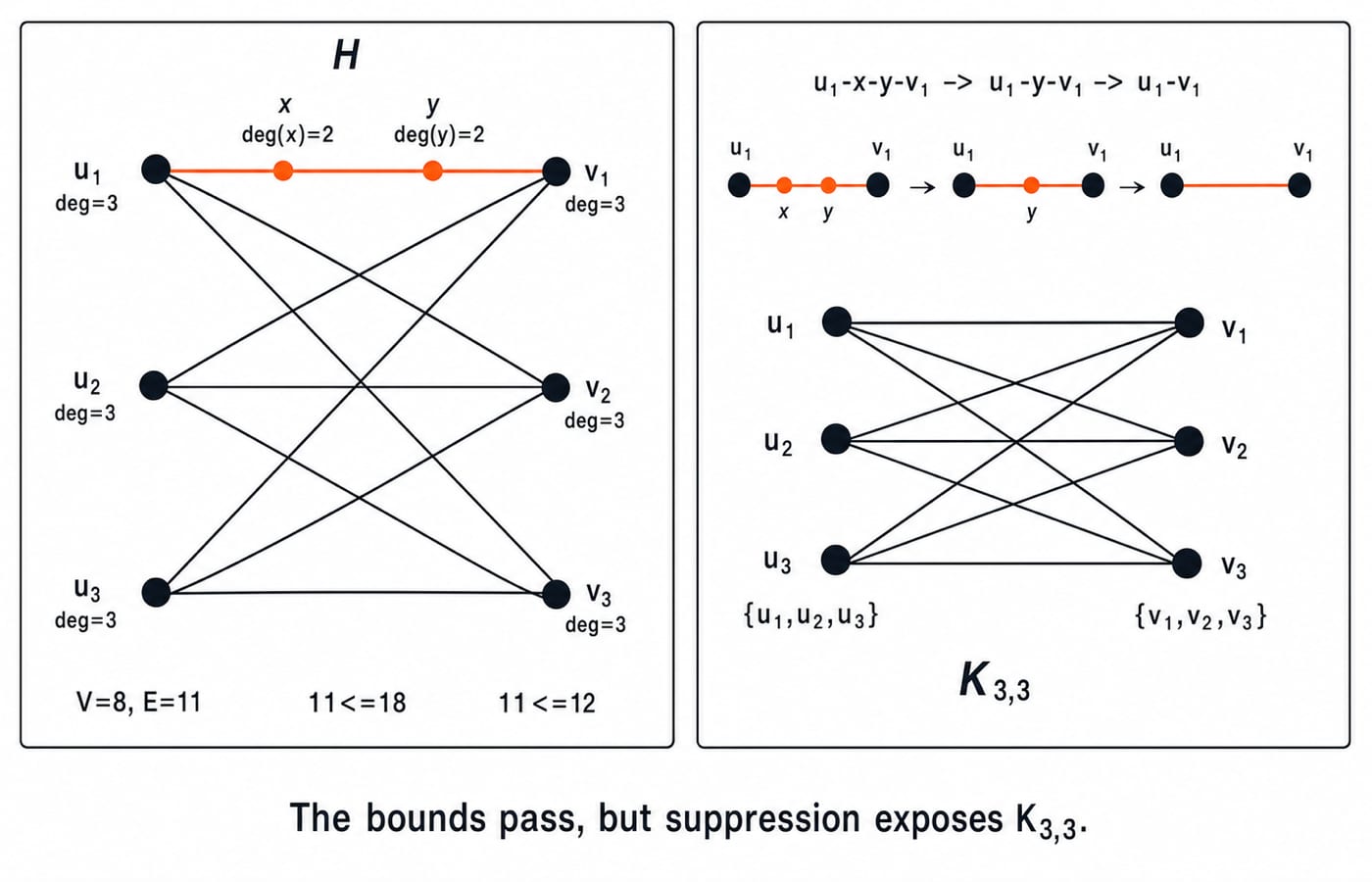
Define graph H with vertices
{u1,u2,u3,v1,v2,v3,x,y}
and edges
{u1x,xy,yv1,u1v2,u1v3,u2v1,u2v2,u2v3,u3v1,u3v2,u3v3}.
Each of u1,u2,u3,v1,v2,v3 has degree three. Vertices x and y each have degree two. The degree sum is therefore 6 x 3 + 2 x 2 = 18+4=22. By the handshaking lemma, 2E=22, so E=11; also, V=8.
Counting does not settle planarity. The general bound gives 11<=3(8)-6=18. Graph H is bipartite with parts {u1,u2,u3,y} and {v1,v2,v3,x}, but it also passes the bipartite bound: 11<=2(8)-4=12. Both results are inconclusive, not evidence that H is planar.
Now reverse the subdivisions one at a time:
Vertex
xhas neighboursu1andy. Suppressxby replacing edgesu1x,xywith the single edgeu1y.Vertex
ynow has neighboursu1andv1. Suppressyby replacingu1y,yv1withu1v1.
The counts trace the same reversal. Suppressing x removes one vertex and replaces two edges with one, leaving V=7 and E=10. Suppressing y does the same again, leaving V=6 and E=9, exactly the counts of K3,3. More importantly, endpoint connection u1-v1 is restored.
Six vertices remain. For every i,j in {1,2,3}, the edge uivj is present, and no edge lies within either part. The remaining graph is exactly K3,3 with parts {u1,u2,u3} and {v1,v2,v3}.
The conclusion is structural: H is a subdivision of K3,3; therefore H is homeomorphic to a Kuratowski obstruction; therefore H is nonplanar. The degree-two vertices did not cause nonplanarity by themselves. Their path preserved the connection between the correct branch vertices.
A reliable decision workflow for planarity questions
Use this order instead of jumping from a messy picture to a verdict:
Read the vertices and adjacencies. Do not trust the geometry of the given drawing.
Attempt a crossing-free redraw, as with
K4.Count
VandE. ApplyE<=3V-6, then applyE<=2V-4only after establishing bipartiteness.While seeking a forbidden subgraph, delete irrelevant leaves or extra edges and suppress degree-two chains without changing their endpoints.
Compare the remaining branch-vertex pattern with
K5andK3,3.
A crossing-free embedding proves planar. A violated necessary bound proves nonplanar. An exhibited subdivision of K5 or K3,3 also proves nonplanar. A passed bound means only “inconclusive”. For example, add a new leaf z and edge zu2 to H. When selecting the Kuratowski subgraph, delete z and zu2. The original K3,3 subdivision remains, so the larger graph is still nonplanar.
Traps that make a plausible proof invalid
Pair each tempting shortcut with its repair:
“The shown edges cross” must become “try another embedding”. The crossed square drawing of
K4becomes crossing-free after redrawing.“
E<=3V-6, so the graph is planar” must become “the necessary screen passed; inspect the structure”. GraphHpasses both bounds and still suppresses toK3,3.“I cannot see an induced
K3,3” must become “look for a subgraph that is a subdivision”. Kuratowski's theorem does not require an induced copy.“Homomorphism preserves planarity” must become “use homeomorphism through subdivisions”. Degree-two vertices help only when their paths join the correct branch vertices.
Extra vertices and edges outside a selected K5 or K3,3 subdivision cannot rescue the graph. Also keep Euler's formula in scope: use V-E+F=2 for a connected plane embedding as stated here. Do not count supposed faces in a drawing that still contains crossings.
How exam-style questions test the same ideas
Four rapid checks:
A simple graph has
V=7,E=16. Since3V-6=3(7)-6=15and16>15, it is nonplanar.A simple bipartite graph has
V=8,E=13. Since2V-4=2(8)-4=12and13>12, it is nonplanar.Graph
HhasV=8,E=11. It satisfies11<=18and11<=12, so the numerical conclusion is “inconclusive”.Suppressing
xandyinHrecovers exactlyK3,3, so the structural conclusion is nonplanar.
For terminology, replacing uv by u-x-v is subdivision. An adjacency-preserving vertex map is a homomorphism, not the relation used in Kuratowski’s theorem. Before choosing an option, write one reason: a redraw, an inequality, or a named recovered obstruction. Then practise the distinction with Graph Theory MCQs: 12 Solved Euler, Coloring, Trees.
Short version and the next practice step
A crossing belongs to a drawing, so try to redraw first. Edge bounds can disprove planarity, but they cannot certify it. When the bounds pass, search for a subdivision and suppress degree-two chains to expose K5 or K3,3. Use that order consistently. In the worked graph, u1-x-y-v1 suppresses to u1-y-v1, then u1-v1, recovering K3,3. If you want a structured route through wider GATE CS preparation, continue with GATE Guidance by Sanchit Sir.
Keep learning
One-to-One (Injective) Function: Definition, Counting Formula, Properties and Worked Examples
Learn how to identify and count injective functions, handle common restrictions, and prove their key composition and inverse properties with clear examples.
Updated 24 Oct 20266 min readEngineering Mathematics
Graphical Method in Linear Programming: Feasible Region, Corner Points and Optimality with a Worked Example
Learn the two-variable graphical method in the right order, then solve and audit a complete maximisation model without trusting the sketch alone.
Updated 21 Oct 20265 min readEngineering Mathematics

Duality in LP: Construct the Dual, Solve a Worked Example, and Apply Key Properties
Learn a reliable matrix-first method to form an LP dual, solve both programs to value 21, and use duality properties to check optimality and avoid sign errors.
Updated 17 Oct 20266 min readEngineering Mathematics

Commutative Property and Abelian Groups: Tests, Worked Examples and Exam Traps
Learn how to separate commutativity from the other group axioms, test custom operations step by step, and avoid the usual classification traps.
Updated 13 Oct 20266 min readEngineering Mathematics