

Number Representation Mistakes: Fix Signed Values, Complements and Overflow
The same eight bits can represent 234, −106, −21 or −22. Learn which convention controls the answer, how to preserve values when widening, and when carry-out does not mean signed overflow.
KnowledgeGate Team
Exam prep & CS education
Updated 4 Nov 20265 min read

You can convert every binary digit correctly and still get the wrong answer by choosing the wrong signed convention. The same bits can mean different values, so calculation must follow interpretation. These worked examples extend the Digital Logic notes with a small set of checks to make before calculating: identify the representation, fix the width and choose the correct arithmetic rule.
1. Reading the bits before choosing the representation
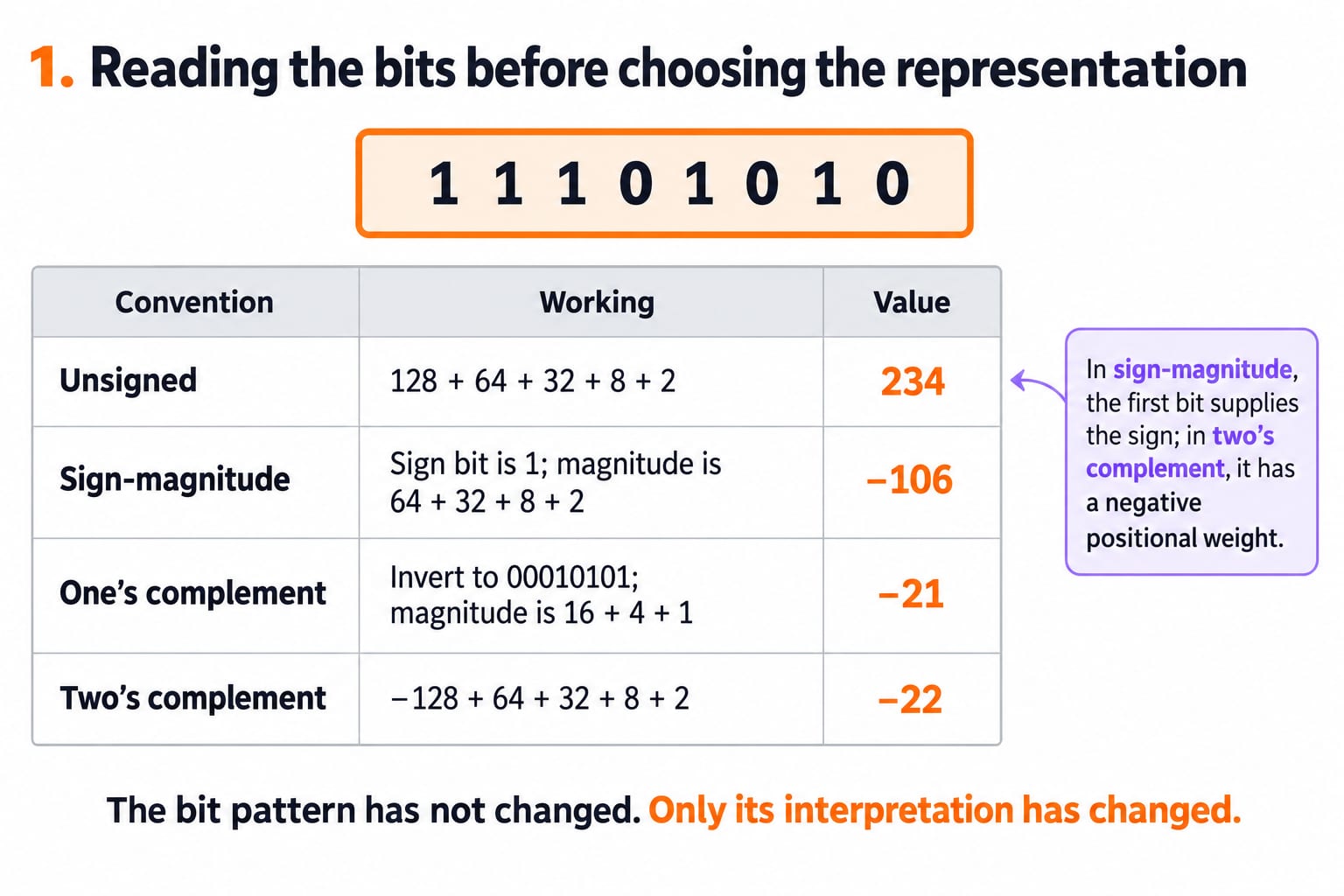
A leading 1 does not automatically mean a negative number. That shortcut fails whenever the pattern is unsigned, and even signed conventions disagree about its value.
Take the eight-bit binary pattern 11101010. All values in the final column below are decimal.
Convention | Working | Value |
|---|---|---|
Unsigned | 128 + 64 + 32 + 8 + 2 | 234 |
Sign-magnitude | Sign bit is 1; magnitude is 64 + 32 + 8 + 2 | −106 |
One's complement | Invert to | −21 |
Two's complement | −128 + 64 + 32 + 8 + 2 | −22 |
The bit pattern has not changed. Only its interpretation has changed. In sign-magnitude, the first bit supplies the sign; in two's complement, it has a negative positional weight.
Corrective habit: write “base 2, width 8, convention …” above your working. Without a stated convention, you cannot infer a signed value from the string alone.
2. Giving fractional bits the wrong weights
Integer place-value habits can mislead you after the radix point. Binary fractional columns have weights 2⁻¹, 2⁻², 2⁻³, meaning one-half, one-quarter and one-eighth.
For 101.101₂, work from the weights:
101.101₂ = 4 + 1 + 1/2 + 0/4 + 1/8 = 5.625₁₀.
Check the fractional part by repeated multiplication:
0.625 × 2 = 1.25: record 1, retain 0.25.0.25 × 2 = 0.5: record 0, retain 0.5.0.5 × 2 = 1.0: record 1, stop at remainder zero.
Read those recorded bits top to bottom, giving .101₂. Reversing them is the mistake: integer division remainders are read bottom to top, but fractional multiplication bits are not.
Label the columns first. For the broader conversion method, revisit number representation and complements.
3. Taking a complement without fixing the width
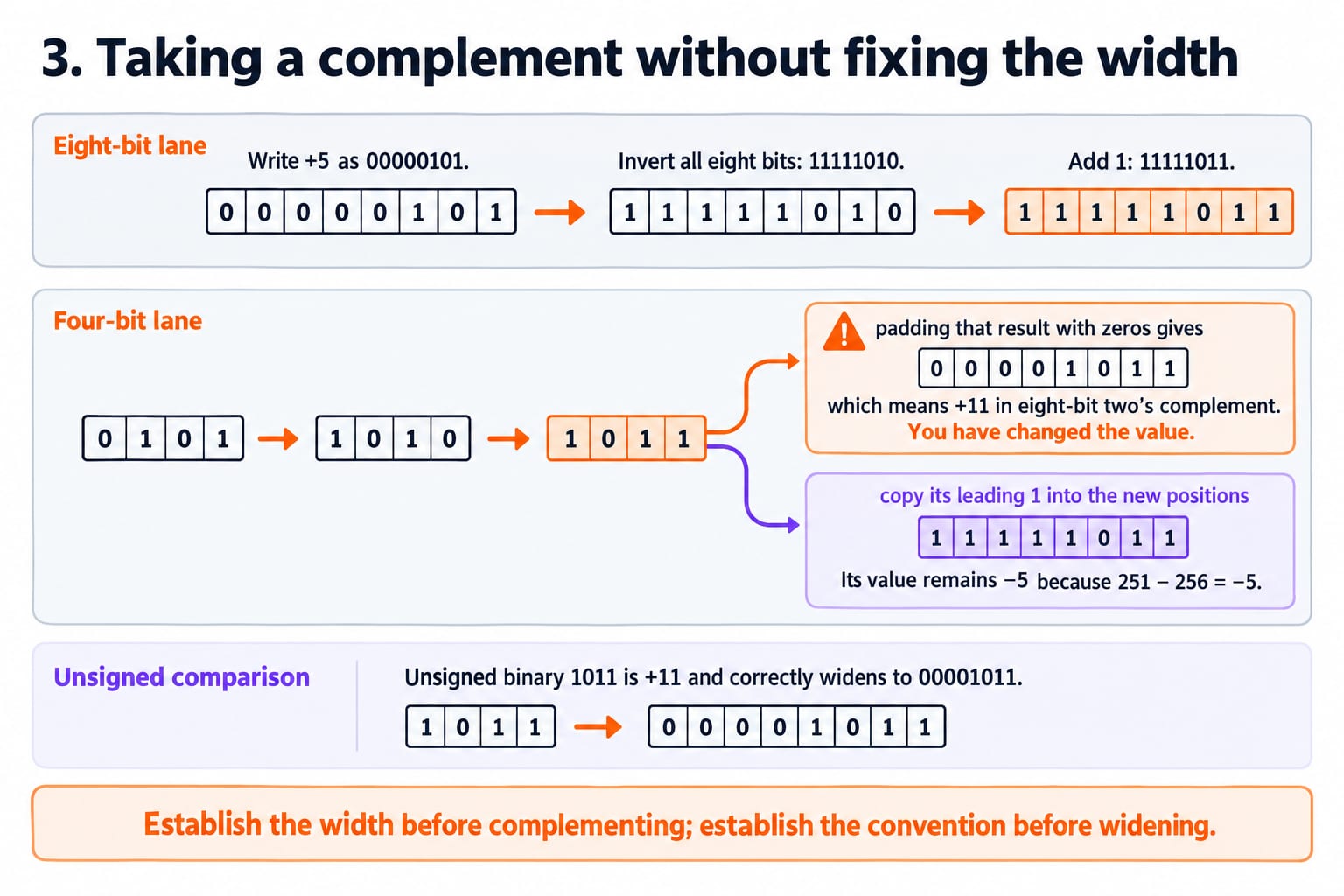
“Invert and add one” needs a width. Inverting four bits and inverting eight bits are different operations.
To represent −5 in eight-bit two's complement:
Write +5 as
00000101.Invert all eight bits:
11111010.Add 1:
11111011.
At four bits, the same procedure takes 0101 to 1010, then 1011. But padding that result with zeros gives 00001011, which means +11 in eight-bit two's complement. You have changed the value.
Instead, sign-extend the four-bit two's-complement pattern 1011: copy its leading 1 into the new positions to obtain 11111011. Its value remains −5 because 251 − 256 = −5.
Unsigned binary 1011 is +11 and correctly widens to 00001011. Establish the width before complementing; establish the convention before widening.
4. Assuming every signed range is symmetric
Thinking “one sign bit, seven value bits” suggests equal positive and negative endpoints. That works for sign-magnitude, but it misdescribes two's complement.
For eight-bit integers:
Representation | Decimal range | Zero encodings |
|---|---|---|
Unsigned | 0 through 255 | One |
Sign-magnitude | −127 through +127 | Two |
One's complement | −127 through +127 | Two |
Two's complement | −128 through +127 | One |
The n-bit two's-complement range is −2^(n−1) through 2^(n−1)−1. Thus, eight-bit 10000000₂ represents −128, while 01111111₂ represents +127.
Try negating the minimum: invert 10000000 to 01111111, then add 1. You get 10000000 again. The intended answer, +128, is outside the range, so this is overflow, not a valid positive result. Check the range before accepting a negation.
5. Using carry-out as the signed-overflow test
Unsigned and signed addition use the same bit addition. Their overflow tests answer different questions, which makes carry-out an easy trap.
For eight-bit two's-complement addition:
01111111 + 00000001 = 10000000
The operands are +127 and +1. Their mathematical sum is +128, but the stored result represents −128. There is signed overflow even though there is no carry-out from the eighth bit.
Now compare:
11111111 + 00000001 = 1 00000000
Under two's complement, this is −1 + 1 = 0. Discard the ninth bit, leaving 00000000; no signed overflow occurs. Under unsigned interpretation, the same addition is 255 + 1 = 256, which exceeds the eight-bit maximum and does overflow.
For signed addition, two operands with the same sign producing a stored result with the opposite sign signal overflow. Mixed-sign addition cannot overflow: the sum stays between the operand values.
Write the operand signs before adding, then compare the result's sign. Apply that distinction in the two’s complement practice questions.
6. Carrying the one's-complement rule into two's-complement subtraction
Both methods complement the subtrahend, but their carry rules differ. Mixing them changes an otherwise correct answer.
For four-bit two's-complement subtraction, calculate 5 − 3 by encoding −3 as 1101:
0101 + 1101 = 1 0010
Discard the carry-out. The retained result is 0010₂ = 2₁₀. Adding the carry back would incorrectly give 0011₂ = 3₁₀.
For four-bit one's-complement subtraction, encode −3 by inverting 0011 to 1100:
0101 + 1100 = 1 0001
Here, add the end-around carry to the retained bits: 0001 + 0001 = 0010, again giving 2.
Write the representation name beside the subtraction before selecting a carry rule. Then check against the decimal calculation, 5 − 3 = 2.
7. Finish with a representation check, not another guess
Before accepting an answer, check four things:
Base: are the integer and fractional weights correct?
Width and convention: how many bits, and which interpretation?
Range: can the mathematical answer fit?
Arithmetic rule: should you discard carry, add it around or test signed overflow?
For example, 10000000 means 128 as eight-bit unsigned binary and −128 as eight-bit two's complement.
Redo one example from each mistaken rule with the convention written down, then check the decimal result. For structured study beyond these corrections, the Digital Electronics course is an optional next step.
Go deeper with the full courseDigital Electronics
Keep learning

Number Representation in Digital Electronics: Conversions, Complements and Worked Examples
Learn number representation through exact conversions, signed encodings, binary arithmetic, special codes, fixed point and IEEE 754 worked examples.
Updated 11 Aug 20266 min read67 viewsDigital Logic

C Fundamentals Mistakes: Fix 11 Data-Type, Operator and Flowchart Errors
Short C expressions can hide strict rules. Diagnose and repair 11 common errors involving initialisation, conversions, operators, increments and flowcharts.
Updated 18 Nov 20265 min readC Programming & Data Structures

Bottom-Up Parsing Mistakes for GATE: Fix Errors That Cost Marks
Prevent the small LR parsing errors that spoil an otherwise correct solution. Trace two examples and use a final check for handles, states, GOTO, closure and acceptance.
Updated 1 Nov 20266 min readCompiler Design

SSC MTS Preparation Mistakes: 7 Habits to Fix Before Your Next Mock
Watching lessons daily but repeating errors in mocks? Diagnose seven preparation habits with worked examples, then choose one repair to test over the coming week.
Updated 30 Oct 20265 min readSSC MTS