NIACL Preparation Strategy: Balance Aptitude with Insurance Awareness
Use a diagnostic to divide 14 weekly hours across aptitude, insurance awareness, English, role-specific study and mock analysis, then adjust without panic.
KnowledgeGate Team
Exam prep & CS education
Updated 22 Jul 20265 min read

Candidates comfortable with bank-style quant and reasoning often postpone insurance awareness, then find in the last fortnight that it is the section deciding their score. Speed in quant does not buy balance. A 90-minute diagnostic settles the split, awareness takes the larger share of a 14-hour week early, and the ratio moves only when a mock says it should.
1. Fix the NIACL route before fixing the timetable
Open the most recent recruitment notice on the official NIACL website. That notice is where the current stages, marks, timing and dates live. Make a four-row scope sheet: aptitude and reasoning, English, insurance or general awareness, and any role-specific or professional component. Leave untested rows blank. Never apply one Bank PO, AO, Assistant or IT Specialist structure to another route.
Use two columns: skills already practised and NIACL-context gaps. Put arithmetic, data interpretation, puzzles and reading in the first only after a diagnostic confirms them. Put insurance vocabulary, institutions, products and dated developments in the second. Use the Banking and Insurance category to close that second column, one topic at a time.
2. Run a 90-minute diagnostic and let the gap set the split
Build your own 100-question diagnostic: 30 quant, 30 reasoning, 20 English and 20 insurance-awareness questions. Hold it to 90 minutes, so the clock shows where speed and recall break down rather than what you could solve untimed.
Suppose the result is:
Area | Correct / attempted | Attempt accuracy |
|---|---|---|
Quant | 24 / 27 | 24 / 27 = 88.9% |
Reasoning | 25 / 28 | 25 / 28 = 89.3% |
English | 15 / 18 | 15 / 18 = 83.3% |
Insurance awareness | 6 / 17 | 6 / 17 = 35.3% |
Chasing skipped quant questions feels comfortable, but awareness is the larger gap. Start a 14-hour week with 5 hours for awareness, 4 for aptitude and reasoning, 1.5 for English, 1.5 for role-specific study if the current notice requires it, and 2 for revision or test analysis. Read your own numbers the same way: if awareness already clears 70% accuracy, cut that block to 3 hours and move the two hours into timed sectionals.
3. Use a three-phase 12-week plan, not one static ratio
Phase | Awareness | Aptitude | English | Role-specific | Testing and analysis | Total |
|---|---|---|---|---|---|---|
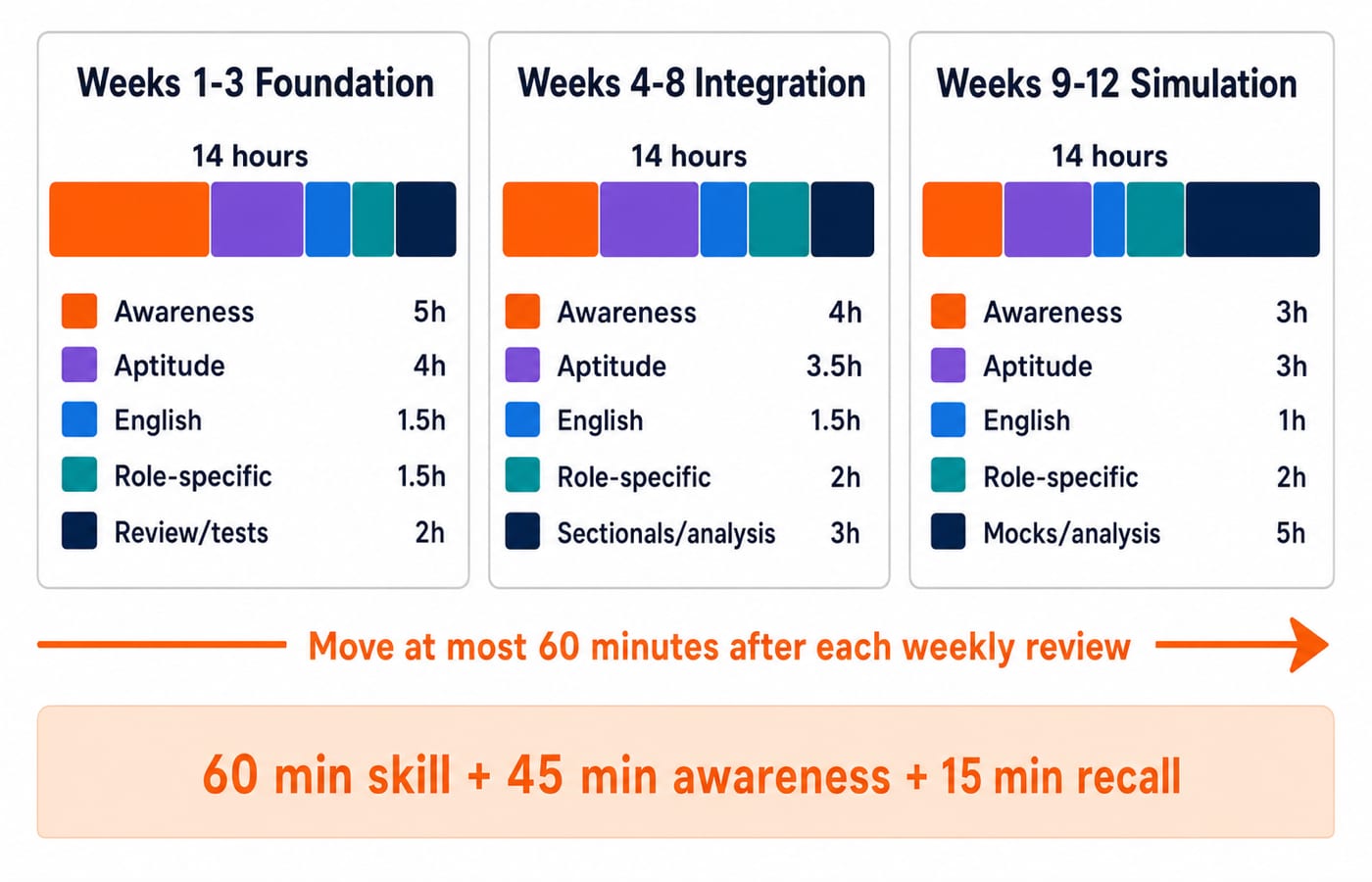
Weeks 1 to 3, foundation | 5h | 4h | 1.5h | 1.5h | 2h review/tests | 14h |
Weeks 4 to 8, integration | 4h | 3.5h | 1.5h | 2h | 3h sectionals/analysis | 14h |
Weeks 9 to 12, simulation | 3h recall | 3h repair | 1h | 2h | 5h mocks/analysis | 14h |
On weekdays, pair a 60-minute aptitude or role-specific block with 45 minutes of awareness and 15 minutes of recall or error-log work. Keep both active weekly. The calendar-agnostic banking preparation plan can organise that rhythm.
After review, move at most 60 minutes in next week's allocation based on accuracy and error type. Never drop a section after one good mock.
4. Build insurance awareness as a concept-to-news ladder
Learn in three layers. First cover risk, premium, policyholder, insurer, sum insured, indemnity, insurable interest, subrogation, underwriting and reinsurance. Next come products, claims, grievance routes, distribution and institutional roles. Finally, attach dated developments to them. Give each item four fields: date, institution, what changed and why it matters.
In a simple pooling example, 10,000 policyholders contribute 500 units each: 10,000 x 500 = 50,00,000 units. Paying 100 covered losses at 40,000 units each uses 100 x 40,000 = 40,00,000 units. That leaves 50,00,000 units - 40,00,000 units = 10,00,000 units before expenses, reserves and other costs. That surplus is the whole mechanism: many small contributions fund a few large payouts. Move either number far enough and you can see why underwriting and reinsurance exist.
End with a five-card recall check. One card asks which principle may let an insurer pursue the responsible third party after compensating a covered loss. Answer: subrogation. The static-plus-current banking-awareness method transfers cleanly here. Keep its split between a static core and dated developments, and swap the IBPS examples for insurance ones.
5. Maintain aptitude with a minimum effective dose
During foundation, do three weekly training sets: 20 quant questions in 25 minutes, 20 reasoning questions in 25 minutes, and 20 mixed questions in 20 minutes. Each one fits inside a working evening. Tag each wrong or skipped item as concept, calculation, reading, selection or time.
In Week 1, 16 correct out of 20 gives 16 / 20 = 80% in 25 minutes. The four errors are two percentage errors, one ratio error and one calculation slip. After two 15-minute percentage-and-ratio repairs, Week 2 reaches 18 / 20 = 90% in the same time. Set your own gate of at least 85% in two consecutive sets before adding speed pressure. The topic ladder in this Bank PO quantitative aptitude guide tells you which repairs to run first.
6. Make mock analysis decide the next week
In a 100-question mixed mock, 82 attempts with 64 correct and 18 wrong give 64 / 82 = 78.0% attempt accuracy. Score it without a penalty unless the current notice states a negative-marking rule.
Classify the 18 errors: 7 concept gaps (5 insurance and 2 aptitude), 5 calculation or reading slips, 4 time traps and 2 low-confidence guesses. Redistribute existing hours: 75 minutes for insurance gaps, 30 for aptitude gaps, 45 for slip correction, 45 for timed selection and 30 for no-guess discipline. Evidence changes the timetable.
Spend 150 minutes after each full mock: 30 recording attempts and accuracy, 60 classifying every wrong or skipped item, 45 re-solving without a timer and 15 updating next week's blocks. Finish before another mock.
7. Protect the final fortnight and recover missed days without panic
Days 14, 10 and 6 are full simulations, run to whatever structure and duration the current notice states. Days 13, 9 and 5 are 120-minute analysis sessions. On Days 12, 8 and 4, use 45 minutes for aptitude, 45 for awareness recall and 30 for role-specific repair. Days 11, 7 and 3 repair the weakest error tag. Days 2 and 1 mean light recall, document or centre checks, sleep and no new chapters.
If Wednesday's two-hour session is lost, recover 30 minutes on Thursday, 30 on Friday and 60 in Sunday's buffer. That restores 120 minutes without a four-hour punishment session or borrowing from sleep.
The short version
Diagnose first, give unfamiliar insurance topics more time early, keep aptitude warm, then shift towards simulations and analysis. NIACL AO IT Specialist candidates can review the NIACL AO IT Specialist course, which carries the role-specific block. Everyone else, work the Banking and Insurance category alongside the most recent official NIACL notice.
Keep learning

NIACL AO Cutoff Trends: Set a Practical Target Score
Read NIACL published Generalist and IT Specialist cutoffs without mixing stages or streams. Apply declared buffers and sectional checks to set a practical mock target.
Updated 21 Aug 20264 min readNIACL
NIACL Assistant Regional Language Test: 14-Day Preparation Plan
Build regional-language confidence through a clear diagnostic, daily drills, an error log, and a light final-day review. Use this plan alongside your current NIACL call letter.
Updated 20 Aug 20265 min readNIACL

NIACL AO vs Assistant: Choose by Role, Mobility and Exam Track
Compare NIACL's AO and Assistant routes using past official notices, then choose with mobility filters, preparation deltas and a five-point fit test.
Updated 18 Aug 20265 min readNIACL

NIACL AO Role: Underwriting, Claims and Career Paths Explained
NIACL AO work before you choose the exam: underwriting, claims and administration, the Generalist and Specialist routes, and where a career can go.
Updated 16 Aug 20265 min readNIACL