NIACL Insurance Awareness: Master Policies, Principles and Key Terms
Learn to separate policy types, insurance principles, and document terms. Then use worked car and warehouse examples to calculate indemnity and contribution correctly.
KnowledgeGate Team
Exam prep & CS education
Updated 25 Jul 20268 min read

Policy types, contract principles, and policy-document terms are often memorised as one flat list. That is why sum insured, indemnity, subrogation, and contribution start sounding interchangeable in a question. A better method is to classify the idea first and recall its definition second, so a first-time aspirant can identify what a question is testing before choosing an answer. At NIACL, The New India Assurance Company Limited, that habit maps onto the business itself: a public-sector general insurer whose Administrative Officers work inside underwriting and claims. Keep the NIACL preparation category beside you for the broader study context.
Build the three-part insurance map
A policy is the contract and cover arrangement. A principle is a rule governing its formation or operation. A term is vocabulary used inside it.
A motor policy shows the hierarchy: the policy is the contract, indemnity helps determine the covered loss payment, and the deductible is an amount applied under its terms.
Use this classification test:
“What is being insured?” points to a policy type.
“Which rule governs the contract or claim?” points to a principle.
“Which word names a document field, party, amount, or event?” points to a key term.
Every rule governing the contract or claim belongs to one of six principles: utmost good faith, insurable interest, proximate cause, indemnity, contribution, and subrogation. In that order they form a chain from disclosure to recovery: what you must reveal, what stake you must hold, what caused the loss, how much is paid, how overlapping cover is split, and who is pursued afterwards.
Classify policies before applying a principle
Class | Risk or subject | Typical example | Indemnity or benefit logic |
|---|---|---|---|
Life insurance | Human life | Death cover | Generally an agreed benefit, not simple indemnity |
Health insurance | Medical events or expenses | Hospital cover | Reimbursement or fixed benefit |
Property insurance | Physical property | Warehouse fire cover | Often indemnity-based |
Motor insurance | Vehicle and related liabilities | Car damage cover | Own damage commonly uses indemnity |
Marine insurance | Marine interests | Cargo transit cover | Commonly indemnity-based |
Liability insurance | Legal liability | Public liability cover | Covered liability, subject to terms |
Reinsurance | An insurer's accepted risk | Risk transferred by insurer | Between insurer and reinsurer |
A fire-damaged warehouse points to property insurance. Hospital expenses reimbursed up to covered costs illustrate indemnity-style health cover. A fixed amount on a defined insured event illustrates benefit cover. General insurance is a broad business class, while property, motor, marine, health, and liability describe subjects or cover lines within it. That line matters at NIACL: New India Assurance writes general insurance, so fire, motor, marine, health and liability are the working rows of this table, and the life row is there to mark the boundary. It is also why indemnity, contribution and subrogation do most of the work in a non-life claim, while a life policy usually pays an agreed benefit on the insured event.
Learn the six insurance principles as one chain
Utmost good faith (disclose): both parties must disclose every material fact honestly, and a material fact is one that would influence the insurer's decision to accept the risk or to price it. Concealing a known illness on a health proposal is the classic breach, and it can make the contract voidable.
Insurable interest (connection): the insured must hold a legally recognised stake in the subject matter, so that its loss causes the insured real financial harm. You can insure your own warehouse but not a stranger's, because only your own loss creates the connection the contract requires.
Proximate cause (cause): when several events form a chain that ends in loss, the claim is judged by the dominant, most effective cause in that chain, not simply the first or the last event in time. If that dominant cause is a covered peril, the loss falls within the cover.
Indemnity (restore): the payment restores the insured to roughly the financial position held just before the loss, never a better one. That is why a claim calculation starts from the assessed covered loss, with the sum insured acting only as the ceiling.
Contribution (share): when the same interest is covered against the same peril by more than one indemnity policy, the insurers share the loss in proportion to their covers. The insured collects the loss once, split across the policies, never once per policy.
Subrogation (recover): after paying an indemnity claim, the insurer steps into the insured's legal position and may pursue the third party responsible for the loss, subject to the contract and law. The insured gives up that recovery right to the extent of the payment, which blocks double compensation.
Suppose a warehouse is valued at INR 20,00,000 and its secured loan outstanding is INR 8,00,000. The owner can suffer the property loss. The lender's financial exposure is limited by the outstanding debt, not automatically the full property value.
The sequence matters. Disclosure comes before cover. Insurable interest creates the relevant connection. Proximate cause tests the loss, indemnity measures payment, contribution shares overlapping liability, and subrogation addresses third-party recovery after payment.
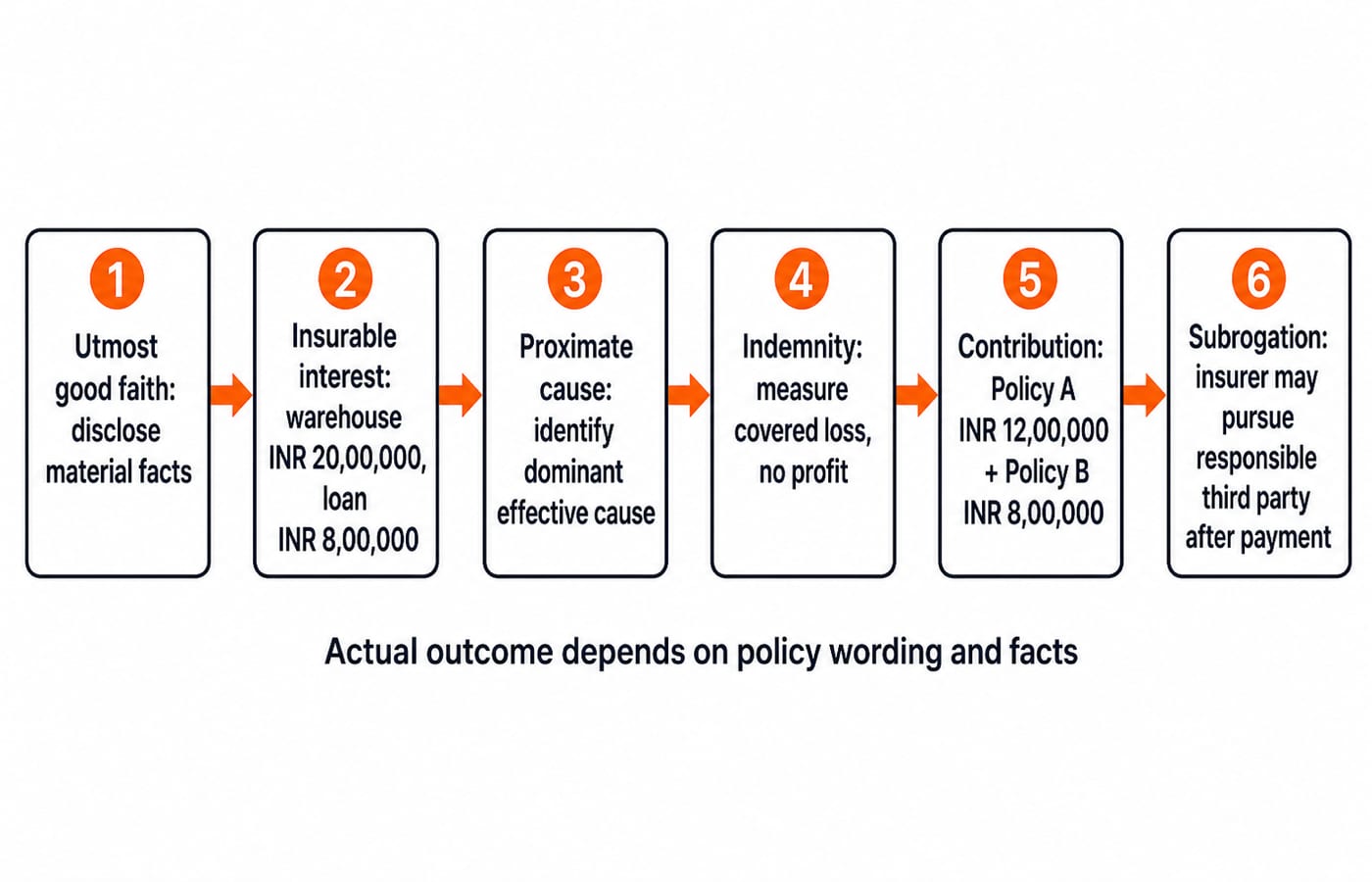
Worked examples: indemnity and contribution
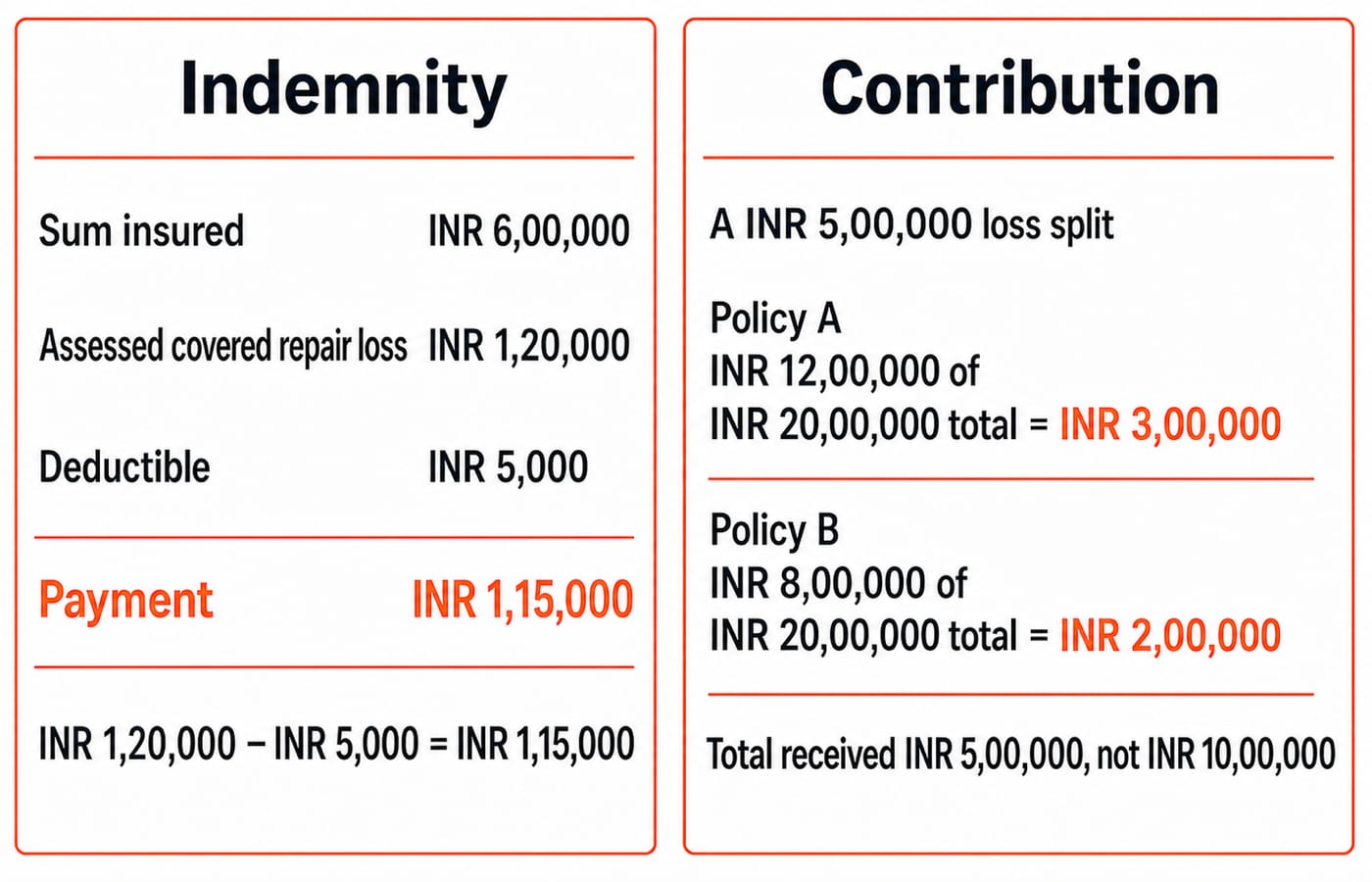
Example A: calculate an indemnity payment. A car has a policy sum insured of INR 6,00,000. A covered accident causes an assessed repair loss of INR 1,20,000, and the applicable deductible is INR 5,000. Assume there is no depreciation, salvage, underinsurance, tax, exclusion, or other adjustment.
Start with the assessed covered repair loss: INR 1,20,000.
Subtract the deductible: INR 1,20,000 − INR 5,000 = INR 1,15,000.
The INR 6,00,000 sum insured is a ceiling here, not an automatic payout. Because the covered loss is lower, the calculation starts at INR 1,20,000.
Example B: divide an overlapping loss. The same warehouse interest is validly covered against the same peril by Policy A for INR 12,00,000 and Policy B for INR 8,00,000. A covered loss is INR 5,00,000. Assume there is no deductible or other adjustment.
Total overlapping insurance = INR 12,00,000 + INR 8,00,000 = INR 20,00,000.
Policy A: 12/20 × INR 5,00,000 = INR 3,00,000.
Policy B: 8/20 × INR 5,00,000 = INR 2,00,000.
Total received: INR 3,00,000 + INR 2,00,000 = INR 5,00,000, not INR 10,00,000.
If an identifiable third party caused the accident, the insurer that paid INR 1,15,000 may seek recovery subject to the policy and law. The insured cannot receive double compensation for the same loss.
Read a policy from schedule to endorsement
Read in order: proposal and disclosures, schedule, definitions, insuring or operative clause, covered perils or benefits, exclusions, conditions, deductible or excess, claim procedure, and endorsements. An endorsement changes or adds to the base wording, so read both.
Consider a fictional schedule for Meera Traders, location 14 Market Road, period 1 April 2025 to 31 March 2026. It shows stock sum insured of INR 20,00,000, a INR 10,000 deductible, and listed perils of fire, lightning, and explosion. An endorsement adds stock kept in the rear storeroom.
Is a flood loss covered? The schedule alone cannot answer. Check the operative clause, definitions, exclusions, and endorsements before deciding.
Keep these terms separate:
Premium: the amount paid for cover.
Sum insured: the stated policy limit in this context.
Claim: a request under the policy.
Deductible or excess: the portion applied before insurer payment.
Peril: what causes loss.
Hazard: what affects loss likelihood or severity.
Endorsement: a documented change.
Fix the common insurance-awareness traps
The most common trap is reading the sum insured as the claim amount. It is a ceiling on what the policy can pay, not an automatic payout, so the assessed covered loss drives the calculation. A related error is assuming every policy works on indemnity; fixed-benefit covers instead pay an agreed amount on a defined insured event.
Candidates also swap subrogation and contribution. Subrogation concerns recovery from a responsible third party after the insurer has paid, while contribution concerns sharing one overlapping loss among insurers. Keep hazard and peril apart the same way: a peril causes the loss, while a hazard affects how likely or severe that loss is. Finally, do not assume a nominee is always the beneficial owner, because the legal effect depends on the product and the applicable law.
In a cause chain, the last event in time is not automatically the proximate cause. A covered event appearing somewhere in the chain also does not prove that a claim is payable. Read the policy wording and exclusions, then identify the dominant effective cause.
For a 20-second elimination routine, identify the policy class, locate the principle, test the numerical ceiling, and reject options that promise profit or double recovery from the same indemnity loss.
How a question can test this concept set
Four question shapes recur. Definition matching pairs a term with its meaning. A statement I/II item asks whether each claim describes a principle or a term. A short calculation asks for an indemnity payout or a contribution split. A mini-scenario gives the facts and asks for the policy class or the proximate cause.
Try this exact prompt: “A INR 5,00,000 covered loss is insured under two same-interest, same-peril policies of INR 12,00,000 and INR 8,00,000. Which pair gives the contribution?” The correct pair is INR 3,00,000 and INR 2,00,000. Distractors might offer INR 2,50,000 and INR 2,50,000, INR 5,00,000 and INR 5,00,000, or INR 12,00,000 and INR 8,00,000. The 12:8 ratio, not the number of insurers, controls this simplified split.
For the wider distinction between durable concepts and moving facts, read Banking Awareness for IBPS PO Mains: Static and Current. To decide how many weekly hours insurance awareness deserves against quant and reasoning, see NIACL Preparation Strategy: Balance Aptitude with Insurance Awareness.
The short version and next step
Disclose material facts.
Prove the relevant interest.
Find the dominant effective cause.
Measure the covered loss.
Share overlapping indemnity correctly.
Pursue responsible third parties only through the proper subrogation route.
Now redraw the six-box chain from memory on blank paper. Solve INR 1,20,000 − INR 5,000, then solve the 12:8 contribution split before opening more notes. Continue with the focused NIACL AO IT Specialist course, or use the Banking Exams blog hub for broader preparation reading.
Keep learning

NIACL AO Cutoff Trends: Set a Practical Target Score
Read NIACL published Generalist and IT Specialist cutoffs without mixing stages or streams. Apply declared buffers and sectional checks to set a practical mock target.
Updated 21 Aug 20264 min readNIACL

NIACL Assistant Regional Language Test: 14-Day Preparation Plan
Build regional-language confidence through a clear diagnostic, daily drills, an error log, and a light final-day review. Use this plan alongside your current NIACL call letter.
Updated 20 Aug 20265 min readNIACL

NIACL AO vs Assistant: Choose by Role, Mobility and Exam Track
Compare NIACL's AO and Assistant routes using past official notices, then choose with mobility filters, preparation deltas and a five-point fit test.
Updated 18 Aug 20265 min readNIACL

NIACL AO Role: Underwriting, Claims and Career Paths Explained
NIACL AO work before you choose the exam: underwriting, claims and administration, the Generalist and Specialist routes, and where a career can go.
Updated 16 Aug 20265 min readNIACL