NIACL AO Interview Preparation: Insurance Awareness and Role-Fit Grid
Build NIACL AO interview answers from your own evidence and official pages, then improve them through two recorded, scored mocks in a 13-hour, 10-day plan.
KnowledgeGate Team
Exam prep & CS education
Updated 2 Aug 20266 min read

After mains, it is easy to keep preparing as if another written paper is coming. Candidates memorise insurance abbreviations but leave their own background and decision-making examples vague. This plan uses a four-part grid covering personal evidence, insurance concepts, NIACL awareness and administrative scenarios, followed by a transcript-based mock loop. The worked plan needs 13 hours across 10 days and can extend if a day is lost. Use the Banking & Insurance category for broader preparation.
1. Start with the official brief, then build a four-part grid
Start with the current NIACL recruitment page and your call letter. Quote a date, venue, marks weighting, document requirement or discipline only where that notice or letter states it.
Build eight personal-background prompts, 12 insurance concept cards, six NIACL notes from three official pages, and six administrative scenarios. Each row needs prompt | source or evidence | 60-second answer | weak point | last checked.
Spend 60 minutes on background prompts, 120 on concept cards, 90 checking the three official pages and writing company notes, and 90 on scenarios. 60 + 120 + 90 + 90 = 360 minutes. Those 360 minutes only build the material; the drills and mocks below account for the remaining 420.
2. Turn personal history into evidence, not a biography
Prepare a 45 to 60-second opening: current identity, relevant evidence, reason for insurance administration, and why this NIACL route. The HR interview question guide covers the same beats generally, so rewrite each answer with insurance-administration evidence first.
Write eight prompts: the 60-second introduction, why insurance rather than banking, why an administrative post rather than a technical one, the gap between your last qualification and today, a decision taken against a deadline, a difficult customer you handled, something you got wrong and what changed after it, and where you expect to be three years into a general insurance career.
Take a candidate called Kavya. She completed B.Tech in 2023, handled an eight-month support internship, tracked about 30 tickets weekly, then prepared for competitive exams for 10 months. “I want a stable and prestigious job” is weak. Her stronger 55-second answer connects ticket triage, clear records and calm customer communication to administrative work.
Her evidence story is specific. A demo was 48 hours away, with 14 defects: four blockers, six major and four minor. She verified and assigned the blockers first, documented the queue, and closed all four before the demo. Your own story needs the same shape: a count, a triage rule, and a closed outcome before the deadline.
3. Learn insurance awareness as connected concepts
Build 12 cards for risk, premium, sum insured, deductible, indemnity, insurable interest, utmost good faith, proximate cause, contribution, subrogation, reinsurance and claim. For each, write a plain-English definition, example, contrast and likely follow-up. Check changing details on IRDAI's official pages.
These are not 12 independent terms. Insurable interest and utmost good faith decide whether the contract stands at all, proximate cause whether the loss falls inside the cover, indemnity caps recovery at the actual loss, and contribution and subrogation settle who pays and who recovers afterwards. NIACL insurance awareness: policies, principles and key terms works that chain through in full, so your cards only have to make each link sayable in 20 seconds.
Assessed damage is 80,000 and the deductible is 10,000. With valid cover, no exclusion and no other adjustment, 80,000 - 10,000 = 70,000. Indemnity prevents profit: the figure restores the loss and no more. In a live file the payable amount also turns on the policy wording and the surveyor's assessment, so never quote it as a settlement.
Take a 10-question sample from KnowledgeGate's bank of over 50 questions on the evolution of Indian banking and financial awareness. If seven are correct and three missed, explain each miss aloud for 60 seconds and retest all three after 48 hours. The static-and-current banking awareness guide separates durable concepts from facts needing a fresh check.
4. Build a one-page NIACL awareness sheet from official pages
Work from NIACL's official company profile, product pages and recruitment pages. Make six rows: exact name, official ownership or status wording, three product families, one recent official development, applied discipline, and one evidence-based reason for fit. Add a URL and last-checked date to each.
Scan the motor, health and marine product pages. For each, note one customer risk, one revision term and one service question. Never recall benefits, exclusions, waiting periods or claim promises from memory.
Answer in 60 seconds: 15 on verified identity, 20 on the three families, 15 on one current development and 10 connecting your evidence to the discipline.
5. Answer administrative scenarios without unauthorised promises
Use this order: acknowledge the person, verify facts and authority, identify permitted options, document the action, escalate when required, and set a follow-up. Where you do not know a rule, say you would check it rather than filling the gap with a guess.
At 3:20 pm, a customer brings an 80,000 motor-repair estimate. The incident was yesterday, no surveyor report is filed, and the customer wants a same-day payment promise. Acknowledge urgency, verify policy and incident details, explain authorised document steps, update the record, route it to the proper claims authority, and give only a permitted follow-up. Never promise 70,000, same-day settlement, acceptance or rejection.
Now prioritise 18 files: two deadline-bound matters, five waiting customers and 11 routine follow-ups, with the system unavailable for 30 minutes. Protect the deadlines, update the customers, use an approved contingency if available, record the outage, then resume the 11 files in a stated order.
6. Run two transcript-based mocks and score what you said
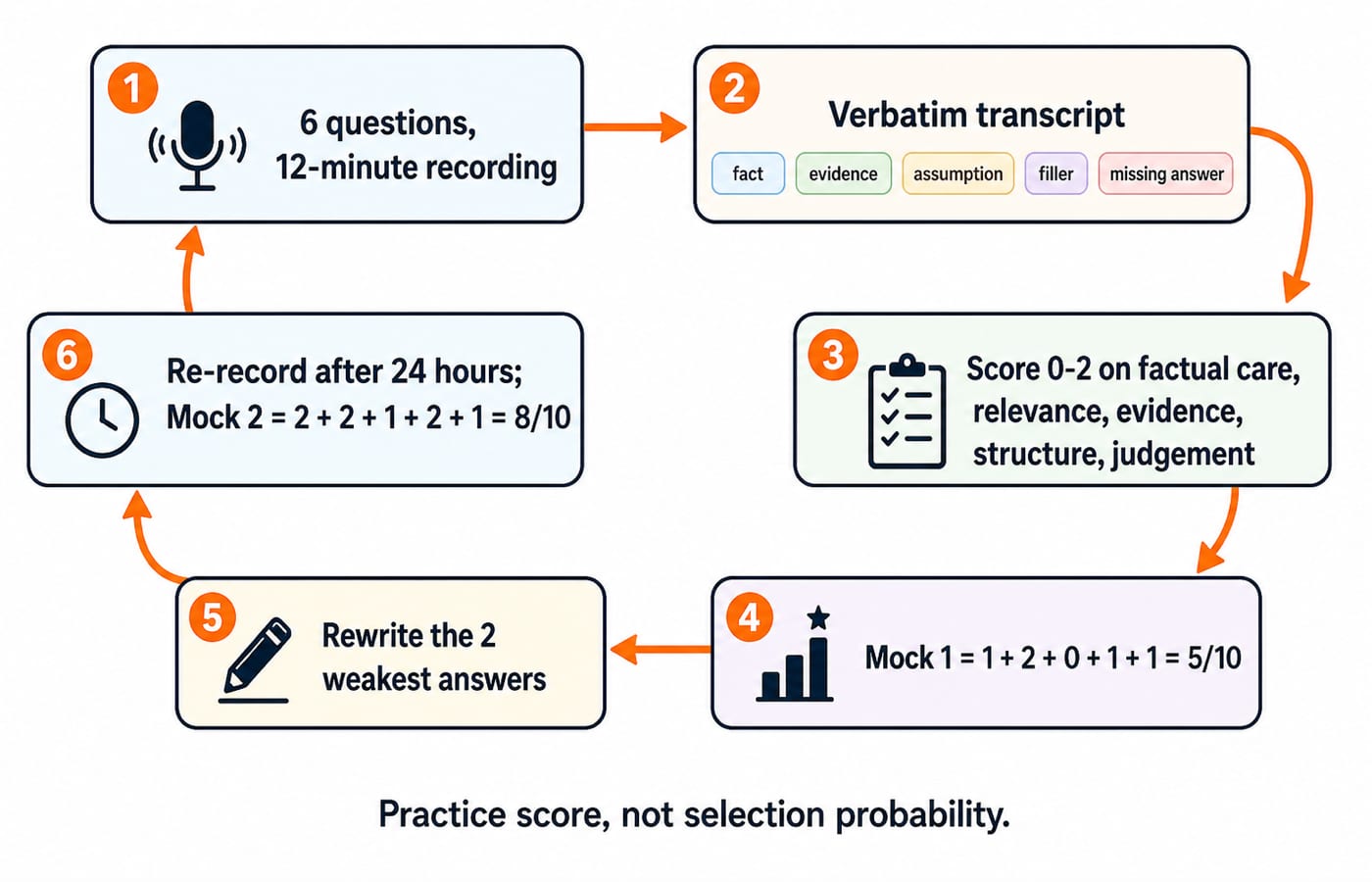
Run a six-question, 12-minute mock: introduction, why NIACL, one insurance concept, one product-family question, the 80,000 scenario and one follow-up challenge. Record it, transcribe it verbatim, and tag each sentence fact, evidence, assumption, filler or missing answer.
Score factual care, relevance, evidence, structure and judgement from 0 to 2. A worked baseline is 1 + 2 + 0 + 1 + 1 = 5/10. Correct the two weakest answers, wait 24 hours, then record again. The second worked score is 2 + 2 + 1 + 2 + 1 = 8/10.
Count the tags before you rescore. A transcript carrying more assumption lines than evidence lines is the pattern that loses answers, and it stays invisible until it is written down. Re-record the answer instead of reading a corrected version aloud, because reading back flatters the score and hides the hesitation the exercise exists to expose.
7. Follow a 10-day, 13-hour plan with a missed-day rule
Phase 1, Days 1 to 3, is 240 minutes: 60 for a baseline recording and transcript, 60 for the evidence grid and 120 for insurance cards. Phase 2, Days 4 to 7, is 300 minutes: 90 for the official NIACL sheet, 90 for insurance and product drills, 90 for six scenarios and 30 for one answer recording.
Phase 3, Days 8 to 10, is 240 minutes: 60 for Mock A, 60 for transcript correction, 60 for Mock B, 30 for a final official-source check and 30 as a floating buffer. Therefore, 240 + 300 + 240 = 780 minutes, and 780 / 60 = 13 hours.
If you miss a 60-minute day, use the 30-minute buffer and add 30 minutes to the next light day. If you miss the 120-minute insurance day, extend the plan by one day instead of deleting half the concepts.
8. Final readiness check, short version and next step
In the final 24 hours, check for eight background answers, two evidence stories, 12 concept cards, three rechecked NIACL pages, six company notes, six scenarios and two scored transcripts. Your call letter overrides this checklist.
In one line: source official facts, connect them to insurance concepts, answer through verification and documentation, then improve from the transcript. Do not invent a question the panel asked, and do not quote a figure you have not rechecked today.
Tonight, complete the first 60-minute baseline mock and mark its two weakest answers. IT-specialist applicants needing written-stage or technical revision can use the NIACL AO IT Specialist course for that stage.
Keep learning

NIACL AO Cutoff Trends: Set a Practical Target Score
Read NIACL published Generalist and IT Specialist cutoffs without mixing stages or streams. Apply declared buffers and sectional checks to set a practical mock target.
Updated 21 Aug 20264 min readNIACL
NIACL Assistant Regional Language Test: 14-Day Preparation Plan
Build regional-language confidence through a clear diagnostic, daily drills, an error log, and a light final-day review. Use this plan alongside your current NIACL call letter.
Updated 20 Aug 20265 min readNIACL
NIACL AO vs Assistant: Choose by Role, Mobility and Exam Track
Compare NIACL's AO and Assistant routes using past official notices, then choose with mobility filters, preparation deltas and a five-point fit test.
Updated 18 Aug 20265 min readNIACL

NIACL AO Role: Underwriting, Claims and Career Paths Explained
NIACL AO work before you choose the exam: underwriting, claims and administration, the Generalist and Specialist routes, and where a career can go.
Updated 16 Aug 20265 min readNIACL