NFA to DFA Conversion MCQs: 12 Solved Questions with Explanations
Solve 12 published NFA to DFA MCQs with concise explanations, power-set calculations, and a complete four-state subset construction.
KnowledgeGate Team
Exam prep & CS education
5 Sep 20267 min read223 views
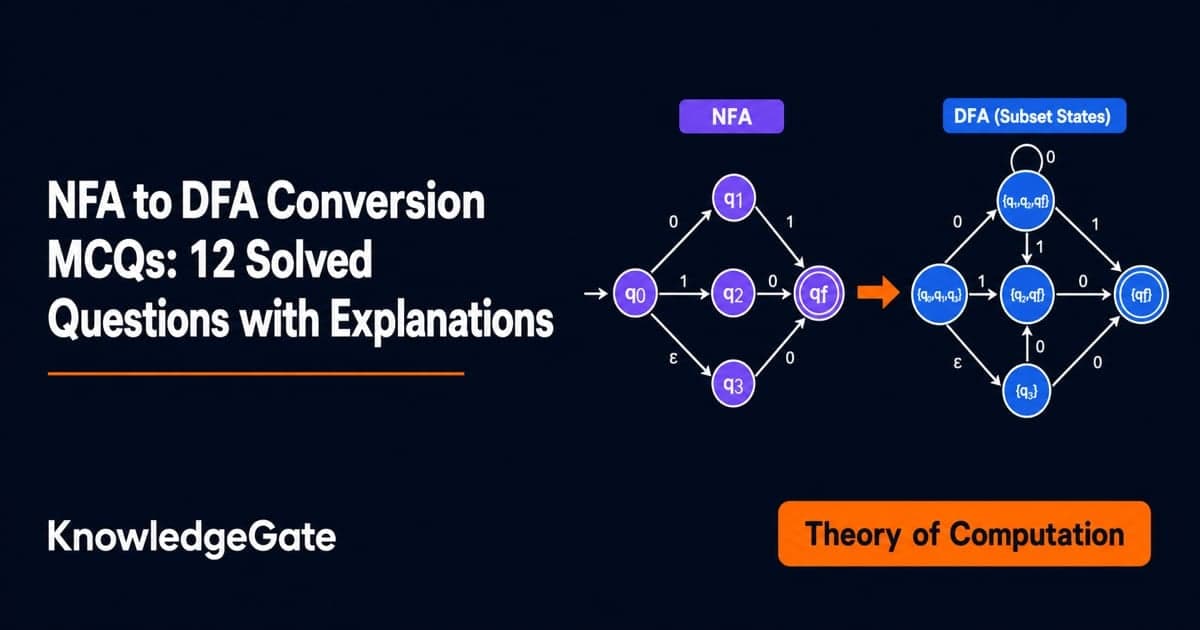
Most mistakes in NFA to DFA questions do not come from the power-set formula itself. They come from treating a worst-case upper bound as an exact count, forgetting the empty subset, or assuming that the NFA must always be smaller.
These 12 published MCQs move from language equivalence to state-count numericals and one complete subset construction. Choose an option and write one line of reasoning before revealing each answer. KnowledgeGate has over 20 published questions on NFA to DFA conversion, including a substantial MCQ pool. You can place the topic within GATE CS Exam Preparation. Questions 1 to 5 share one further-practice route, reachable from their question headings.
NFA to DFA conversion rules to use before the MCQs
Rule | What to do |
|---|---|
DFA state | Treat each DFA state as a subset of NFA states. |
Start state | Use the NFA start-state set, or its epsilon-closure when epsilon-transitions exist. |
Transition | For subset |
Accepting state | Mark a subset accepting if it contains at least one accepting NFA state. |
For three NFA states, Q = {q0, q1, q2}, the power set has 2^3 = 8 members: empty set, {q0}, {q1}, {q2}, {q0,q1}, {q0,q2}, {q1,q2}, and {q0,q1,q2}. These are the maximum candidate states, not a promise that all eight will be reachable or remain distinct after minimisation.
If a transition from a reachable subset produces no NFA state, the DFA enters empty set. Every symbol then returns to empty set, so it acts as the dead state. Read NFA to DFA Conversion for GATE for the full conceptual walkthrough.
NFA to DFA MCQs 1-3: language equivalence
Question 1
Which of the following is False?
(a) The languages accepted by FAs are regular languages
(b) Every DFA is an NFA
(c) There are some NFAs for which no DFA can be constructed
(d) If L is accepted by an NFA with ∈ transitions then L is accepted by an NFA without ∈ transitions
Answer: (c). Subset construction gives every NFA an equivalent DFA. Finite automata recognise regular languages; every DFA is an NFA. Option (d) uses ∈ for epsilon-transitions, removable by epsilon-closure without changing the language.
Question 2
Which of the following is TRUE ?
(a) L(DFA) = L(NFA)
(b) L(DFA) ⊂ L(NFA)
(c) L(DPDA) = L(NPDA)
(d) L(DFA) = L(DPDA)
Answer: (a). L(machine) denotes the accepted language class. Every DFA is an NFA, and every NFA can be determinised, so the classes are equal. Option (b) claims a proper subset; (c) and (d) compare different classes.
Question 3
A language that is accepted by a non-deterministic finite automaton (NFA) is also accepted by
(a) Deterministic finite automaton (DFA)
(b) Turing machine only
(c) Pushdown automaton only
(d) None of the above
Answer: (a). The DFA tracks the active NFA-state set after each prefix. More powerful models also simulate finite automata, but only makes (b) and (c) wrong.
NFA to DFA MCQs 4-6: equal, smaller and exponential state counts
Question 4
Consider the following statements: S1: The Number of states in an NFA can never be equal to its corresponding DFA. S2: The number of states in NFA is always less than and equal to its corresponding DFA. S3: The number of states in an NFA may be equal to its corresponding DFA. Which of the above statements is/are TRUE.
(a) Only S1 and S2
(b) Only S2 and S3
(c) Only S3
(d) Only S2
Answer: (c). A deterministic NFA shows equality, so S1 is false and S3 is true. Redundant or unreachable NFA states can make the minimal equivalent DFA smaller, refuting S2. A raw conversion table need not be minimal.
Question 5
An NFA has 3 states. What is the maximum possible number of states in the equivalent DFA constructed using subset construction?
(a) 6
(b) 9
(c) 3
(d) 8
Answer: (d). With n = 3, the maximum is 2^3 = 8, those eight subsets. A particular NFA may reach fewer; this asks for the maximum.
Question 6
If NFA of 5 states excluding the initial state is converted into DFA, maximum possible number of states for the DFA is?
(a) 64
(b) 32
(c) 128
(d) 187
Answer: (a). Five states exclude the initial state, so n = 5 + 1 = 6 and the ceiling is 2^6 = 64. The distractor 32 = 2^5 forgets the initial state. Review the exact solved question.
NFA to DFA MCQs 7-9: missing formula, reachable subsets and minimisation
Question 7
How many states of DFA can be converted from an NFA with ‘n’ states?
(a) n
(b) n2
(c) 2n
(d) None of the above
Answer: (d). The maximum 2^n is absent from (a) to (c). At n = 4, 2n = 8 but 2^n = 16. See the worked answer.
Question 8
Consider the Nondeterministic Finite State Automaton (NFA) below. State with a small incoming arrow are initial states while a double circle state denotes a final state.
The number of states in the MINIMAL Deterministic Finite-State Automaton (DFA) for this language is:
(a) 2
(b)
4(c) 6
(d) 8
Answer: (b). Name the pictured states q0, q1, and q2 from left to right. State q0 is initial and loops on a,b; q0 --b--> q1; q1 --a,b--> q2; and q2 is final. Subset construction gives:
DFA subset | on | on | accepting? |
|---|---|---|---|
|
|
| no |
|
|
| no |
|
|
| yes |
|
|
| yes |
Reachability: A reaches B on b; B reaches C on a and D on b, covering every subset shown. All four subsets are reachable. Acceptance immediately separates A and B from C and D. Within the non-final pair, A and B differ on a: A stays non-final, while B reaches final C. Within the final pair, C and D differ on b: C reaches non-final B, while D stays final. No pair can merge, so the minimal DFA has four states. Check the exact solved question.
Question 9
Let N be an NFA with n states and let M be the minimized DFA with m states recognizing the same language. Which of the following in NECESSARILY true?
(a) m ≤ 2ⁿ
(b) n ≤ m
(c) M has one accept state
(d) m = 2ⁿ
Answer: (a). Subset construction gives at most 2^n states; minimisation cannot increase the count. Redundant NFA states refute (b). Multiple accepting states refute (c). The ceiling need not be reached, so (d) is false. See the worked solution.
NFA to DFA MCQs 10-12: the tight power-set bound
Question 10
Let be an NFA with n states. Let be the number of states of a minimal which is equivalent to . Which one of the following is necessarily true?
(a)
(b)
(c)
(d)
Answer: (d). Here k counts states in a minimal equivalent DFA. Power-set construction gives at most 2^n states, and minimisation cannot increase it. The bound k <= n^2 is not universal because suitable NFAs require exponential growth. Review the exact question.
Question 11
Given an arbitary non-deterministic finite automaton (NFA) with N states, the maximum number of states in an equivalent minimized DFA is at least
(a) N²
(b) 2ᴺ
(c) 2N
(d) N!
Answer: (b). This is the tight worst case. Subset construction gives the 2^N upper bound, and some NFA families make every subset reachable and distinguishable, so a minimal DFA can require all 2^N states. At N = 4, N^2 = 2^N = 16; at N = 5, the values are 25 and 32, while 2N = 10. See the worked solution.
Question 12
Let L be a set accepted by a non-deterministic finite automaton. The number of states in the non-deterministic finite automaton is |Q|. The maximum number of states in the equivalent deterministic finite automaton (DFA) that accepts L is
(a) |Q|
(b) 2|Q|
(c) 2<sup>|Q|</sup> − 1
(d) 2<sup>|Q|</sup>
Answer: (d). The power set of Q has 2^{|Q|} members. Option (c) discards the empty subset. For |Q| = 2, they are empty set, {q0}, {q1}, and {q0,q1}: 2^2 = 4, not 3. See the exact solved question.
The traps these 12 NFA to DFA questions expose
Trap or rule | Questions |
|---|---|
Equivalent language classes | 1 to 3 |
NFA and DFA counts can be equal | 4 |
Read exactly what | 5 to 7 |
Reachable subsets versus all subsets | 8 |
Upper bound versus necessary equality | 9 to 11 |
The empty subset counts | 12 |
Use this 45-second routine: identify equivalent, minimal, or maximum; count NFA states; write 2^n as the ceiling; build reachable subsets from a diagram; mark subsets containing a final NFA state; minimise only when requested.
If nondeterministic transitions are still slowing you down, practise NFA Basics & Design MCQs. Remember that subset construction and minimisation are separate operations, then use DFA Minimization for GATE to sharpen the second step.
NFA to DFA conversion: the next practice step
Redo Questions 4, 6, 8, 9, and 12 once without looking at the answers. Write one option and supporting line each. Together they test possible equality, careful state counting, full subset construction, minimisation, and the empty subset. Review its rule before starting a fresh set.
For a sequenced Theory of Computation route, continue with GATE Guidance by Sanchit Sir. For timed practice after you can justify each answer, use the GATE Test Series.
The short version: 2^n tells you how many subsets are possible. The transition table tells you which are reachable. Accepting-state membership and minimisation tell you what survives.
Keep learning
Closure Properties MCQs: 12 Solved Regular Language PYQs with Explanations
Solve 12 regular-language PYQs with proofs, counterexamples, and step-by-step transformations. The set targets the quantifier traps that make closure questions difficult.
13 Sep 20268 min readTheory of Computation MCQs
Grammar Design via Regex MCQs: 12 Solved PYQs with Explanations
Solve 12 grammar and regex PYQs by tracing productions, removing dead branches, tracking symbol counts and proving membership with exact derivations.
12 Sep 20268 min readTheory of Computation MCQs
Decision Properties MCQs: 10 Solved CFG and PDA Questions
Solve ten Decision Properties MCQs by separating the input model from the property being tested, then checking the relevant algorithm or undecidability result.
11 Sep 20268 min readTheory of Computation MCQs

Closure Properties MCQs for Turing Machines: 12 Solved Questions
Test the closure rules that separate decidable and Turing-recognisable languages. These 12 solved MCQs show how complement, difference, dovetailing, and countability shape the answers.
Updated 9 Sep 20268 min readTheory of Computation MCQs