Multi Agent Systems in AI: Concepts, Nash Equilibrium and Auctions with Worked Examples
Learn the complete MAS concept set, then compute a Nash equilibrium, a minimax choice and a Vickrey auction outcome step by step.
KnowledgeGate Team
Exam prep & CS education
Updated 4 Aug 20266 min read
Single-agent AI feels comfortable: one vacuum cleaner moves, or one route planner finds a path. Add a self-interested agent and every answer depends on what the other agent will do. Two rival pricing agents both end up cutting and settle at (2, 2), a rational MAX takes a guaranteed 3 rather than chase a 14 it will never be handed, and a Vickrey bidder who values a compute slot at 120 wins it, pays 100 and keeps 20. Nash equilibrium, minimax and mechanism design are the three ideas behind those three numbers.
What changes when the environment contains other agents
A multi agent system (MAS) contains multiple autonomous agents whose outcomes depend on their own actions and those chosen by others. Dirt does not strategise against a vacuum agent. Chess, auctions and network routing include deliberate opponents or partners.
The agents' performance measures determine the environment:
Competitive: goals conflict. In chess, my gain is your loss.
Cooperative: goals align. Two delivery robots both benefit from avoiding a collision.
Mixed: some goals align and others conflict. Taxi drivers avoid collisions together but compete for passengers.
The best action depends on the state and on what rational agents will do. This is why MAS uses game theory alongside search.
The MAS concept set: vocabulary the exam quotes
Benevolent agents share an objective, often in distributed problem solving. Self-interested agents maximise separate utilities, as marketplace bidding bots do.
Three capabilities organise their interaction:
Coordination manages dependencies so activities do not clash over time or resources.
Cooperation lets agents work toward a shared goal.
Negotiation helps agents reach agreement when interests conflict.
Agent communication languages use speech-act theory. Each message combines content with a performative such as inform, request, propose, accept or refuse. KQML and FIPA ACL are the key names.
A homogeneous MAS uses similar agent designs. A heterogeneous MAS mixes designs, capabilities or owners. Heterogeneity plus self-interest makes open e-commerce systems difficult because common behaviour and objectives cannot be assumed.
Nash equilibrium in a pricing game: payoff matrix and dominant strategies
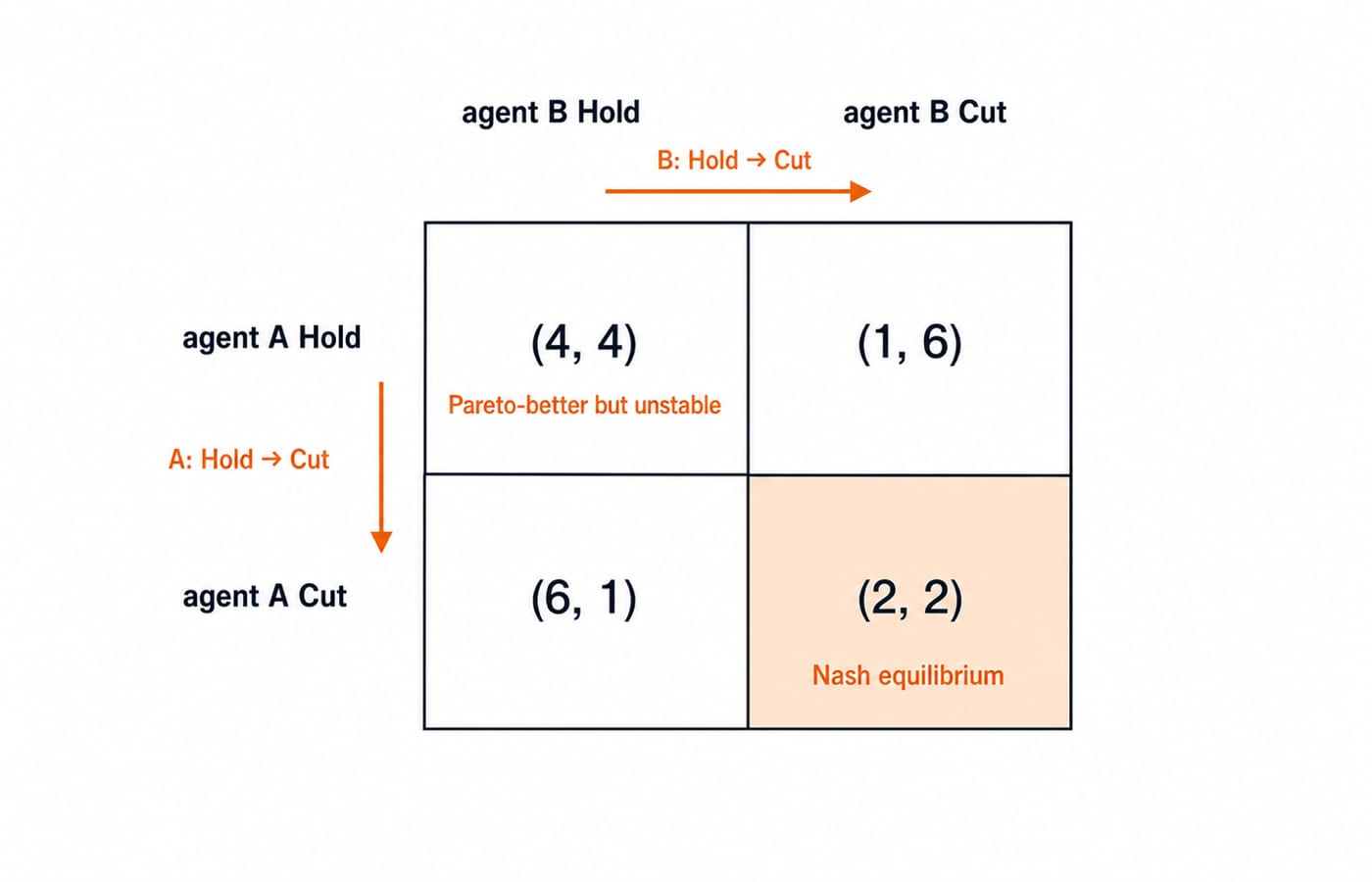
Two rival coaching-bot agents, A and B, simultaneously choose Hold price or Cut price. Each cell shows quarterly profit in lakhs as (A's payoff, B's payoff).
A's action | B: Hold | B: Cut |
|---|---|---|
A: Hold | (4, 4) | (1, 6) |
A: Cut | (6, 1) | (2, 2) |
Test A's choices one case at a time:
If B Holds, A receives 6 by Cutting and 4 by Holding. Since 6 > 4, A should Cut.
If B Cuts, A receives 2 by Cutting and 1 by Holding. Since 2 > 1, A should Cut again.
Cut strictly dominates Hold for A and, by symmetry, for B. The unique Nash equilibrium is (Cut, Cut) with payoff (2, 2). Check it: if either agent alone changes to Hold, its payoff falls from 2 to 1. Neither can improve through a unilateral deviation.
The (Hold, Hold) result at (4, 4) is Pareto-superior but unstable. Either agent can Cut and raise its payoff from 4 to 6. This is the prisoner's dilemma structure in a pricing setting.
Zero-sum encounters: thinking two moves ahead with minimax
In a strictly competitive zero-sum game, one agent's gain is exactly the other's loss. Minimax assumes a rational opponent: MAX chooses the move that maximises the minimum value MIN can hold it to.
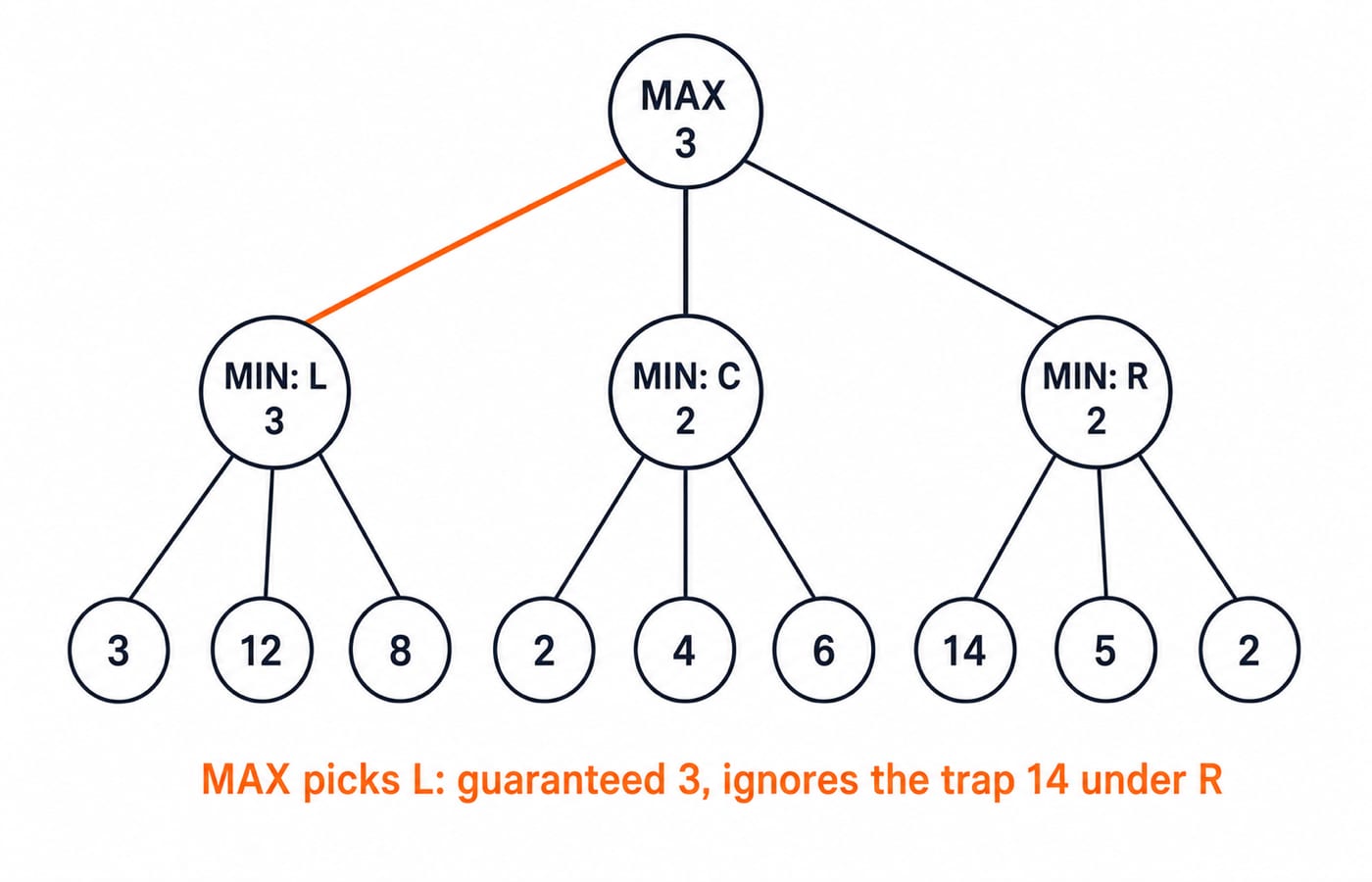
Suppose MAX has moves L, C and R. Their leaf utilities are:
L: 3, 12, 8, so MIN backs up min(3, 12, 8) = 3.
C: 2, 4, 6, so MIN backs up min(2, 4, 6) = 2.
R: 14, 5, 2, so MIN backs up min(14, 5, 2) = 2.
MAX computes max(3, 2, 2) = 3 and chooses L. The 14 below R is tempting, but rational MIN selects 2. Against a careless opponent minimax is safe but over-cautious, because it assumes resistance that never arrives. The same tree, pruned with alpha-beta and extended to evaluation functions and chance nodes, is worked in Game Playing in AI: Minimax and Alpha-Beta Pruning.
Reaching agreements: auctions and the contract net
Auctions allocate resources or tasks among self-interested agents. Mechanism design is inverse game theory: choose rules that channel rational self-interest toward the intended outcome.
Auction | Rule |
|---|---|
English | Bids rise openly; the winner pays the final bid. |
Dutch | A visible price descends; the first accepter wins. |
First-price sealed-bid | Each bid is hidden; the winner pays its own bid. |
Vickrey, or second-price sealed-bid | Each bid is hidden; the winner pays the second-highest bid. |
Three agents value a compute slot at 120, 100 and 80 units. With truthful Vickrey bids of 120, 100 and 80, agent 1 wins, pays the second-highest bid of 100, and receives utility 120 - 100 = 20.
Why can lying not help here? A bid above 100 changes nothing: agent 1 still wins, pays 100 and receives 20. A bid below 100 loses the slot, reducing utility to 0. So truthful bidding is a dominant strategy in a Vickrey auction: no other bid does better for agent 1, whatever the rivals bid.
For cooperative task allocation, the contract net protocol has four steps: a manager announces a task, contractors bid, the manager awards the best bid, and the contractor reports the result. Exams pair this protocol with auctions.
Traps: where good students lose marks
Nash equilibrium means the best outcome. It does not. Equilibrium means no unilateral improvement. Check each deviation, not total welfare.
Nash implies dominant strategies. Every dominant-strategy equilibrium is Nash, but a Nash equilibrium can exist without dominant strategies. Test every relevant action comparison.
A Vickrey winner pays its own bid. The winner pays the second-highest bid. Truthful bidding is dominant here, not in a first-price sealed-bid auction, where rational bidders shade bids below value.
Minimax backs up the maximum everywhere. Levels alternate. Max-everywhere would incorrectly compare 12, 6 and 14 in the example and pick R for 14, ignoring MIN's reply.
MAS is just distributed computing. Distributed components follow a designer's protocol. MAS agents are autonomous and may be self-interested, so message passing alone cannot model their strategic behaviour.
How papers and interviews test multi agent systems
Classic GATE CS papers centre AI-adjacent questions on search and logic. MAS appears explicitly in the AI units of the newer AI and data-science oriented papers and in UGC NET Computer Science. The unit list that binds you is the official syllabus for your own paper and cycle, published for UGC NET at ugcnet.nta.nic.in, so check it there before you plan your revision.
Expect four shapes: classify an environment or agent; find dominant strategies and Nash equilibria; compute an auction winner, price and utility; or back up a minimax tree. An interview may ask how multiple LLM agents should coordinate. Answer using shared goals versus self-interest, coordination, negotiation and message performatives.
UGC NET aspirants can place the AI unit within the wider paper using UGC NET Computer Science High-Yield Topics, Ranked.
The short version, and your next step
MAS means autonomous agents with interdependent outcomes. Classify the environment and the agents. For a one-shot interaction, test dominant strategies and unilateral deviations: the pricing game ends at (Cut, Cut) with (2, 2). Minimax gives a root value of 3. The Vickrey winner pays 100 and earns 20, while contract net handles cooperative tasks.
Rebuild the matrix and derive its equilibrium from a blank page. Then rerun Vickrey with values 90, 70 and 50. If both drills take more than fifteen minutes, revise before moving on.
For structured full-subject preparation, GATE Guidance by Sanchit Sir provides the mentorship path. If you met MAS through interviews and want the applied track, use AI & ML for Placements | Generative AI Placement Course. Continue browsing connected notes from the ML & Data Science blog.
Keep learning
Agent Architecture and Program Types in AI: A Worked Warehouse Example and Exam Traps
Separate architecture, program and agent function, then compare four program types through one fully worked warehouse routing problem.
Updated 25 Oct 20266 min readML & Data Science
Problem Representation in AI: State Space, Worked Water-Jug Example and Exam Traps
Learn how states, operators, goals and costs turn a verbal task into a search problem. The worked water-jug trace separates valid states from reachable ones.
Updated 23 Oct 20265 min readML & Data Science
Foundations and Evolution of AI: Approaches, Timeline and a Worked Rational-Agent Example
Build a connected map of AI foundations, historical shifts and major paradigms, then calculate how a rational agent chooses under uncertainty.
Updated 19 Oct 20266 min readML & Data Science
Natural Language Processing Explained: Pipeline, TF-IDF Worked Example and Exam Patterns
Start from raw text, build BoW and TF-IDF vectors, compute cosine similarity, examine ambiguity, and finish with evaluation and exam-style checks.
Updated 15 Oct 20266 min readML & Data Science