

Wells Fargo Coding Questions: Three Patterns with Worked Solutions
Learn to recognise three coding patterns from the task itself. Follow complete Python solutions, trace each state change, and catch mistakes involving duplicate values, repeated characters and negative numbers.
KnowledgeGate Team
Exam prep & CS education
Updated 13 Nov 20265 min read
While preparing for Wells Fargo coding questions, you may understand a solution after reading it yet struggle to choose an approach for an unfamiliar prompt. These three representative practice exercises give you exact traces, Python implementations and failure cases; they are not verified previous Wells Fargo questions or a prediction of its current assessment.
The published Capgemini coding questions guide owns its four-pattern treatment, including moving zeroes, monotonic stacks and greedy scheduling; this Wells Fargo set overlaps only on the sliding-window idea and instead works through two-sum and prefix-sum counting with full traces.
Read the constraint before choosing a coding pattern
Start with the required output and constraints. Contiguous means adjacent positions with no omissions.
What the task asks | Useful pattern |
|---|---|
Two distinct indices whose values reach a target | Hash lookup |
Longest contiguous substring without repetition | Sliding window |
Count contiguous subarrays with a target sum, including negatives | Prefix-sum frequencies |
Brute force gives a correctness baseline. For n = 100,000, checking every distinct pair requires n(n-1)/2 = 100,000 x 99,999 / 2 = 4,999,950,000 checks. A hash-based pass removes repeated searches, assuming average constant-time lookup; this is an expected complexity claim, not a runtime promise.
Seek an invariant, a condition preserved after every step. Keep coding alongside broader placement preparation resources.
Hash lookup: find two indices with the required sum
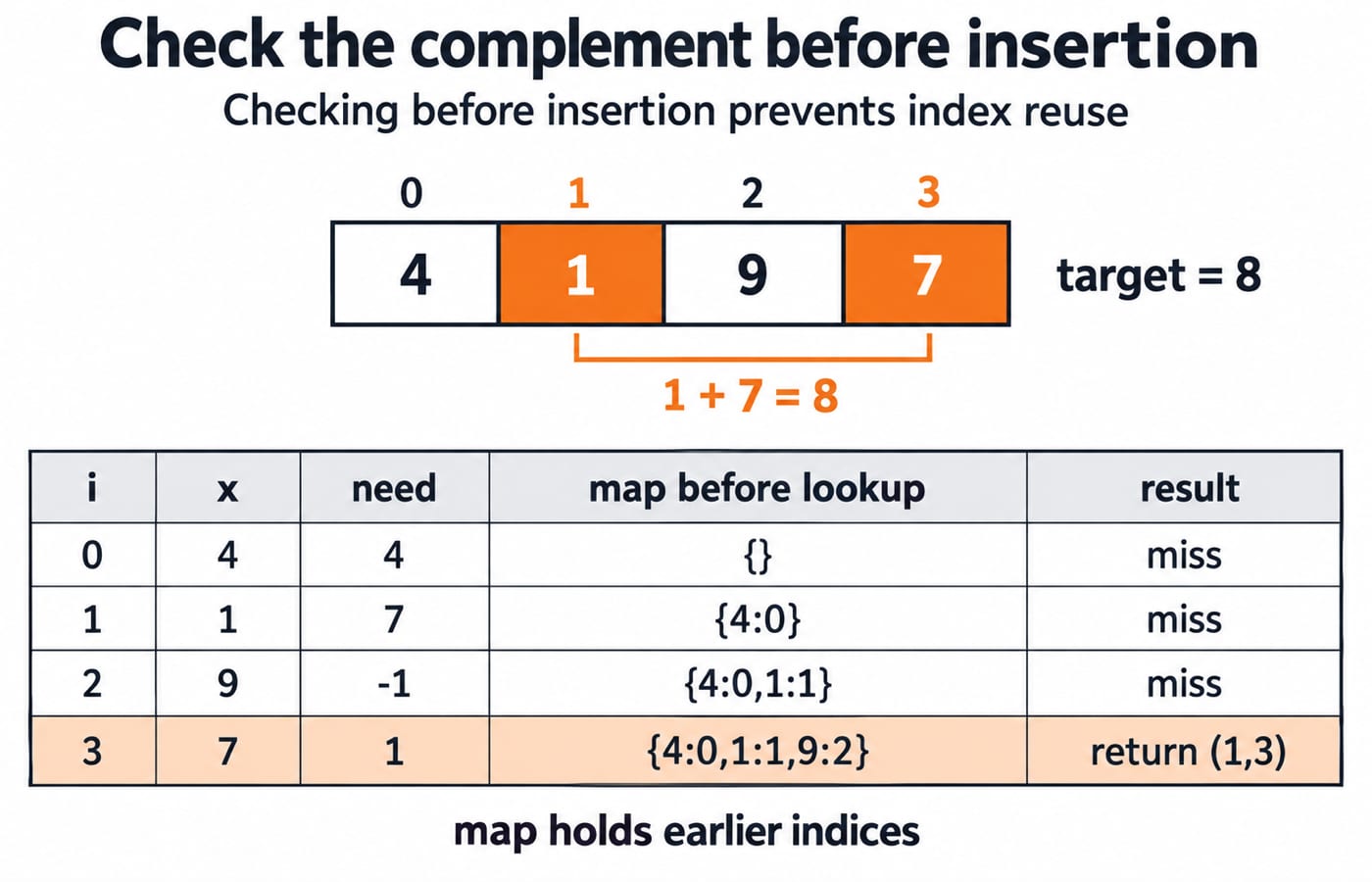
Given [4, 1, 9, 7] and target 8, return any two different zero-based indices whose values sum to 8, or None. Duplicate values are allowed, and the returned pair's order does not matter.
For each value x, look for target - x among earlier elements. The invariant is simple: the map contains only earlier indices. Check before inserting, so the current element cannot match itself.
i | x | need = 8 - x | Map before lookup | Result |
|---|---|---|---|---|
0 | 4 | 4 |
| Miss; store |
1 | 1 | 7 |
| Miss; add |
2 | 9 | -1 |
| Miss; add |
3 | 7 | 1 |
| Return |
The answer uses values 1 + 7 = 8.
def two_sum(a, target):
    seen = {}
    for i, x in enumerate(a):
        need = target - x
        if need in seen:
            return (seen[need], i)
        seen[x] = i
    return None
Expected time is O(n), and auxiliary space is O(n). For [4] with target 8, the result is None; for [4,4], it is (0,1). Equal values are valid when their indices differ.
Sliding window: longest substring without repeated characters
For s = "abba", return the length of the longest contiguous substring with distinct characters. The answer is 2: both "ab" and "ba" qualify. A substring cannot skip positions, whereas a subsequence can.
Track the current window's left boundary and each character's last index. Start with last = {}, left = 0 and best = 0.
right | Character | left after update | Window | Length | best |
|---|---|---|---|---|---|
0 | a | 0 | a | 1 | 1 |
1 | b | 0 | ab | 2 | 2 |
2 | b, previously at 1 | 2 | b | 1 | 2 |
3 | a, previously at 0 | 2 | ba | 2 | 2 |
def longest_unique(s):
    last = {}
    left = best = 0
    for right, ch in enumerate(s):
        if ch in last:
            left = max(left, last[ch] + 1)
        last[ch] = right
        best = max(best, right - left + 1)
    return best
The invariant is a duplicate-free current window. At the final a, max(2, 0 + 1) keeps left = 2. Moving it backwards to 1 would incorrectly admit "bba".
The empty string returns 0; "aaaa" returns 1. Expected time is O(n), and space is O(min(n, alphabet size)).
Prefix-sum frequencies: count target sums even with negatives
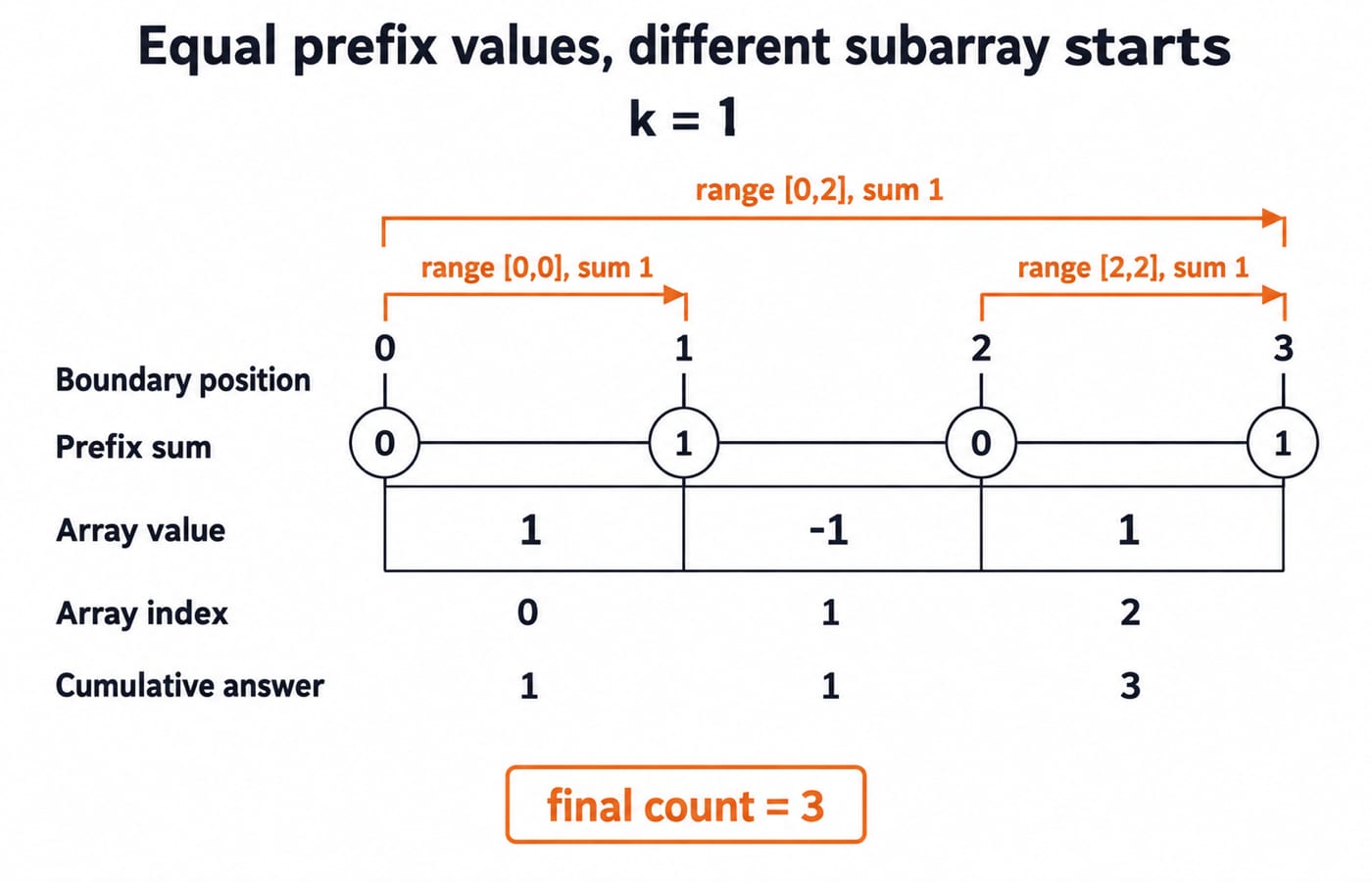
Count non-empty contiguous subarrays of [1, -1, 1] with sum k = 1. The answer is 3, from inclusive ranges [0,0], [0,2] and [2,2].
A prefix sum is the sum before a boundary. Current prefix minus earlier prefix gives a subarray sum, so we need earlier prefixes equal to prefix - k.
Start with freq = {0:1}, prefix = 0, answer = 0. The initial zero represents the boundary before the array, allowing ranges starting at index 0.
i | Value | prefix | Needed | Frequency hit | answer | freq after insertion |
|---|---|---|---|---|---|---|
0 | 1 | 1 | 0 | 1 | 1 |
|
1 | -1 | 0 | -1 | 0 | 1 |
|
2 | 1 | 1 | 0 | 2 | 3 |
|
def count_sum(a, k):
    freq = {0: 1}
    prefix = answer = 0
    for x in a:
        prefix += x
        answer += freq.get(prefix - k, 0)
        freq[prefix] = freq.get(prefix, 0) + 1
    return answer
Before each lookup, frequencies count earlier prefixes. A set loses repeated starts. Expected time and space are O(n).
With negatives, extending a window can decrease its sum, so "shrink when too large" lacks monotonicity. Explore more DSA interview patterns after tracing this distinction.
Catch the edge cases before submitting
Bug | Consequence | Repair |
|---|---|---|
Insert before two-sum lookup |
| Look up first |
Move the window left backwards |
| Use |
Store prefix existence only | Miss one of two zero-prefix starts | Store frequencies |
For [0,0], k = 0, the first element adds 1 match and the second adds 2: total 3. Lookup must precede increment; otherwise the current boundary matches itself and counts an empty range. An empty array returns 0 for any k.
In Java/C++, use sufficiently wide integer types for sums and counts. With 100,000 zeros, n(n+1)/2 = 100,000 x 100,001 / 2 = 5,000,050,000 subarrays have sum zero. Python integers avoid fixed-width overflow here.
Distinguish index answers, length answers and count answers. These functions use zero-based indices and assume no platform-specific input format.
How to practise for a Wells Fargo coding assessment
Wells Fargo's Our Hiring Process page says interviews vary by business group. Follow your actual invitation for platform, timing and permitted language; that general page does not establish a single coding-paper format.
Try this suggested 35-minute practice drill, not an employer test duration:
5 minutes: restate the task, output and constraints.
15 minutes: implement one solution.
10 minutes: check edge cases against brute force.
5 minutes: explain the invariant and complexity.
Apply it to the prefix-sum example, then reimplement without the trace. Explain why frequencies are sufficient: each matching earlier boundary creates exactly one valid range ending here. Naming a dictionary alone does not explain correctness. Use coding-round time management to organise subsequent practice sessions.
Short version: choose the invariant, then practise a variant
Remember three invariants: earlier indices for two-sum, a duplicate-free current window, and frequencies of earlier prefix sums. Each retains exactly the information needed for the next decision.
Now rerun two-sum on [3,3], target 6. Expect (0,1): the first 3 is stored only after its lookup fails, and the second finds index 0. Explain why reversing that order breaks the distinct-index requirement.
For structured general coding practice, continue with Coding for Placements. Trace a solution, implement it, then test a variant independently.
Keep learning
Publicis Sapient Coding Questions: Three Patterns with Worked Solutions
Recognising code is easier than explaining why it works. Practise three patterns through Java methods, exact traces, invariants and edge cases before your next coding assessment.
Updated 17 Nov 20265 min readCompany-Specific Prep
JPMorgan Chase Coding Questions: Three Patterns with Solved Examples
Know a solution but struggle when the input changes? Practise complement lookup, sliding windows and take-or-skip dynamic programming with exact traces and clear invariants.
Updated 14 Nov 20266 min readCompany-Specific Prep
Capgemini Coding Questions: 4 Patterns with Step-by-Step Solutions
Learn four transferable coding patterns through constructed Capgemini preparation examples. Each solution includes an invariant, complete trace, complexity and edge-case checks.
Updated 19 Oct 20266 min readCompany-Specific Prep
TCS NQT Coding Questions 2026: Pattern-Wise Solutions in Python and Java
TCS NQT coding questions grouped into six recurring patterns, from digit logic to array scans, each solved step by step in Python and Java with variants.
Updated 29 Oct 20268 min read475 viewsPlacement Preparation