Time Complexity of Loops MCQs: 12 Solved Questions with Explanations
Solve 12 previous-year loop questions by counting iterations, tracing values, summing dependent loops and separating running time from return values.
KnowledgeGate Team
Exam prep & CS education
Updated 5 Sep 20268 min read
"What is the time complexity of this loop?" recurs across GATE, ISRO, UGC NET and state-PSC papers. Wrong answers usually come from assuming two loops mean n squared instead of counting iterations. Attempt these 12 previous-year questions first. About 60 questions are available for practice under Iterative Loops & Code. Course PYQs link to exact solutions; find the ISRO and TPSC questions through the Algorithms learn module.
Warm-up: a doubling loop contributes log n
Count body executions, then multiply only for independent loops. Doubling from 1 through n takes ⌊log₂n⌋ + 1 passes. For broad practice across growth rates, loops and recurrences, use Time Complexity MCQs: 12 solved questions on asymptotic analysis. Three GATE questions recur below because each exposes a different loop trap: independent counts multiply, dependent step sizes sum and accumulated values require a trace.
Q1. ISRO 2020
What is the complexity of the following code?
sum = 0;
for (i = 1; i <= n; i *= 2)
    for (j = 1; j <= n; j++)
        sum++;
(a) O(n²) (b) O(n log n) (c) O(n) (d) O(n log n log n)
Answer: (b). The outer values 1, 2, 4, ... give ⌊log₂n⌋ + 1 passes. The inner loop runs n times per pass, so total work is n(⌊log₂n⌋ + 1) = Θ(n log n). Two n-length loops would give n².
Consider the following segment of C-code:
int j, n;
j = 1;
while (j <= n)
    j = j*2;
The number of comparisons made in the execution of the loop for any n > 0 is:
(a) ⌈log n⌉ + 2 (b) n (c) ⌈log n⌉ (d) ⌊log n⌋ + 2
Base of Log is 2 in all options.
Answer: (d). For n = 8, j is tested at 1, 2, 4, 8, then 16: 5 comparisons, and ⌊log₂8⌋ + 2 = 3 + 2 = 5. For n = 5, tests at 1, 2, 4, 8 give 4. Option (a) gives ⌈log₂5⌉ + 2 = 5, but (d) gives ⌊log₂5⌋ + 2 = 2 + 2 = 4.
Trace questions: the loop computes a value
For a final variable value, trace assignments in order.
Q3. ISRO 2007
Consider the following pseudo-code
x:=1;
i:=1;
while (x <= 1000)
begin
  x:=2^x;
  i:=i+1;
end;
What is the value of i at the end of the pseudo-code?
(a) 4 (b) 5 (c) 6 (d) 7
Answer: (b). From x = 1, i = 1, the passes produce (x, i) = (2, 2), (4, 3), (16, 4), (65536, 5). Since 65536 > 1000, i ends at 5. The test precedes the overshooting pass.
Q4. UGC NET June 2020
Consider the following pseudo-code fragment, where a and b are integer variables that have been initialized:
/* Pre-conditions : (a>1 ∧ a<b) */
/* Assume that overflow never occurs */
int x=0; int p=1;
while (p<b){
p=p*a;
x=x+1;
}
When the while loop terminates, what will be the value of x in terms of a and b?
(a) a^b (b) b^a (c) ⌊log_a b⌋ (d) ⌈log_a b⌉
Answer: (d). After x passes, p = a^x. It stops at the first a^x >= b, so x = ⌈log_a b⌉. For a = 2, b = 10, p goes 1, 2, 4, 8, 16 and x ends at 4. Indeed, ⌈log₂10⌉ = ⌈3.32⌉ = 4, not the floor value 3.
Half ranges and doubled counters together
A range from n/2 through n still has Θ(n) iterations.
Q5. ISRO December 2017
Consider the program
void function(int n) {
int i, j, count=0;
for (i=n/2; i <= n; i++)
for (j = 1; j <= n; j = j*2)
count++;}
The complexity of the program is
(a) O(log n) (b) O(n²) (c) O(n² log n) (d) O(n log n)
Answer: (d). The outer loop runs roughly n/2 + 1 = Θ(n) times. The inner takes ⌊log₂n⌋ + 1 = Θ(log n) passes. Their product is Θ(n log n).
Consider the following function:
int unknown(int n){
int i, j, k=0;
for (i=n/2; i<=n; i++)
    for (j=2; j<=n; j=j*2)
        k = k + n/2;
return (k);
}
The return value of the function is
(a) Θ(n²) (b) Θ(n² log n) (c) Θ(n³) (d) Θ(n³ log n)
Answer: (b). About (n/2 + 1)⌊log₂n⌋ passes each add n/2. Thus k ≈ (n/2)(log₂n)(n/2) = (n²log₂n)/4 = Θ(n² log n). Running time is only Θ(n log n); the extra factor comes from the accumulated value.
When the inner loop shrinks with the outer
When an inner bound depends on the outer variable, sum its work. Geometric n + n/2 + ... stays below 2n; harmonic n/1 + n/2 + ... + n/n equals nH_n = Θ(n log n).
Q7. TPSC Senior Computer Assistant 2024
What is time complexity of fun()?
int fun(int n)
{
int count = 0;
for (int i = n; i > 0; i /= 2)
for (int j = 0; j < i; j++)
count += 1;
return count;
}
(a) O(n²) (b) O(n*log(n)) (c) O(n) (d) O(n*log (n*log(n)))
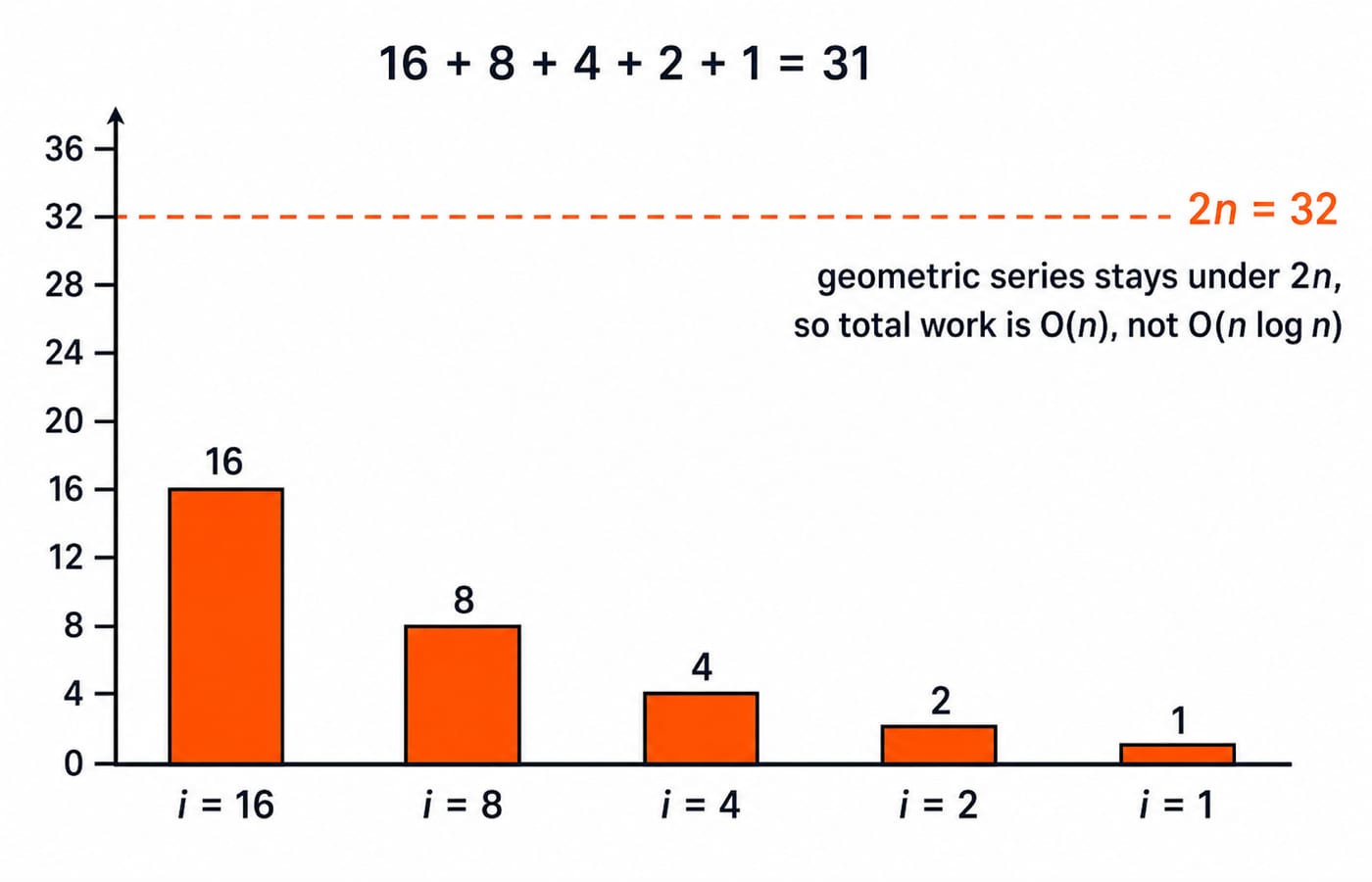
Answer: (c). For n = 16, work is 16 + 8 + 4 + 2 + 1 = 31, below 2n = 32. Generally, n + n/2 + n/4 + ... + 1 < 2n, so total work is O(n), not O(n log n).
Consider the following C function
int fun(int n) {
    int i, j;
    for(i=1; i<=n; i++) {
        for (j=1; j<n; j+=i) {
            printf("%d %d", i, j);
        }
    }
}
Time complexity of fun in terms of Θ notation is
(a) Θ(n√n) (b) Θ(n²) (c) Θ(n log n) (d) Θ(n² log n)
Answer: (c). For fixed i, the inner loop runs about n/i times. Total work is n/1 + ... + n/n = nH_n = Θ(n log n). For n = 8, exact counts are 7 + 4 + 3 + 2 + 2 + 2 + 1 + 1 = 22, close to 8H_8 ≈ 8 × 2.72 = 21.76.
What value does the loop leave behind?
For an accumulated value, read the update before counting rounds.
Consider the following C-program fragment in which i, j and n are integer variables.
for (i = n, j = 0; i > 0; i /= 2, j += i);Let val(j) denote the value stored in the variable j after termination of the for loop. Which one of the following is true?
(a) val(j) = Θ(log n) (b) val(j) = Θ(√n) (c) val(j) = Θ(n) (d) val(j) = Θ(n log n)
Answer: (c). Each update halves i, then adds the new i. For n = 16, i becomes 8, 4, 2, 1, 0 while j becomes 8, 12, 14, 15, 15. Thus j = 15. Generally, j = n/2 + n/4 + ... + 1, with integer rounding, so j = Θ(n).
Worst case, best case, and exact counting
Early exits split upper and lower bounds. Exact counts need a closed form and small-input check. See MCQ, MSQ or NAT? GATE Question Types Explained for the response formats.
Consider the following C code segment:
int IsPrime(n)
{
  int i,n;
  for(i=2;i<=sqrt(n);i++)
     if(n%i == 0)
      {printf("Not Prime\n"); return 0;}
  return 1;
}
Let T(n) denotes the number of times the for loop is executed by the program on input n. Which of the following is TRUE?
(a) T(n) = O(√n) and T(n) = Ω(√n)
(b) T(n) = O(√n) and T(n) = Ω(1)
(c) T(n) = O(n) and T(n) = Ω(√n)
(d) None of the above
Answer: (b). Prime n takes about √n - 1 iterations, so T(n) = O(√n). Even n returns at i = 2, so T(n) = Ω(1). That constant case breaks option (a)'s Ω(√n) claim.
Consider the following pseudo code. What is the total number of multiplications to be performed?
D = 2
for i = 1 to n do
    for j = i to n do
        for k = j + 1 to n do
            D = D * 3
(a) Half of the product of the 3 consecutive integers.
(b) One-third of the product of the 3 consecutive integers.
(c) One-sixth of the product of the 3 consecutive integers
(d) None of the above.
Answer: (c). Count triples with 1 <= i <= j < k <= n: C(n + 1, 3) = (n - 1)n(n + 1)/6. For n = 3, (i, j) = (1, 1) gives 2 choices for k; (1, 2) and (2, 2) give 1 each. Total = 2 + 1 + 1 = 4, matching 2 × 3 × 4/6 = 4. The consecutive integers are n - 1, n, n + 1.
Consider the following C function.
int fun1 (int n) {
     int i, j, k, p, q = 0;
     for (i = 1; i < n; ++i)
     {
        p = 0;
       for (j = n; j > 1; j = j/2)
           ++p;
       for (k = 1; k < p; k = k * 2)
           ++q;
     }
     return q;
}
Which one of the following most closely approximates the return value of the function fun1?
(a) n² (b) n(log n)² (c) n log n (d) n log(log n)
Answer: (d). The middle loop makes p = ⌊log₂n⌋. The third adds ⌈log₂p⌉ = Θ(log log n) per outer pass, so q ≈ (n - 1)log₂(log₂n) = Θ(n log log n). For n = 1024, p = 10; k takes 1, 2, 4, 8, adding 4 on each of 1023 passes. Thus q = 1023 × 4 = 4092.
The short version and your next step
A doubling or halving counter gives log n passes.
Multiply loop counts only when their bounds are independent. Otherwise sum the work: geometric series stay linear, while harmonic series give n log n.
A range from n/2 through n is still Θ(n).
Return-value questions count what accumulates, not merely how many rounds run.
Early exits can split the O upper bound from the Ω lower bound.
Every GATE PYQ above is solved inside GATE Guidance by Sanchit Sir. Identify your weak pattern, browse the GATE CS preparation options, then practise a focused set.
Keep learning
Computer Graphics Applications and Core Components MCQs: 12 Solved Questions with Explanations
Solve 12 published computer graphics questions, then use the explanations and worked calculations to strengthen the distinctions that make each answer clear.
17 Sep 20267 min readAlgorithms MCQs
Matrix Chain Order MCQs: 12 Solved GATE and UGC NET Questions with Explanations
Solve Matrix Chain Multiplication questions by applying one cost rule, comparing valid groupings, and filling the dynamic-programming table without arithmetic slips.
Updated 15 Sep 20267 min readAlgorithms MCQs
Substitution Method MCQs: 12 Solved GATE and ISRO Questions with Explanations
Work through 12 published GATE and ISRO PYQs on subtract-and-conquer, geometric growth, square-root recurrences, recursive code, and asymptotic matching.
Updated 14 Sep 20268 min readAlgorithms MCQs
Recursion Tree Method MCQs: 12 Solved Questions with Explanations
Solve 12 recursion tree MCQs covering exponential trees, uneven splits, harmonic level sums, square-root arguments, and exact recurrence forms.
Updated 13 Sep 20267 min read59 viewsAlgorithms MCQs