

Flowchart Interview Questions and Answers: Symbols, Traces and Debugging
Learn how to define, draw, trace and debug flowcharts in an interview. Two worked examples cover a terminating sum loop and a maximum calculation that preserves a tie.
KnowledgeGate Team
Exam prep & CS education
Updated 23 Nov 20266 min read
Remembering that a diamond means a decision is easy. The real test is turning a requirement into correct branches, terminating the loop, tracing values and explaining an edge case. In one trace, N = 5 produces 15, while A = 17, B = 23, C = 23 preserves the tie and identifies the maximum 23. Interview formats vary, so use these as preparation lenses.
What is a flowchart? Give the interview answer before the symbols
What is a flowchart? A flowchart visually represents an algorithm or process. Standard shapes hold actions, inputs, outputs and decisions; directed arrows show control order. A reviewer can inspect branches and loops before language syntax hides the logic.
Artefact | Representation | Best use |
|---|---|---|
Algorithm | Finite step-by-step method | Defining the logic |
Flowchart | Graphical control-flow view | Inspecting branches and loops |
Pseudocode | Language-neutral text | Preparing for code |
The three can describe the same logic but are distinct artefacts. A useful flowchart declares inputs and outputs, has a clear entry, labels decision exits, progresses on every loop path, and reaches termination unless it is deliberately ongoing. Neatness does not prove correctness.
Flowchart symbols interviewers expect you to use correctly
Shape | Meaning | Example |
|---|---|---|
Oval or rounded terminator | Start or finish |
|
Parallelogram | Input or output |
|
Rectangle | Assignment or calculation |
|
Diamond | Decision with distinct exits |
|
Arrow | Direction of execution | Loop body back to the decision |
Small connector circle | Continuation point | Avoiding crossed, unreadable lines |
Why must decision branches be labelled? A diamond states a condition; labels bind truth values to actions. Without Yes/True and No/False, readers must guess. For i <= N?, Yes enters the loop and No reaches output.
Assignments belong in rectangles. Diamonds mark genuine choices; connectors prevent crossings, not decorate simple logic.
Worked flowchart: sum the integers from 1 to 5
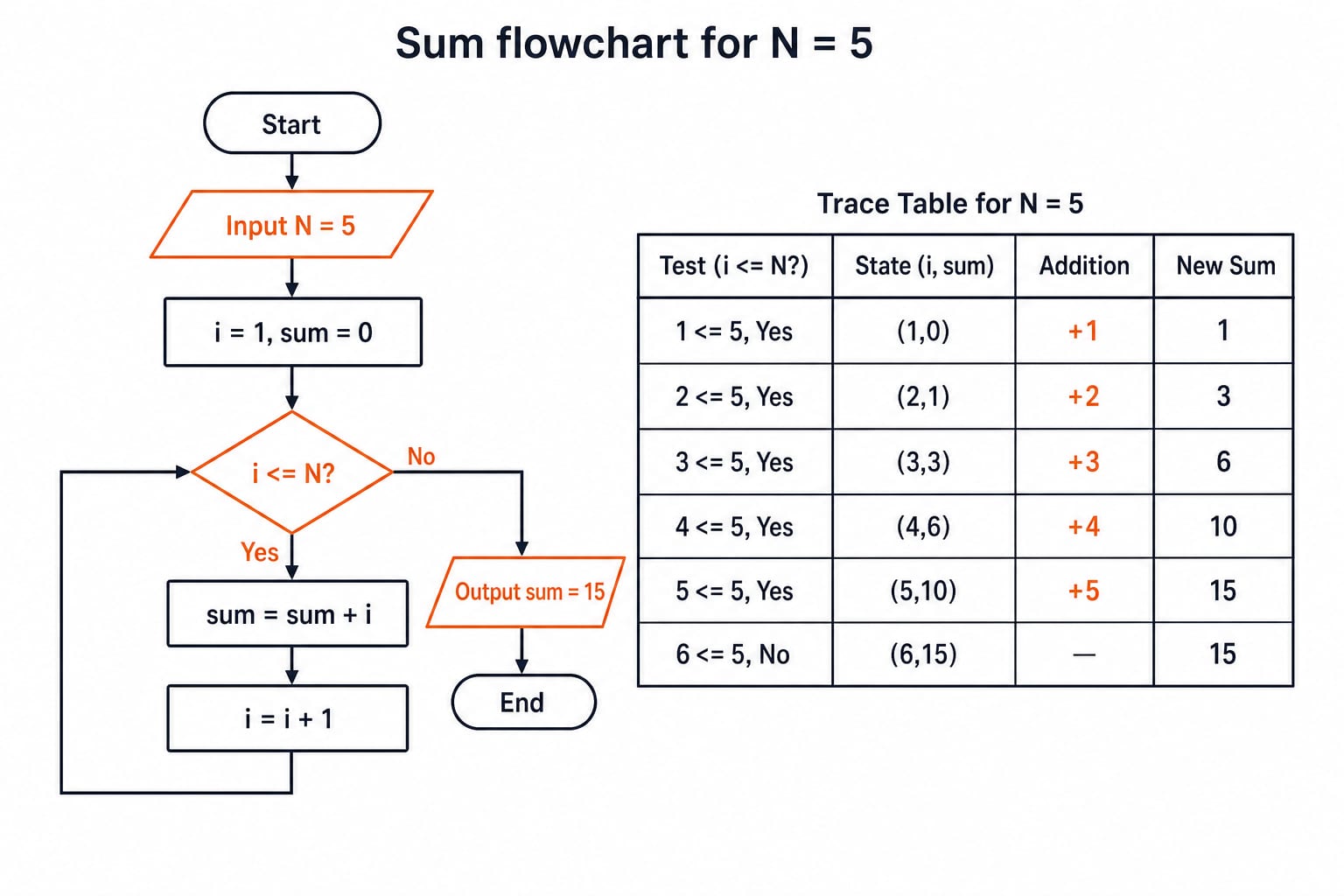
Draw a flowchart to compute the sum from 1 to N. Declare one integer input N >= 0; output 1 + 2 + ... + N. For N = 0, the result is 0.
The flow is Start -> Input N -> i = 1, sum = 0 -> i <= N?. On Yes, perform sum = sum + i, then i = i + 1, and return to the decision. On No, go to Output sum -> End. Incrementing before the back edge guarantees progress.
Decision value | Value added | Sum after addition | i after increment |
|---|---|---|---|
| 1 | 1 | 2 |
| 2 | 3 | 3 |
| 3 | 6 | 4 |
| 4 | 10 | 5 |
| 5 | 15 | 6 |
| none | 15 | 6 |
The output for N = 5 is 15. For N = 0, the first test 1 <= 0 is false, so the initial sum 0 is output. Negative input is outside the contract, so add a validation decision.
Worked decision flowchart: largest of three without losing a tie
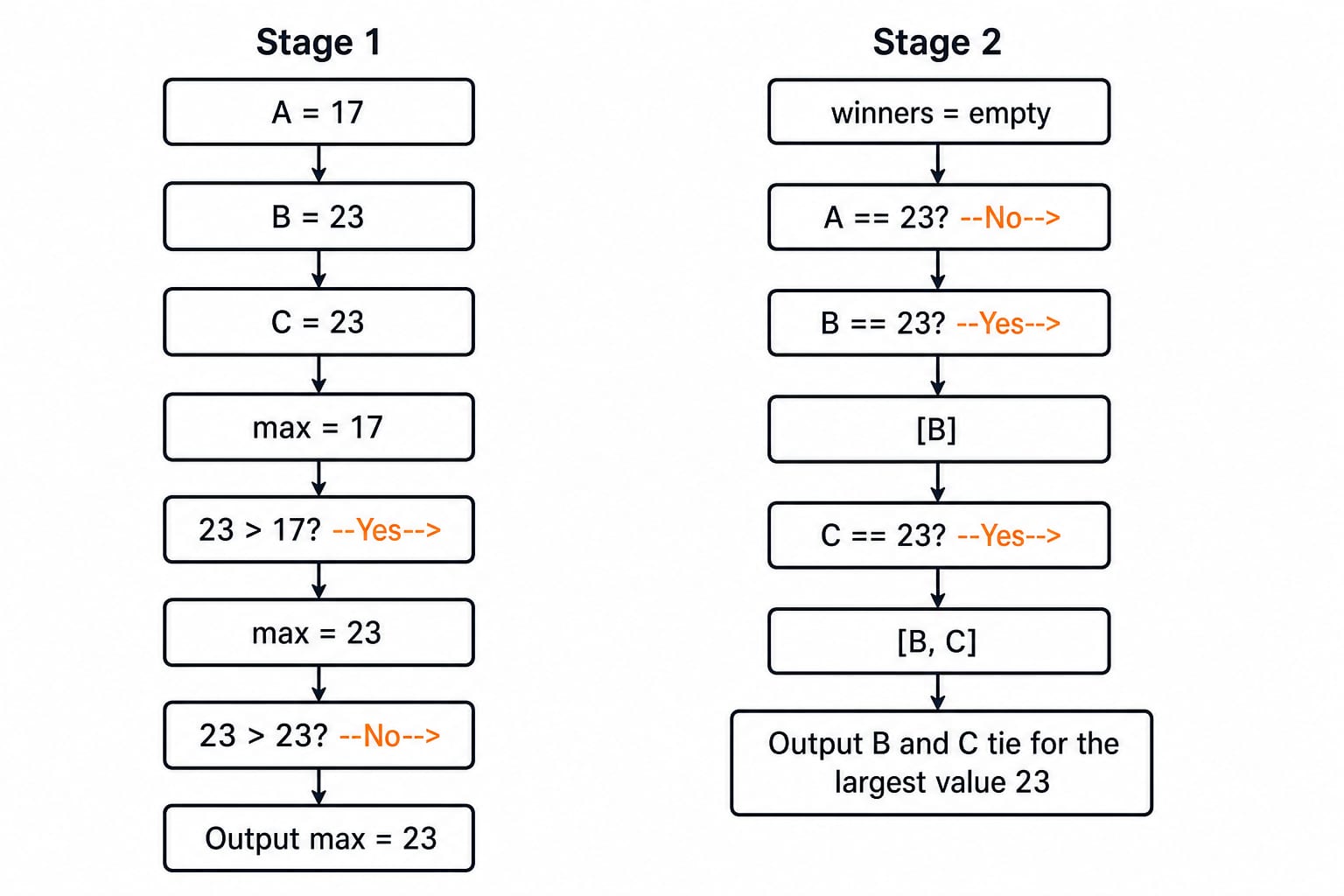
Draw a flowchart to find the largest of three values. For a maximum-value-only answer, initialise max = A. Test B > max?; update max = B only on Yes. Rejoin both exits before testing C > max?; update max = C only on Yes, then rejoin both exits before output.
For A = 17, B = 23, C = 23, start with max = 17. Since 23 > 17 is true, max becomes 23. Then 23 > 23 is false, so max remains 23. Output 23. Equality is safe because either equal input represents the same maximum value.
What if the interviewer asks which inputs share the maximum? Initialise winners as empty after finding max, then make three independent equality checks. A == 23 is false. B == 23 is true, so append B; C == 23 is true, so append C. Independent checks matter because stopping after B would miss another equal input such as C. Output B and C tie for the largest value 23. Keep the earlier > checks because they find a value, not a unique winner.
Trace, debug and translate the flowchart instead of redrawing blindly
What happens if the loop condition is i < N? With N = 5, i = 1 and sum = 0, the loop adds 1 + 2 + 3 + 4. It stops at i = 5 and outputs 10, not 15. Use i <= N because both endpoints are included.
What happens if i = i + 1 is missing? After the first pass, i remains 1. The condition 1 <= 5 stays true, so the loop never terminates. There is no final sum. Check every loop for an initial state, condition, progress update and reachable exit.
The chart translates to INPUT N; i <- 1; sum <- 0; WHILE i <= N: sum <- sum + i; i <- i + 1; OUTPUT sum. It must reproduce the chart's trace table. Use Pseudocode Questions for Placements: 3 Solved Traces for more practice.
Six common flowchart interview questions with model answers
Question | Model answer with reason |
|---|---|
Flowchart versus algorithm? | The algorithm is the method; a flowchart visualises its paths. |
Flowchart versus pseudocode? | One is graphical and one textual; both should produce the same trace. |
How is a loop shown? | A condition and back edge form the loop; |
Can a flowchart have several end points? | Yes, but one merged end makes a small diagram easier to verify. |
Does a flowchart prove correctness? | No. Contracts, path coverage, invariants and traces matter, as the failed |
When should a connector be used? | To prevent crossings or continue a large chart, never as unexplained shorthand. |
Label every decision's Yes and No exits. For broader language-level practice, translate the same trace into a small C function and test its boundary cases.
How a short flowchart question becomes a deeper interview discussion
A fundamentals prompt may ask for a definition, symbols and the N = 5 output. A deeper follow-up may change the contract to N = 0, introduce equal maxima, ask for termination reasoning, or request matching pseudocode and code.
Use this whiteboard routine:
Restate the input domain and exact output.
Write the smallest state variables.
Label every branch.
Trace one ordinary case and one edge case.
Read each path aloud and confirm progress towards exit.
For the sum, use N = 5 and then N = 0. For the maximum, compare ordinary input 17, 23, 19 with tie input 17, 23, 23. Capgemini Technical Interview: Pseudocode to Projects gives one recruiter-specific preparation context, not a universal process. Once both traces are reproducible without notes, Coding For Placements offers structured cross-language practice.
Flowchart interview answers in 30 seconds, then the next step
A flowchart visualises an algorithm. Terminators mark entry and exit, parallelograms handle input or output, rectangles perform work, diamonds split control, arrows set order, and loops must move state towards an exit.
Redraw N = 5 -> sum = 15 and 17, 23, 23 -> maximum 23 with winners B and C from memory, including every update and branch label. Build the underlying syntax with C Programming, or use Placement Preparation as the wider interview route.
Keep learning
Introduction to Flowcharts: Symbols, a Worked Example and Exam Traps
Learn how flowchart symbols express sequence, decisions and loops. Then trace a complete even-sum example, translate it into C and repair common logic defects.
Updated 18 Oct 20266 min read60 viewsC Programming & Data Structures
C Data Types Interview Questions and Answers: 12 Model Answers with Output Traces
Prepare C fundamentals with speakable answers, portable type rules and step-by-step output traces for integer division, promotions and unsigned conversion.
Updated 23 Nov 20266 min readInterview Corner

C Fundamentals Mistakes: Fix 11 Data-Type, Operator and Flowchart Errors
Short C expressions can hide strict rules. Diagnose and repair 11 common errors involving initialisation, conversions, operators, increments and flowcharts.
Updated 18 Nov 20265 min readC Programming & Data Structures
Debugging in Python: A Step-by-Step Tutorial with Runnable Examples
A repeatable Python debugging workflow built around one runnable invoice example. Learn to reproduce, inspect, fix, and protect the result with tests.
Updated 31 Oct 20265 min readPython