Infosys SE, DSE and Specialist Roles: A 6-Week Preparation Plan
Choose an SE anchor and a DSE or Specialist stretch lane, then follow a 72-hour plan built around fresh diagnostics, tested code, trace tables and measurable project evidence.
KnowledgeGate Team
Exam prep & CS education
Updated 25 Aug 20266 min read
SE, DSE and Specialist ambitions demand different depth from the same core: correct coding, CS fundamentals and project evidence. Use the Company-Specific Placement Courses catalog to find the available Infosys preparation resources, but confirm role names and requirements in your current assessment invitation or job description. Then follow one anchor role, one stretch role and six weeks of measured practice.
SE, DSE and Specialist: translate goals into preparation lanes
Use the three lanes below to allocate practice depth. Confirm official role names, selection rules and requirements in the current Infosys invitation or job description.
Lane | Preparation emphasis | Proof to produce |
|---|---|---|
SE anchor | Reliable implementation, aptitude or pseudocode practice, CS fundamentals | One correct, tested solution explained clearly |
DSE stretch | Stronger DSA range, complexity choices, project depth | Solve a fresh medium problem and defend the data structure |
Specialist stretch | Multi-constraint algorithms, optimisation, deeper trade-offs | Compare two approaches and explain when each fails |
Anchor the lane you can prove today, then give controlled extra time to the next lane. An application or home score cannot predict role consideration or allocation. Use the Infosys Superset Preparation Course for company-specific drills, then let the current invitation decide the exact practice mix.
Score a 100-point baseline before choosing the role anchor
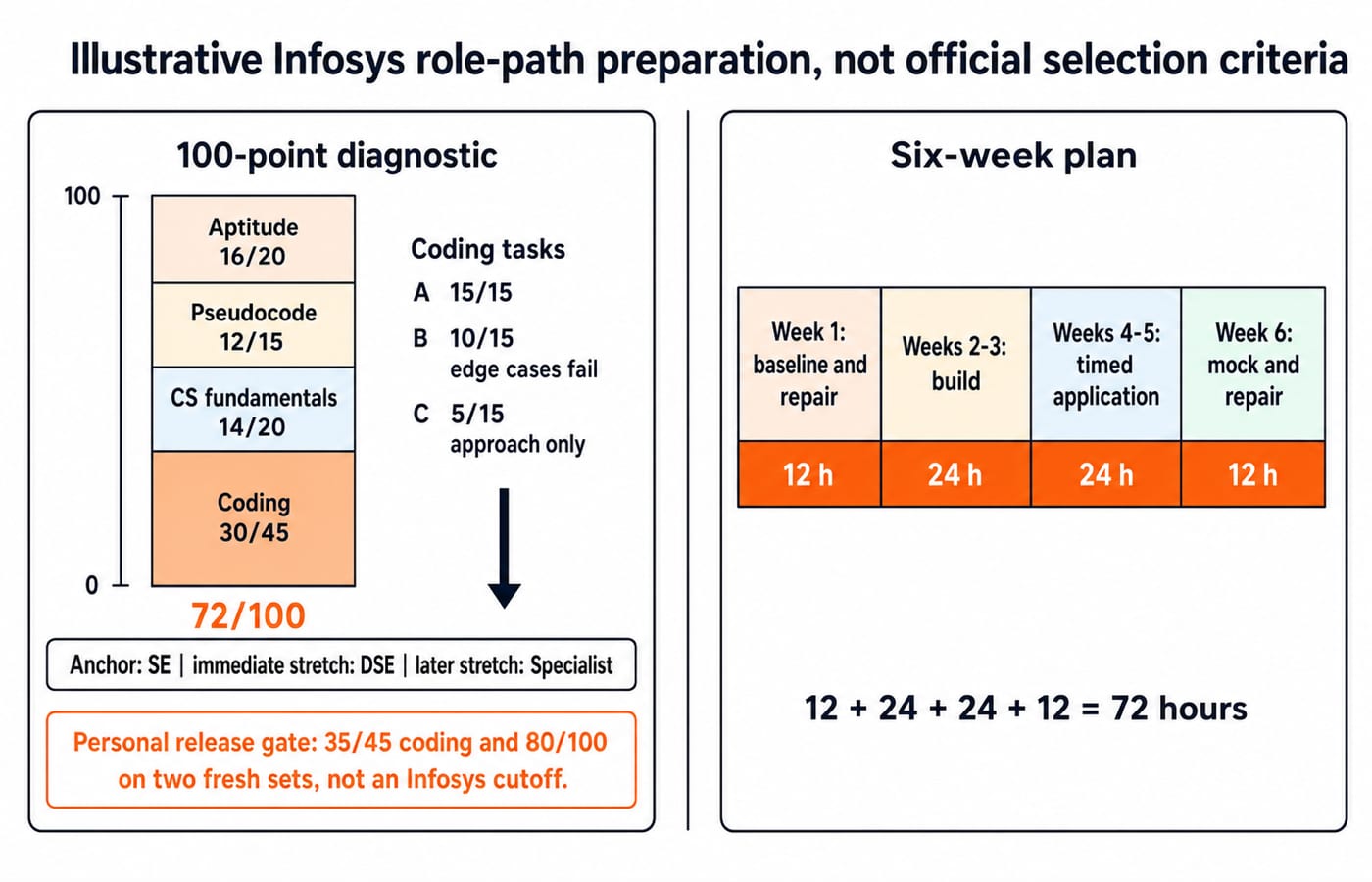
Build a home diagnostic with aptitude worth 20 points, pseudocode 15, CS fundamentals 20 and coding 45: 20 + 15 + 20 + 45 = 100. This is a personal practice rubric. Match its content, rather than these weights, to the current invitation.
Each of three coding tasks is worth 15: 5 for an approach, 5 for working code and 5 for edge tests. A learner scores aptitude 16/20, pseudocode 12/15 and CS 14/20. Task A earns 15/15; B earns 10/15 because edge cases fail; C earns 5/15 for an approach only. Coding is 15 + 10 + 5 = 30/45; total is 16 + 12 + 14 + 30 = 72/100.
That evidence makes SE the initial anchor, DSE the immediate stretch and Specialist a later stretch. Use personal release gates of 35/45 in coding, no zero implementation score, and 80/100 overall on two fresh sets. These are repeatability targets for your own practice, so compare only fresh sets built with the same rubric.
Infosys role preparation: spend 72 hours across six weeks
Use Monday to Thursday 90 minutes daily, Friday 60, Saturday 180 and Sunday 120, with breaks outside counted study time. (4 x 90) + 60 + 180 + 120 = 720 minutes = 12 hours; 6 x 12 = 72 hours.
Phase | Allocation | Total |
|---|---|---|
Week 1 | 2 h diagnostic + 3 h language/debugging + 3 h aptitude/pseudocode + 2 h CS + 2 h error review | 12 h |
Weeks 2-3 | Weekly: 5 h DSA/coding + 2 h aptitude + 2 h pseudocode + 2 h CS + 1 h review | 24 h |
Weeks 4-5 | Weekly: 6 h timed coding + 2 h CS + 2 h project/interview + 1 h mixed drill + 1 h review | 24 h |
Week 6 | 4 h mocks + 3 h repair + 2 h coding replay + 2 h project/resume + 1 h invitation/checklist | 12 h |
Check: 12 + 24 + 24 + 12 = 72 hours. Keep the timetable stable. SE adds test discipline, DSE adds broader structures and trade-offs, and Specialist adds multi-constraint optimisation. Use the current invitation or job description to decide which overlay gets extra time. The Infosys Superset Preparation Course provides company-specific drills for those study blocks.
Test one coding problem at SE, DSE and Specialist depth
For A = [4, 2, 7, 2, 9, 4, 2], return the most frequent value, its frequency and earliest zero-based index. Break frequency ties by earlier first occurrence.
A one-pass hash map records 4 -> count 2, first 0, 2 -> count 3, first 1, 7 -> count 1, first 2 and 9 -> count 1, first 4. Therefore the output is (2, 3, 1). With n elements and k distinct values, expected time is O(n) and space is O(k).
Test [5] -> (5, 1, 0); [3, 1, 3, 1] -> (3, 2, 0) because 3 appears first; and [-1, -1, 0] -> (-1, 2, 0). At SE depth, implement the map cleanly and test singletons, ties and negative values. At DSE depth, compare the expected O(n) map with in-place sorting at O(n log n): sorting can use little extra memory when the input may be reordered, but it costs more time and destroys the original order. At Specialist depth, add a streaming constraint. If the distinct-value map cannot fit in memory, explain why an exact count needs external state or extra passes, then state the error guarantee required before choosing an approximate heavy-hitter method. Continue with Coding for Placements.
Measure pseudocode, aptitude and CS practice
Start a = 3, b = 5. For i = 1 to 3, set a = a + i, then b = b + a.
Step | Result |
|---|---|
After |
|
After |
|
After |
|
The answer is a = 9, b = 24. Infosys Pseudocode Questions applies the same trace-table method to additional practice.
Make a 20-question home set: 7 quantitative, 5 logical, 4 verbal and 4 CS. A result of 5/7 + 4/5 + 4/4 + 3/4 = 16/20 = 80% means 4 wrong. If three correct answers were guesses, review 4 wrong + 3 guessed = 7 items. Revisit every wrong or guessed answer and note its cause. Use the current invitation or job description to decide whether the next set needs more aptitude, pseudocode, CS or coding.
Build measurable project evidence for role interviews
Use problem, measurement, change and trade-off. An illustrative search endpoint has 420 ms median latency over 100 local requests. After a composite database index, the same workload records 160 ms: (420 - 160) / 420 x 100 = 61.9% lower.
The database grows from 200 MB to 228 MB: 28 / 200 x 100 = 14%. Explain why faster reads justified storage and write cost. Record your own before-and-after measurements with the same workload instead of copying these illustrative figures into a resume.
SE explains implementation and testing. DSE defends index order and benchmark fairness. Specialist examines a write-heavy workload or changed query shape. Practise a 90-second version and this resume line: “Benchmarked a local search endpoint across 100 requests; reduced median latency from 420 ms to 160 ms with a composite index while documenting growth from 200 MB to 228 MB.”
Review six-week evidence and choose the next 60 minutes
Use the same rubric with fresh questions after Weeks 2, 4 and 6. Progress from 72 -> 77 -> 82 while the error count falls 14 -> 9 -> 5 shows fewer repeated causes only when the sets are fresh and similarly difficult. The two-set gate is not met because Week 4 is 77/100, even though Week 6 reaches 82/100 overall and 37/45 in coding. Keep SE as the anchor, retain DSE as the stretch, and run another fresh set. Specialist remains a target until multi-constraint tasks are explained consistently.
Lose 90 weekday minutes? Move 45 to the weekend and carry 45 into next week's lowest-priority new work. Lose 12 hours? Extend the calendar if the drive timeline permits. Never compress 12 + 12 = 24 hours into one week.
Next, spend 15 minutes reading the current invitation, 30 on a diagnostic slice and 15 opening an error log. The Infosys Placement Preparation Guide adds drive context. For structured company-specific study, use the Infosys Superset Preparation Course.
Keep learning
HCLTech Recruitment Process and Test Pattern: Build Your Drive Map
Build a source-controlled HCLTech drive map from the current role page and invitation, then use worked diagnostics to prepare for each assigned stage.
Updated 23 Oct 20265 min readCompany-Specific Prep
Capgemini Coding Questions: 4 Patterns with Step-by-Step Solutions
Learn four transferable coding patterns through constructed Capgemini preparation examples. Each solution includes an invariant, complete trace, complexity and edge-case checks.
Updated 19 Oct 20266 min readCompany-Specific Prep
Capgemini Placement Preparation: An 8-Week Test-Matched Study Plan
Build an eight-week Capgemini preparation timetable from the route you are actually invited to take. Use two baselines and an error log to decide where every study hour goes.
Updated 15 Oct 20265 min readCompany-Specific Prep
Cognizant Recruitment Process and Test Pattern: What Each Stage Screens
Learn how to read a Cognizant drive invitation, map each possible stage to the skill it screens, and turn the stated test blocks into a focused study plan.
Updated 11 Oct 20265 min readCompany-Specific Prep