IBPS SO IT Officer DBMS: the professional knowledge topics that matter
The DBMS core of the IBPS SO IT Officer Mains Professional Knowledge paper: the ER model, keys, normalization with a worked example, SQL essentials and transactions, and how each is tested.
KnowledgeGate Team
Exam prep & CS education
Updated 26 Jul 20266 min read1.2k views
For the IBPS SO IT Officer, the Mains is a Professional Knowledge paper, and Database Management Systems is one of the most dependable subjects on it. Five blocks carry the DBMS core: the ER model, keys, normalization, SQL, and transactions. Get those straight and the questions become quick, clean marks rather than guesswork, because they reward applied understanding and punish half-memorised definitions.
DBMS and the Professional Knowledge paper: why a banking exam tests it
A database management system is software that stores, organises, and retrieves data while enforcing consistency and controlling concurrent access. It matters to a bank because banking runs on transactional data: accounts, balances, and transfers that must stay correct under heavy simultaneous use. That is exactly why the DBMS questions lean on the ER model and keys, normalization, SQL, and the transaction guarantees that keep data correct. Learn those five and the rest follows.
The ER model: entities, attributes, and relationships
The Entity-Relationship model is how a database is designed before it is built.
An entity is a real-world object the database stores data about, such as Customer or Account.
An attribute is a property of an entity, such as a customer's name or an account's balance. A key attribute uniquely identifies each instance.
A relationship connects entities, such as a Customer holds an Account.
Relationships carry a cardinality: one-to-one, one-to-many, or many-to-many. Reading the cardinality of a described relationship is a standard question, so hold those three types clearly. The ER diagram is then mapped to tables to build the actual relational schema.
Keys: how rows are identified
Keys are the backbone of the relational model and a reliable question source. Keep the hierarchy straight.
A super key is any set of attributes that uniquely identifies a row.
A candidate key is a minimal super key, one with no removable attribute.
The primary key is the candidate key chosen to identify rows; it cannot be null and must be unique.
A foreign key is an attribute in one table that refers to the primary key of another, which is how tables are linked and how referential integrity is enforced.
The one line that answers most key questions: every candidate key is a super key, but only a minimal super key is a candidate key.
Normalization: a worked 1NF to 3NF example
Normalization organises attributes into tables to remove redundancy and the update problems it causes. It proceeds through normal forms. Work one small example end to end.
Start with one unnormalised table, StudentCourses, holding StudentID, StudentName, DepartmentID, DepartmentName and a repeating group of {CourseID, Grade} crammed into a single cell:
1NF (First Normal Form): atomic values. Every cell must hold a single value. Split the repeating {CourseID, Grade} group so each student-course pair is its own row. The table is now in 1NF, with a composite key of (StudentID, CourseID).
2NF (Second Normal Form): no partial dependency. A non-key attribute must depend on the whole key, not part of it. StudentName and the department attributes depend only on StudentID, which is part of the composite key, so move them into a separate Student table keyed by StudentID and leave Enrollment holding (StudentID, CourseID) and Grade. The partial dependency is gone.
3NF (Third Normal Form): no transitive dependency. A non-key attribute must not depend on another non-key attribute. Student now holds StudentID, StudentName, DepartmentID and DepartmentName, and DepartmentName depends on DepartmentID rather than on StudentID. Move DepartmentID and DepartmentName into their own Department table, keep DepartmentID in Student as a foreign key, and the transitive dependency is gone.
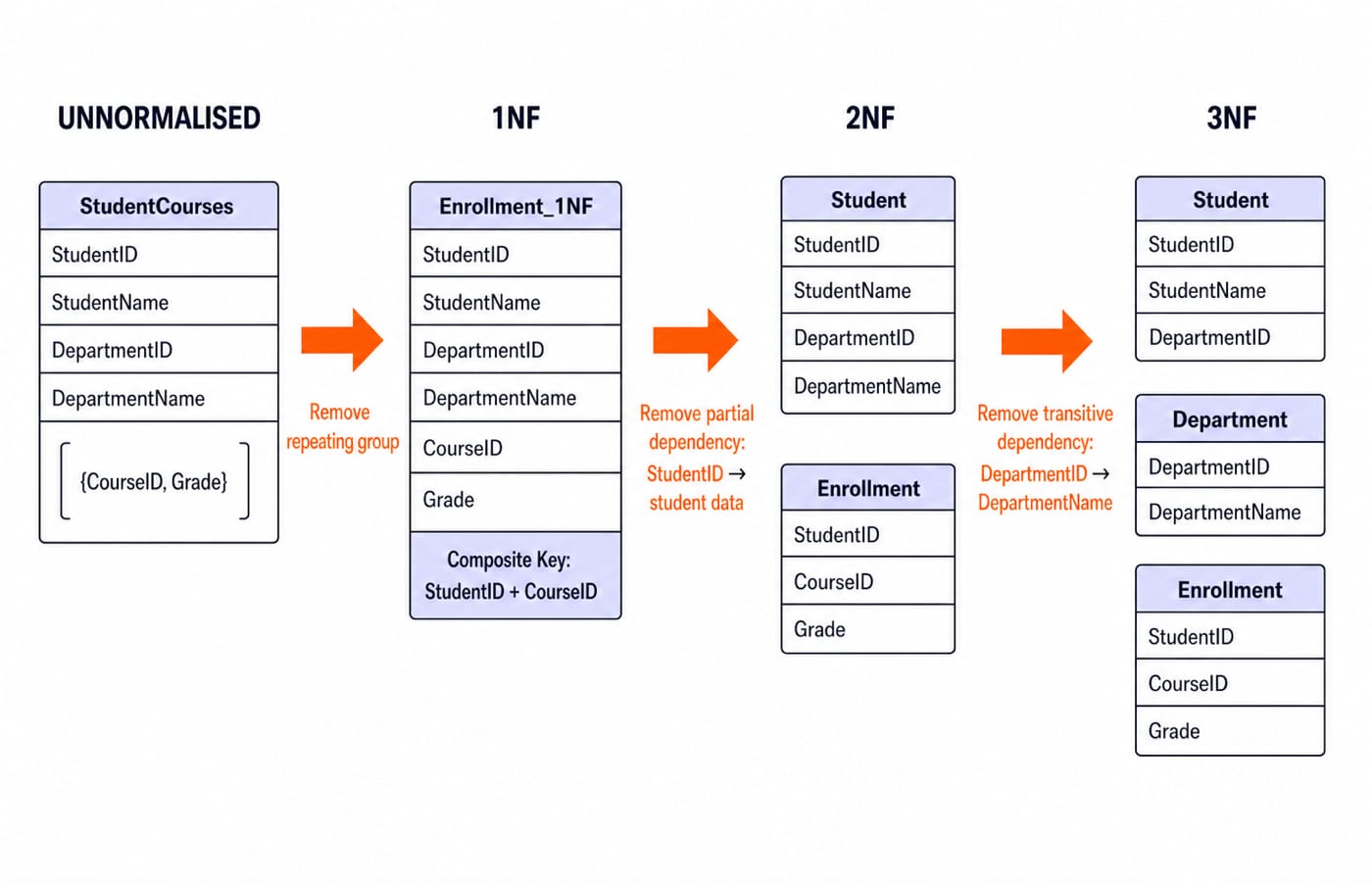
The progression to memorise: 1NF removes multi-valued cells, 2NF removes partial dependencies, 3NF removes transitive dependencies, and BCNF is a stricter form of 3NF. Being able to name which normal form a table violates is the exact skill the paper tests.
SQL: the query language essentials
SQL is how you talk to a relational database, and the Professional Knowledge paper expects working familiarity.
DDL (Data Definition Language) defines structure: CREATE, ALTER, DROP.
DML (Data Manipulation Language) handles data: SELECT, INSERT, UPDATE, DELETE.
A basic query reads SELECT columns FROM table WHERE condition, with GROUP BY for aggregation and ORDER BY for sorting.
A JOIN combines rows from two tables on a related column; an inner join keeps only matching rows, while outer joins keep unmatched rows from one or both sides.
Aggregate functions, COUNT, SUM, AVG, MAX, MIN, summarise groups of rows.
Expect a short query to read and interpret, or the odd one out among clause keywords. Fluency with SELECT, WHERE, and JOIN covers most of it.
Transactions and ACID
A transaction is a unit of work that must complete fully or not at all, and this is where banking cares most. The guarantees are the ACID properties:
Atomicity. All operations in a transaction succeed together, or none do.
Consistency. A transaction moves the database from one valid state to another.
Isolation. Concurrent transactions do not interfere; each behaves as if run alone.
Durability. Once committed, changes survive even a system crash.
A transfer between two accounts is the textbook case: debit one and credit the other must be atomic, or money is created or lost. Naming an ACID property from a described failure is a favourite question, and the banking framing makes it stick.
How DBMS is tested in IBPS SO IT
On the Mains Professional Knowledge paper, DBMS appears as objective questions pitched at applied understanding rather than rote recall. The reliable patterns: identify a key type, name the normal form a table violates, read a short SQL query, match an ACID property to a scenario, and read the cardinality of an ER relationship. Because this is the same relational core that GATE, UGC NET, and campus placements test, preparation transfers across exams. How many DBMS questions appear and how the paper is weighted is set in the official notification, so confirm it on ibps.in for your cycle.
Take the ACID pattern, where marks leak most easily. Two withdrawals hit the same account at the same instant, both read the old balance, and the account ends up overdrawn. That is an isolation failure: each transaction behaved as though it were running alone when it was not. Consistency would be the answer only if a completed transaction had left the data breaking a stated rule, and durability only if a committed change went missing after a crash. Read the failure first, then name the property.
Our question bank carries over 2,000 DBMS questions, with SQL, keys, normalization and transactions among the largest blocks, so practice there lands on the same patterns.
Your next step
DBMS deserves a large share of your Professional Knowledge revision because it is dependable: the concepts are fixed and the question shapes repeat. The IBPS SO IT Mains course prepares the Professional Knowledge paper subject by subject, and it sits inside the IBPS IT Officer Scale-I bundle, which covers Prelims, Mains and the interview. Browse the wider set from the banking and insurance category.
For the full paper's subject spread, our IBPS SO IT professional knowledge topic map sets DBMS in context. To go deeper on normalization and SQL, our normalization in DBMS explained and SQL queries and joins in DBMS deep-dives, written for GATE and campus-placement readers, carry the same core further.
Learn the ER model and keys cold, work one normalization example by hand, read SQL fluently, and know ACID by its banking example. Do that, and DBMS becomes the most reliable subject on your Professional Knowledge paper.
Keep learning
SQL Joins Explained: INNER, LEFT, RIGHT, FULL, CROSS and SELF with Runnable Examples
Trace all six SQL join types on one support-agent dataset, with runnable queries, exact outputs, NULL behaviour, row counts and filter-placement traps.
Updated 21 Oct 20265 min readDBMS
GROUP BY and HAVING in SQL: Syntax and Worked Examples
Trace eight sales rows through WHERE, GROUP BY, aggregates, and HAVING, then tackle multiple columns, NULLs, COUNT variants, and common query traps.
Updated 17 Oct 20265 min readDBMS
SQL Aggregate Functions: COUNT, SUM, AVG, MIN and MAX with Examples
Use one runnable sales table to see exactly how SQL aggregates treat rows, NULL values, duplicates and groups. Every result includes the arithmetic behind it.
Updated 13 Oct 20265 min readDBMS
Query Languages in DBMS: Relational Algebra, SQL and a Worked Query
Follow one database request from plain English to relational algebra, intermediate relations, relational calculus and SQL, with every result traced.
Updated 9 Oct 20265 min readDBMS