

GATE CS Syllabus Dependency Map: Prerequisites for Every Subject
See which GATE CS subjects reuse earlier concepts, test your readiness with a simple 0 to 3 scale, and choose a sensible next subject without forcing one fixed order.
KnowledgeGate Team
Exam prep & CS education
Updated 23 Nov 20265 min read
The official syllabus tells a first-time aspirant what to cover, but not which ideas make later subjects easier. Data Structures supports Algorithms, while automata and grammars reappear in Compiler Design. Concept reuse makes some subjects easier to start after others, and prerequisite readiness helps choose the next subject. The dependency map complements GATE CS Exam Preparation without imposing one compulsory order.
1. Start with the official syllabus boundary, not a coaching sequence
The completed GATE 2026 CS syllabus names ten sections: Engineering Mathematics, Digital Logic, Computer Organization and Architecture, Programming and Data Structures, Algorithms, Theory of Computation, Compiler Design, Operating System, Databases, and Computer Networks. For concept reuse, treat Engineering Mathematics as Discrete Mathematics and Linear Algebra + Calculus + Probability, and treat Programming and Data Structures as C Programming and Data Structures. General Aptitude stays separate.
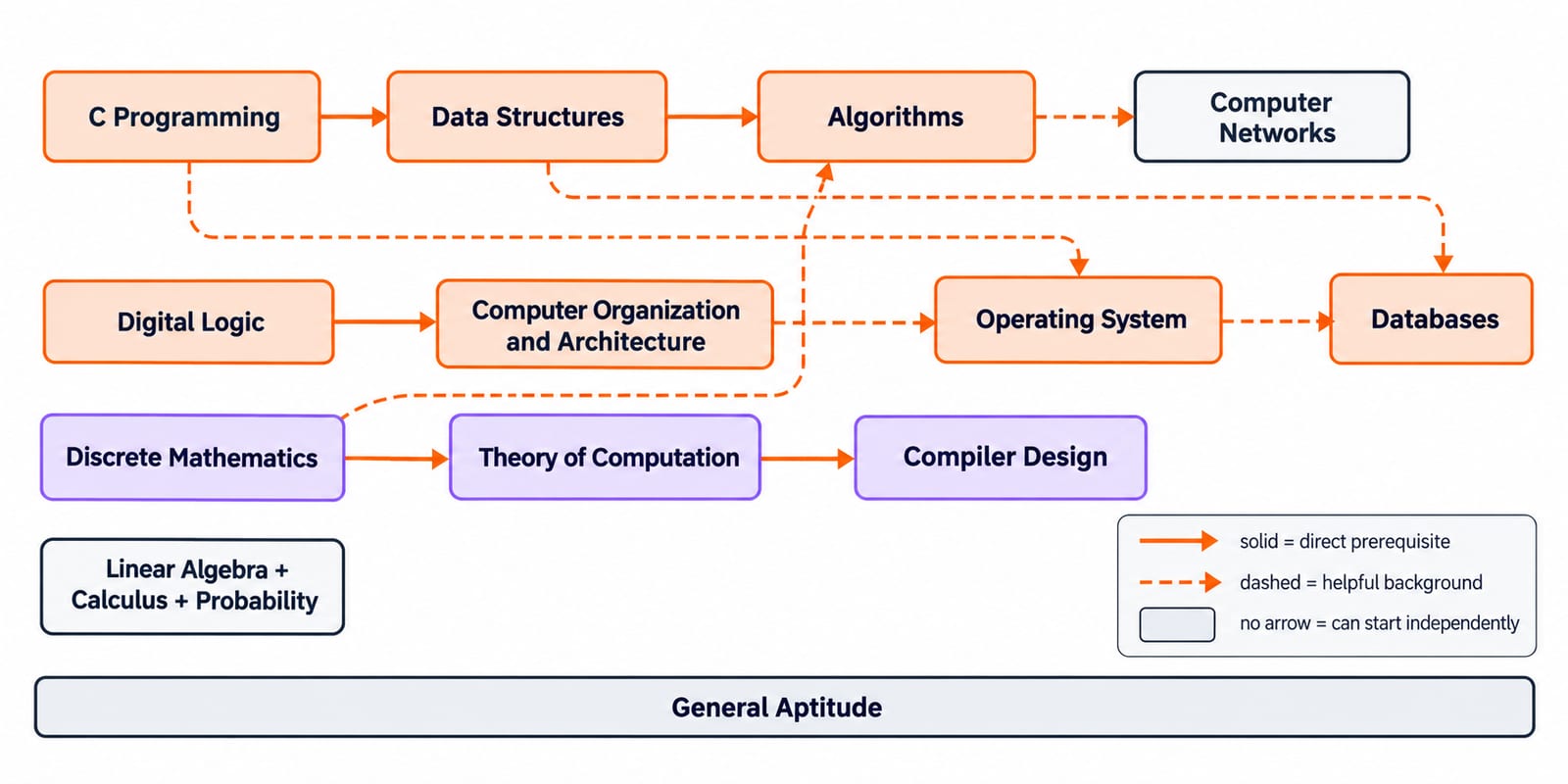
The ten official sections define the syllabus boundary, and the arrows show how concepts can be reused during study. Solid means direct reuse, so learn the source first. Dashed means helpful background that can be repaired when needed. No arrow permits an independent start. Arrows never mean higher weightage.
2. Use the dependency map before choosing a starting point
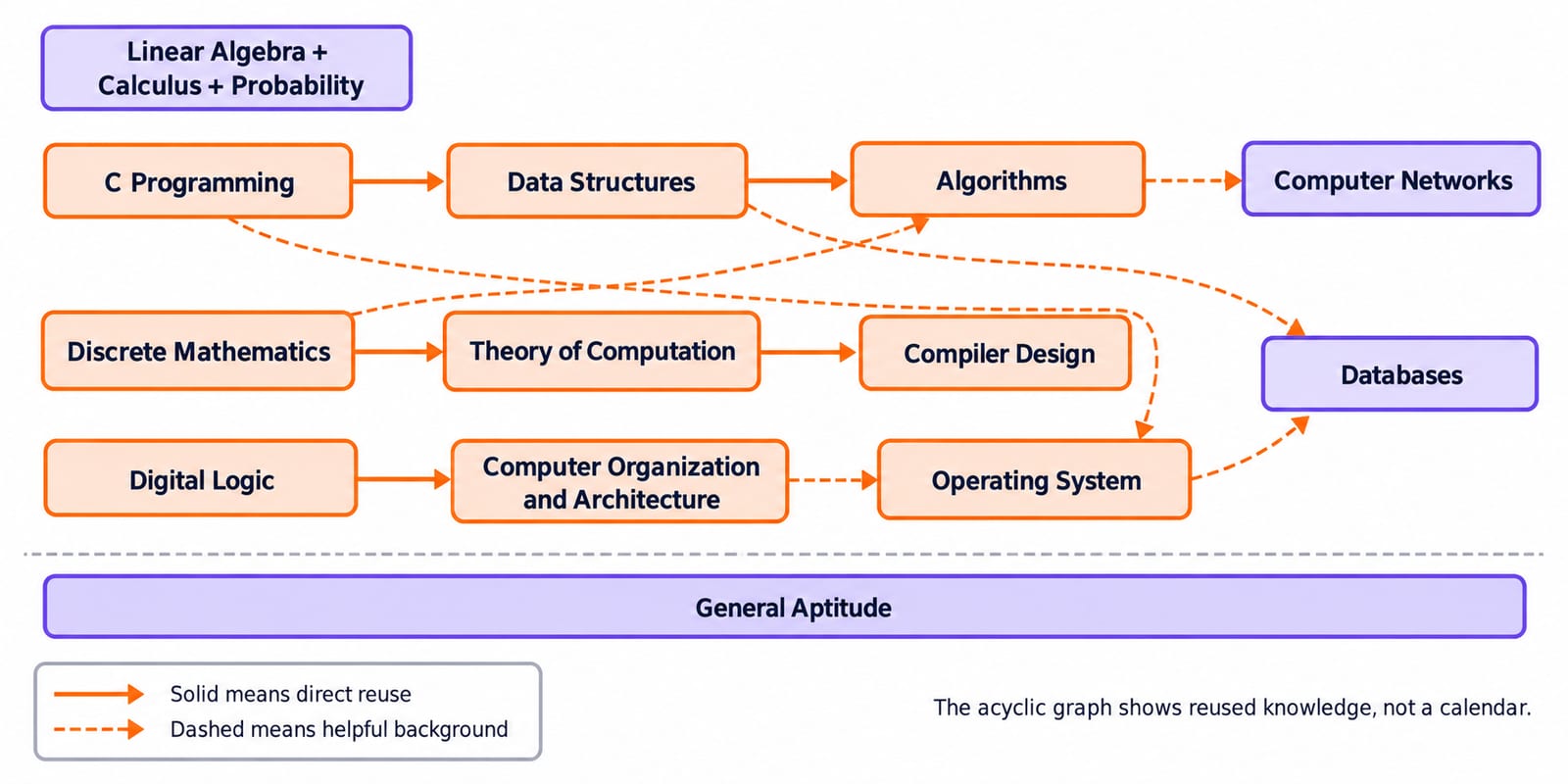
Read left to right. The main roots are C Programming, Discrete Mathematics, and Digital Logic. Linear Algebra + Calculus + Probability is a parallel root, while General Aptitude is a continuous lane outside the CS map. Databases and foundational Computer Networks can start independently.
Solid chains are C Programming -> Data Structures -> Algorithms, Discrete Mathematics -> Theory of Computation -> Compiler Design, and Digital Logic -> Computer Organization and Architecture. Dashed arrows are Discrete Mathematics -> Algorithms, Computer Organization and Architecture -> Operating System, C Programming -> Operating System, Data Structures -> Databases, Operating System -> Databases, and Algorithms -> Computer Networks. The acyclic graph shows reused knowledge, not a calendar.
3. Programming to data structures to algorithms: prove the arrow with one trace
C provides arrays, pointers, recursion, and representation. Data Structures adds lists, trees, heaps, and graphs. Algorithms then asks you to search, sort, optimise, and analyse those structures. This is concept reuse, not an official prescribed order.
Take V = {A,B,C,D} with undirected edges AB=4, AC=1, BC=2, BD=1, CD=5. Its adjacency lists are A: B(4), C(1); B: A(4), C(2), D(1); C: A(1), B(2), D(5); D: B(1), C(5).
Run Dijkstra from A:
Start:
A=0;B=C=D=infinity.After
A:B=4,C=1.After
C: improveBto1+2=3; setDto1+5=6.After
B: improveDto3+1=4.
Final distances are A=0, C=1, B=3, D=4; the shortest route to D is A-C-B-D. The adjacency list and priority choice are the Data Structures layer. Relaxation and shortest-path reasoning are the Algorithms layer.
4. Discrete mathematics to theory of computation to compiler design
Sets, relations, functions, logic, and graphs support formal state-and-transition thinking. Theory of Computation develops regular expressions, finite automata, context-free grammars, and push-down automata. Compiler Design reuses regular-language ideas in lexical analysis and grammar ideas in parsing.
For sum2+3, apply ID = [a-z][a-z0-9]* and NUM = [0-9]+ to get ID(sum2), PLUS(+), NUM(3). For token shape id + id, use E -> E + T | T and T -> id. The leftmost derivation is E => E + T => T + T => id + T => id + id. This shows reuse, not that every Compiler Design topic must wait for all of Theory of Computation.
5. Digital logic to architecture, then helpful context for operating systems
Digital Logic -> Computer Organization and Architecture is solid because number representation and combinational or sequential logic feed arithmetic, datapaths, control, and memory organisation. COA -> Operating System is dashed: architecture helps with interrupts, I/O, memory hierarchy, and address translation, but OS study can begin earlier.
Take a toy 16-bit logical address 0x5A3C with a 4 KiB = 2^12 page. Its lower 12 bits give offset 0xA3C = 10 x 256 + 3 x 16 + 12 = 2620; its upper 4 bits give page number 0x5 = 5. The bit boundaries come from Digital Logic, memory organisation from COA, and paging interpretation from Operating System. This is not an official GATE machine specification.
6. Treat databases and networks as multi-entry subjects, not locked endpoints
Arrows into Databases are dashed: sets and relations help with the relational model, trees with B and B+ tree indexing, and Operating System concurrency with transactions and concurrency control. Yet SQL, ER modelling, and basic relational algebra can begin earlier.
Computer Networks has an independent entry through layering, framing, IP addressing, TCP, UDP, and application protocols. Algorithms helps with routing topics such as shortest paths. The four-node graph is an analogy, not a real protocol. GATE CS subject weightage separates two decisions: dependency centrality asks what unlocks learning, while weightage or practice density asks where study time may pay off.
7. Apply the map to a learner with actual readiness scores
Score each node: 0 = not started, 1 = recalls definitions, 2 = solves guided questions, 3 = solves timed PYQs. A node is ready when every solid prerequisite reaches 2. Dashed gaps need repair notes but do not block it. Use genuine questions and the PYQ readiness-check method for level 3.
Suppose C Programming=3, Data Structures=2, Discrete Mathematics=1, Digital Logic=0, and later nodes are 0. Algorithms is ready because Data Structures is 2. Theory of Computation is not because Discrete Mathematics is 1; Computer Organization and Architecture is not because Digital Logic is 0; Compiler Design is not because Theory of Computation is 0. Databases and foundational Computer Networks may start, with dashed gaps logged.
Turn the diagnosis into a calendar with GATE CS Subject Order: A Prerequisite-Led Plan That Avoids Relearning. That plan owns the 24-week calendar, hour budget, recovery rule, and block-level readiness checks; this map owns the conceptual arrows, dependency examples, and node-by-node readiness decision. For a structured, personalised option, consider GATE Guidance by Sanchit Sir. Use matching CS and Discrete Mathematics practice questions to test readiness; practice depth is not official weightage.
8. Avoid three map-reading mistakes, then choose the next action
Three mistakes distort the map: treating arrows as official weightage; waiting for a prerequisite to reach 3 when 2 is enough; and turning dashed edges into barriers. Keep General Aptitude and the independent mathematics lane running in parallel.
Score every node from 0 to 3, pick one whose solid prerequisites are at least 2, and write one repair note for each dashed gap. Score the map today, then retest weak nodes with timed mixed questions after your first syllabus pass.
Go deeper with the full courseGATE Guidance by Sanchit Sir
Keep learning
GATE CS Subject Order: A Prerequisite-Led Plan That Avoids Relearning
Choose GATE CS subjects by what they unlock. This practical route combines dependency gates, a parallel mathematics lane, and an 18-hour weekly budget.
Updated 22 Nov 20265 min readGATE Strategy & Roadmap
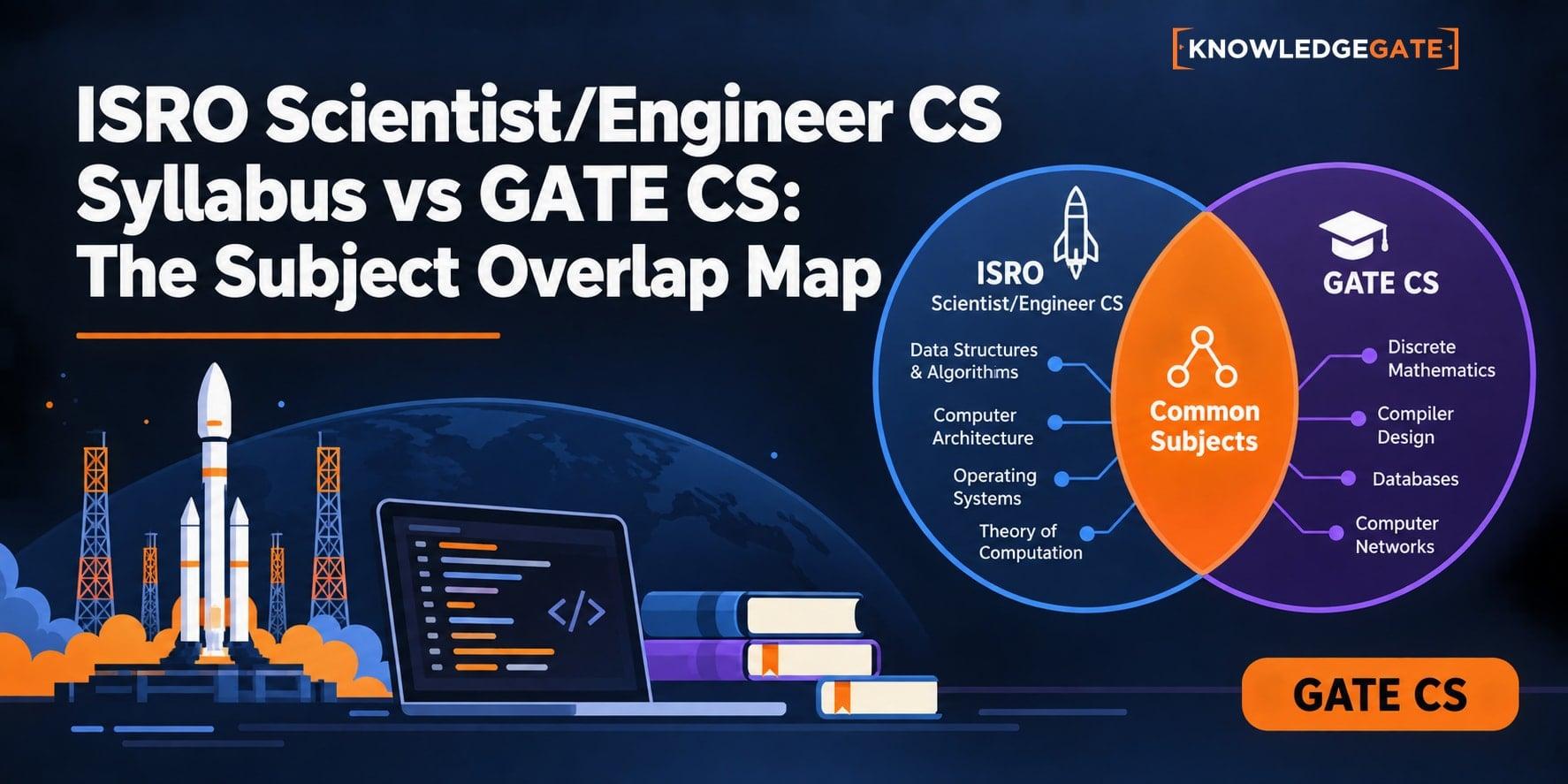
ISRO Scientist/Engineer CS Syllabus vs GATE CS: The Subject Overlap Map
See which core CS subjects transfer directly from GATE to ISRO, what drops out, how the question texture changes and where an ISRO-specific polish helps.
Updated 29 Oct 20264 min read80 viewsGATE Strategy & Roadmap
PSU Through GATE CS Interview Preparation: A 14-Day Core-Subject Revision Map
Turn a broad CS syllabus into a focused interview plan. This 14-day map uses answer cards, whiteboard drills, diagnostics, and two feedback-led mocks.
Updated 30 Oct 20265 min readPSU Through GATE

GATE CS Subject Weightage: Where Your Study Hours Actually Pay Off
Not every GATE CS subject rewards your hours equally. Here is a practical way to prioritise, grounded in how questions actually distribute across the syllabus.
Updated 29 Oct 20264 min read214 viewsGATE Strategy & Roadmap