Group Theory in Discrete Mathematics: Group Tests, Subgroups and Worked Examples
Learn a repeatable group test through addition and multiplication modulo 8, subgroups, cosets, a quotient map, and non-commuting permutations in S_3.
KnowledgeGate Team
Exam prep & CS education
Updated 13 Aug 20266 min read
Remembering the words closure, identity and inverse is not enough to classify an algebraic structure. Every property depends on both the set and the named operation, so a familiar set can pass one group test and fail another. The method that survives this is fixed in order: name the set, name the operation, then test closure, associativity, identity and inverses one at a time. Addition and multiplication modulo 8, the subgroup of even residues, a map from Z_8 to Z_4, and permutations in S_3 each stress a different part of that order.
The algebraic-structure ladder: operation to Abelian group
A binary operation on a set G is a map * : G x G -> G: it combines any two elements of G and returns an element of G. Closure gives an algebraic structure. If the operation is associative, the structure is a semigroup. Add an identity and it becomes a monoid. If every element has an inverse, it is a group. If the operation also commutes, it is an Abelian group.
Always name the pair, such as (G, *), because changing * can change the classification. For example, finite strings under concatenation form a monoid. Concatenation is associative and the empty string epsilon is the identity, but ab has no string inverse: no finite string concatenated with ab can produce epsilon. Rings and fields sit one level above, adding a second operation to the same set, and groups, rings and fields works that hierarchy out on the integers modulo 6.
Worked group test: addition and multiplication modulo 8
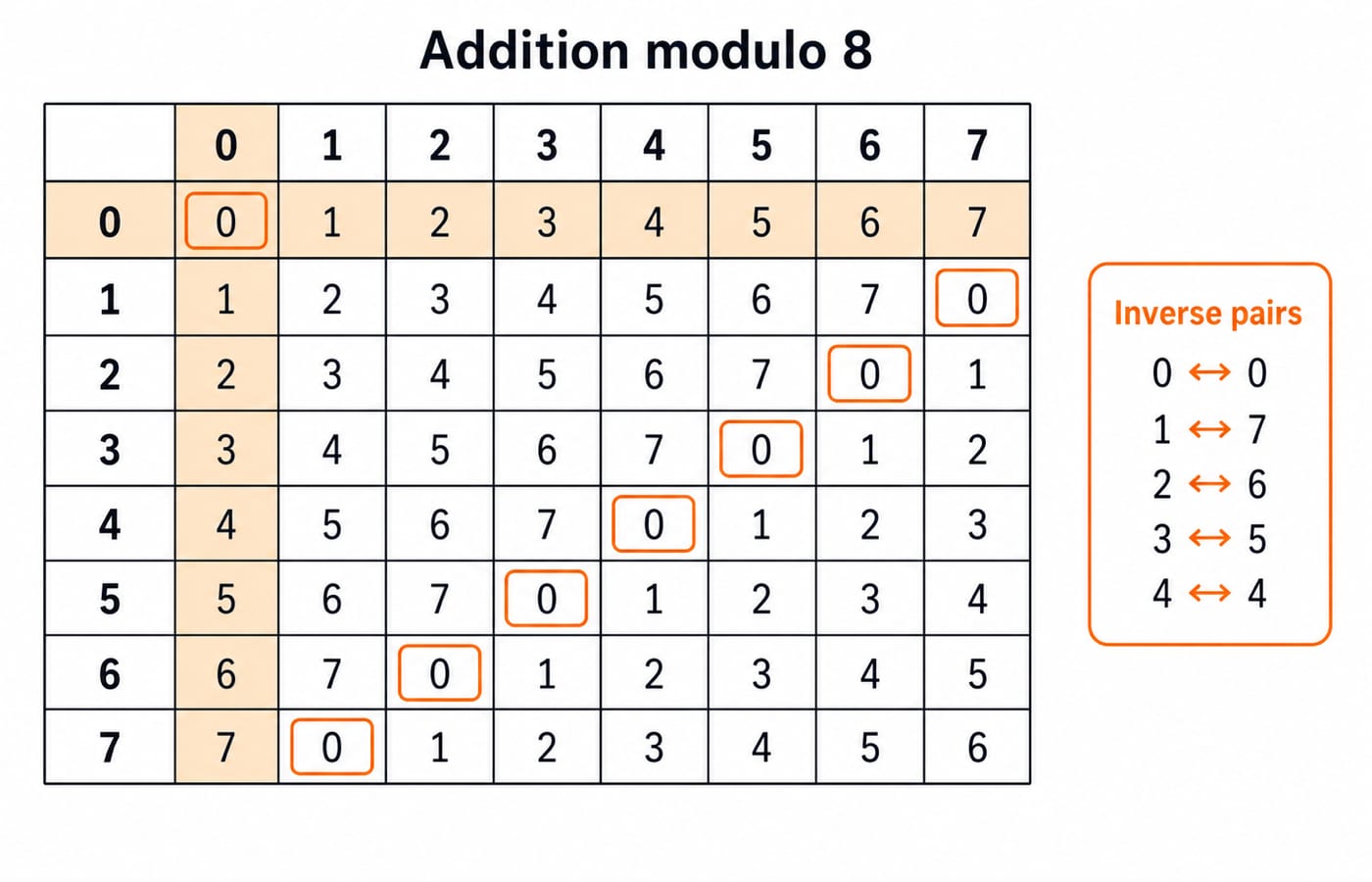
Take Z_8 = {0,1,2,3,4,5,6,7} under addition modulo 8. Closure holds because reducing the sum of two residues modulo 8 returns another residue in Z_8. For a concrete check, 5 + 6 = 11 = 3 (mod 8). Associativity comes from integer addition:
([a] + [b]) + [c] = [a + b + c] = [a] + ([b] + [c]).
The identity is 0. Every element has an additive inverse, with pairs 0 <-> 0, 1 <-> 7, 2 <-> 6, 3 <-> 5, and 4 <-> 4. Each pair sums to 0 modulo 8. Finally, [a] + [b] = [b] + [a], so (Z_8, +_8) is an Abelian group.
Now keep the set but use multiplication modulo 8. The pair (Z_8, x_8) is closed and associative, and its identity is 1. It still is not a group. Multiplying every residue by 2 gives
2 x {0,1,2,3,4,5,6,7} (mod 8) = {0,2,4,6,0,2,4,6}.
The result never equals 1, so 2 has no multiplicative inverse. The element 0 has none either. Changing only the operation has changed the structure.
Cyclic groups, element order, subgroups and cosets
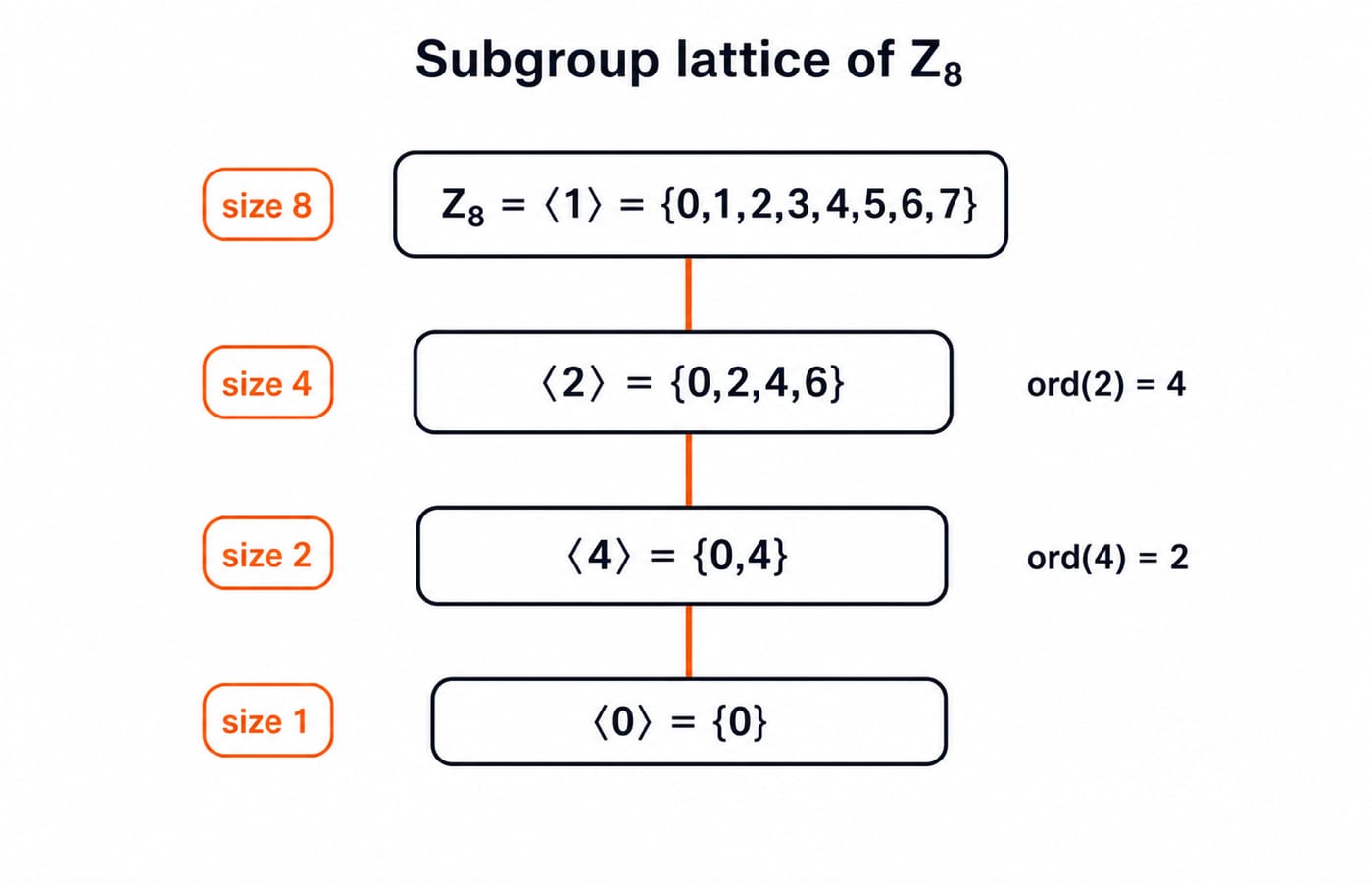
In additive Z_8, repeated addition of 2 gives <2> = {0,2,4,6}, then returns to 0, so ord(2) = 4. Similarly, <4> = {0,4} and ord(4) = 2. Each of 1, 3, 5 and 7 generates all eight residues, so each is a generator of Z_8.
Let H = {0,2,4,6}. The one-step subgroup test first asks whether H is non-empty, which it is. If a and b are even residues, then a - b (mod 8) is also even, so it remains in H. Thus H is a subgroup. Only now should Lagrange's theorem be applied: |H| = 4 divides |Z_8| = 8. The two distinct cosets are H = {0,2,4,6} and 1 + H = {1,3,5,7}. Those two cosets are exactly the equivalence classes of the relation that holds when a - b lies in H, so they partition Z_8 with nothing left over and nothing shared.
Homomorphisms, kernels and the quotient idea
Define phi : Z_8 -> Z_4 by phi([x]_8) = [x]_4. This is well-defined because numbers equal modulo 8 are also equal modulo 4. It preserves addition. In Z_8, [5] + [7] = [12] = [4], so phi([4]) = [0]_4. Separately, phi([5]) + phi([7]) = [1] + [3] = [0]_4. Both routes agree.
The kernel is ker(phi) = {0,4}, while every residue of Z_4 appears in the image, so im(phi) = Z_4. The four kernel cosets are {0,4}, {1,5}, {2,6} and {3,7}. Therefore Z_8/ker(phi) has four elements and is isomorphic to Z_4. A homomorphism preserves the operation. An isomorphism is a bijective homomorphism, so it says that two groups have the same group structure.
Why not every group is Abelian: a permutation check in S_3
The group S_3 contains the six permutations e, (12), (13), (23), (123) and (132). Use the right-to-left convention for composition. Let sigma = (12) and tau = (23). Then sigma o tau = (123): for instance, 1 first stays 1 under tau, then moves to 2 under sigma. The complete trace is 1 -> 2, 2 -> 3, 3 -> 1.
In the other order, tau o sigma = (132). Here 1 first moves to 2 under sigma, then to 3 under tau; the complete trace is 1 -> 3, 3 -> 2, 2 -> 1. Since the products differ, S_3 is non-Abelian. It is still a group: e is the identity, and (123)^(-1) = (132).
Group Theory preparation for GATE and technical interviews
IIT Guwahati's official GATE 2026 Computer Science syllabus places Monoids, Groups under Discrete Mathematics. The syllabus does not assign a topic-wise question count or weightage, so do not invent one while planning practice.
Prepare around five prompt shapes: classify a set-operation pair; find its identity and inverses; determine an element's order or generated subgroup; reject a claimed group using one failed axiom; and check whether a map preserves the operation. For interview-style explanation, defend why string concatenation is a monoid but not a group, then demonstrate why S_3 is non-Abelian. KnowledgeGate splits Group Theory practice into six areas that map onto those shapes: closure and semigroups, the inverse property, Abelian groups, finite versus infinite classification, subgroup verification, and the order of elements. Timed topic and mock practice helps you test the same decisions under a clock.
Common Group Theory traps and the fastest corrections
Trap | Consequence | Correction |
|---|---|---|
Treating closure as sufficient | Other axioms go unchecked | Run the full group test |
Taking an identity outside the set | The claimed identity is invalid | Verify membership first |
Using additive inverses for multiplication |
| Solve the stated operation |
Inferring associativity from examples | A few trials prove nothing | Use a known law or a general proof |
Assuming every group commutes |
| Compare |
Confusing | Group size and cycle length get mixed | Count the set, then count repeats |
Calling any subset a subgroup | Closure can fail | In |
Keep this mental checklist in order: set, operation, closure, associativity, identity, inverses, commutativity. The first six establish a group. The seventh only decides whether that group is Abelian.
The short version and the next practice step
A semigroup plus an identity is a monoid; a monoid plus inverses is a group; commutativity makes the group Abelian. Rework (Z_8,+_8), (Z_8,x_8), <2>, phi, and both S_3 products without notes. For a sequenced route, use structured GATE CS preparation, or browse all GATE courses and test options. Then take the next Discrete Mathematics lesson on Euler paths, Hamiltonian paths and graph colouring, and apply the same habit: name the object, state the property, then prove it.
Keep learning
Classification of Finite and Infinite Groups: Orders, Cyclicity and Worked Examples
Learn how group axioms, group order, element order and generators classify finite and infinite groups through complete, checkable examples.
Updated 4 Oct 20266 min readEngineering Mathematics
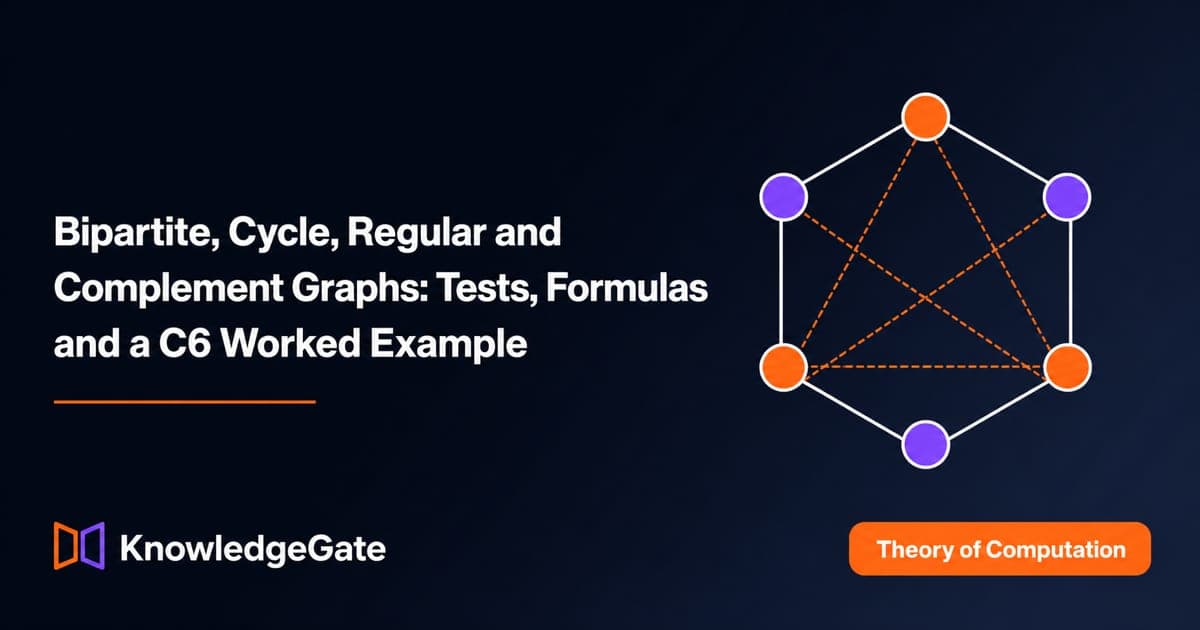
Bipartite, Cycle, Regular and Complement Graphs: Tests, Formulas and a C6 Worked Example
Learn a dependable order for classifying simple graphs, then apply it to C6 and list, count and test every edge in its complement.
Updated 29 Sep 20266 min readEngineering Mathematics
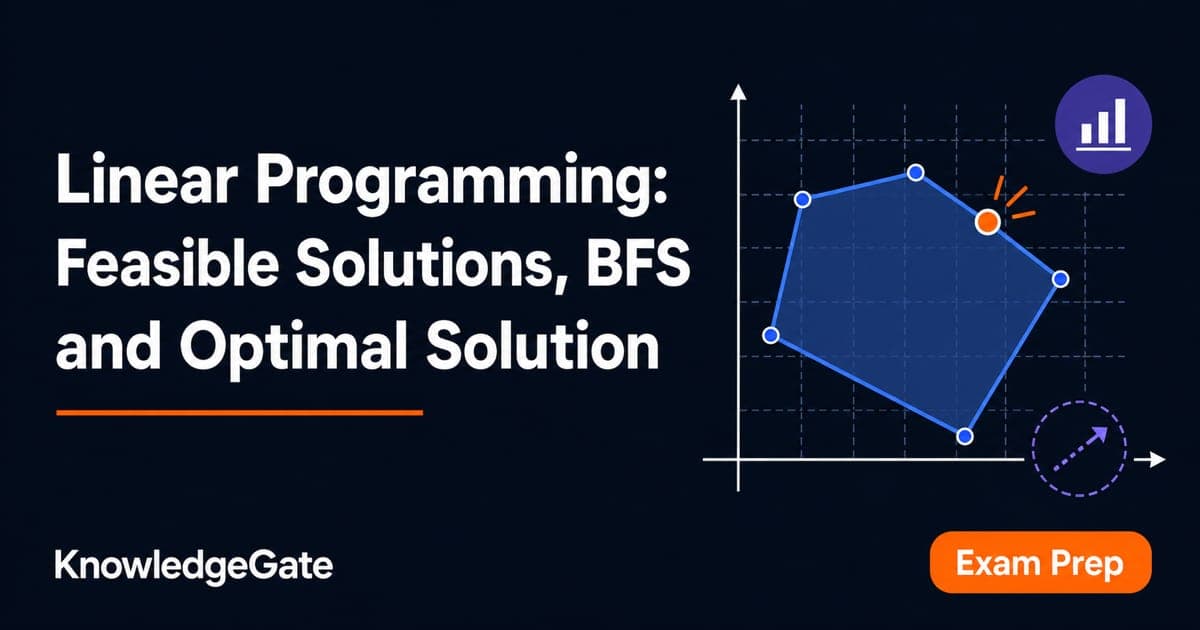
Basic Terminologies in Linear Programming: Feasible Solutions, BFS and an Optimal Solution Worked Step by Step
Separate feasible, basic feasible and optimal solutions through geometry, slack variables, vertex enumeration and concise counterexamples.
Updated 25 Sep 20265 min readEngineering Mathematics
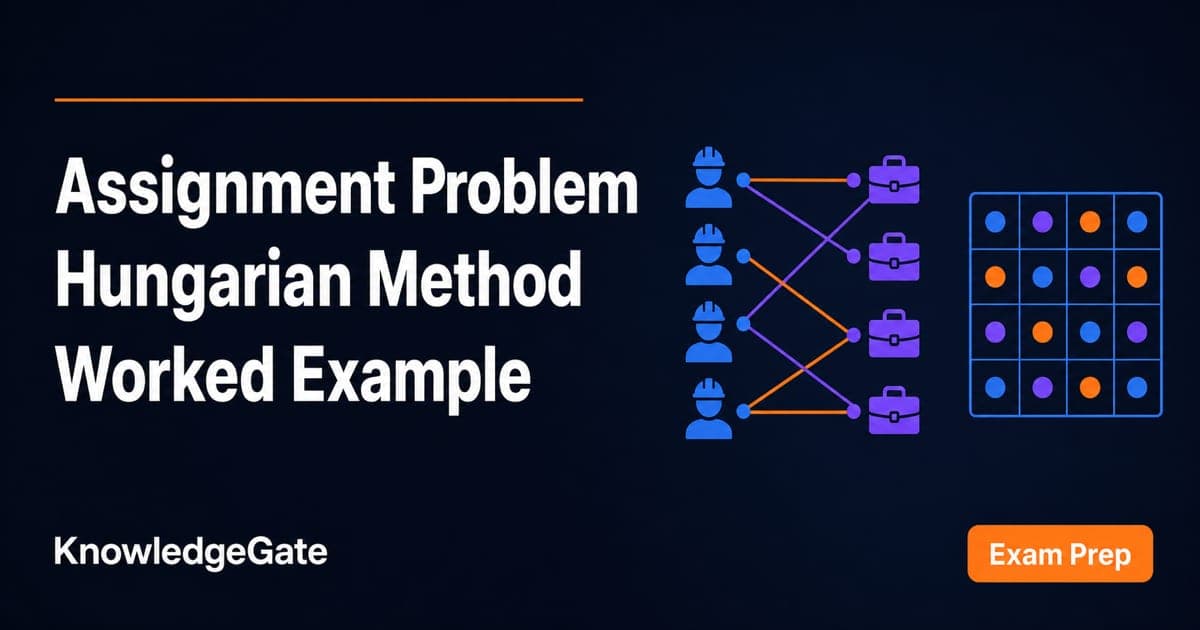
Assignment Problem and Hungarian Method: Formulation with a Complete Worked Example
Learn why greedy assignment fails, how matrix reductions preserve the optimum, and how the uncovered-value adjustment leads to a minimum cost of 140.
Updated 24 Sep 20266 min readEngineering Mathematics