Logic Gates MCQs: 12 Solved NOT, OR and AND Gate Questions
Test the three basic logic gates through 12 worked MCQs, then tackle truth-table size, bit masking, De Morgan's law, feedback and a custom operator.
KnowledgeGate Team
Exam prep & CS education
20 Aug 20267 min read116 views
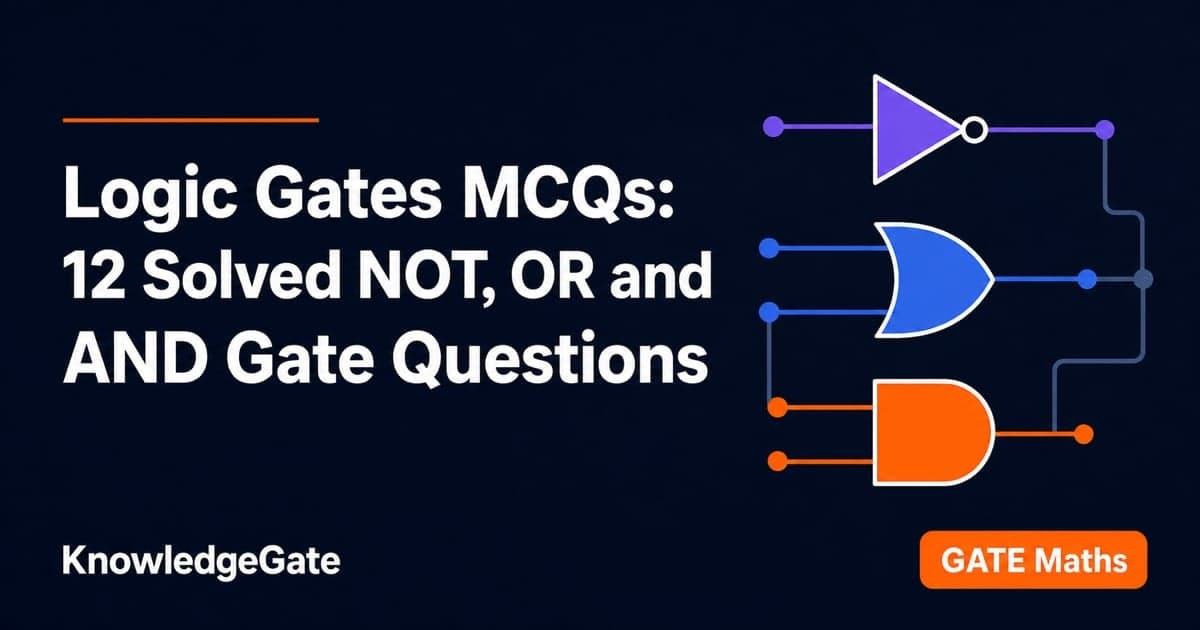
Basic gate MCQs often blur “at least one input is 1” with “all inputs are 1”, or treat Boolean complement as arithmetic. Both slips come from skipping the truth table. The fix is mechanical: name the gate rule, write the one row that decides the question, and only then read the options. It holds for a four-input truth table, a bit mask, a De Morgan rewrite and a feedback loop that has to settle. For where these gates sit in the wider syllabus, see GATE CS courses and practice.
NOT, OR and AND gates in one truth table
A logic gate implements a Boolean function. NOT complements one input. OR returns 1 when at least one input is 1; AND requires every input to be 1. The circuit's physical form does not change these rules.
Whatever the implementation, a truth table is the clean abstraction: list every input combination, apply the rule, and record the output. In Boolean notation, ′ means complement, + means OR, and · means AND.
A | B | A′ | A + B | A·B |
|---|---|---|---|---|
0 | 0 | 1 | 0 | 0 |
0 | 1 | 1 | 1 | 0 |
1 | 0 | 0 | 1 | 0 |
1 | 1 | 0 | 1 | 1 |
For A=1, B=0, NOT gives A′=0, OR gives A+B=1, and AND gives A·B=0. This row separates the rules. Digital Logic provides the broader concept map. Every other gate, NAND, NOR and XOR included, can be built from these three alone, which is why they are called the basic set.
Logic-gate MCQs 1-2: the basic set and inversion
Question 1
Basic logic gates are of _________ types.
A. 2
B. 3
C. 4
D. 5
Correct answer: B. 3
The basic set is AND, OR and NOT. AND and OR combine inputs; NOT reverses one input. NAND, NOR, XOR and XNOR are additional gates, so they do not belong in this count. Practise this question in the logic gates module.
Question 2
Which of the following statements about a NOT gate is true?
A. It adds two binary numbers.
B. It inverts the input signal.
C. It gives the same output as the input.
D. It multiplies two binary digits.
Correct answer: B. It inverts the input signal.
NOT maps 0 to 1 and 1 to 0, so its output is A′. Option C describes a buffer; addition and multiplication do not describe a one-input inverter. Practise this question in the logic gates module.
AND and OR gate MCQs 3-6: notation, truth conditions and statements
Question 3
What is the Boolean expression for the AND gate?
A. A + B
B. A . B
C. A' + B'
D. A' . B'
Correct answer: B. A . B
The full stop is the Boolean product symbol, so A . B means AND; A + B means OR. Complementing either input changes the function. Option B matches the table's A·B column. Practise this question in the logic gates module.
Question 4
The output of an OR gate is 1 if :
A. All inputs are 0
B. At least one input is 1
C. Only one input is 0
D. All inputs are 1
Correct answer: B. At least one input is 1
For two inputs, 01, 10 and 11 produce 1; only 00 produces 0. Option D is sufficient but not necessary. OR requires at least one high input, making B the complete rule. Practise this question in the logic gates module.
Question 5
For a basic two-input AND gate, which input combination will produce an output of 1?
A. A = 1, B = 1
B. A = 0, B = 0
C. A = 0, B = 1
D. A = 1, B = 0
Correct answer: A. A = 1, B = 1
The four products are 0·0=0, 0·1=0, 1·0=0, and 1·1=1. Any zero forces an AND result to zero, so only option A produces one. Practise this question in the logic gates module.
Question 6
Which of the following statement(s) is/are correct regarding AND logic gate?
I. The AND gate produces the output value 1 if input A and input B are both equal to 1.
II. The algebraic operation symbol of the AND function is the same as the multiplication symbol of ordinary arithmetic.
A. Neither I nor II
B. Only I
C. Both I and II
D. Only II
Correct answer: C. Both I and II
Statement I matches A=1, B=1, where A·B=1. Statement II is correct because a dot or adjacency denotes Boolean multiplication. Thus both statements hold. Practise this question in the logic gates module.
OR gate MCQs 7-8: a sensor application and truth-table size
Question 7
A railway crossing has 4 railway tracks. If a train comes on at least 1 of the tracks, the crossing has to be closed. Which gate can be used to implement this?
A. NAND
B. NOR
C. OR
D. AND
Correct answer: C. OR
Let T1, T2, T3, T4 indicate train presence. Then C=T1+T2+T3+T4: 0000 gives C=0, while 0100 gives C=1. AND would require trains on all four tracks. Practise this question in the logic gates module.
Question 8
An OR gate has 4 inputs. The number of words (i.e., rows) in the truth table will be ________.
A. 4
B. 8
C. 16
D. More than one of the above
E. None of the above
Correct answer: C. 16
With n binary inputs, a truth table has 2^n rows. Each input independently has two states. Here 2^4=16, covering 0000 through 1111. The gate type affects outputs, not the number of input combinations. Practise this question in the logic gates module.
Gate-operation MCQs 9-10: masking and De Morgan's law
Question 9
The mask logical micro operation is equivalent to which logical gate?
A. OR gate
B. NOR gate
C. AND gate
D. NAND gate
Correct answer: C. AND gate
Bitwise, 11010110 AND 11110000 = 11010000. A mask 1 preserves the source bit; a 0 clears it. OR sets selected positions, while NOR and NAND complement the intended result. Practise this question in the logic gates module.
Question 10
The Boolean expression (A·B)′ is equivalent to:
A. A′·B′
B. A + B′
C. A′·B
D. A′ + B′
Correct answer: D. A′ + B′
De Morgan's law swaps AND for OR and complements each input: (A·B)′=A′+B′. At A=1, B=0, both sides equal 1. Option A fails to swap the operator. Practise this question in the logic gates module.
Logic-gate MCQs 11-12: feedback and a custom Boolean operator
Question 11
Consider a feedback circuit made of three AND gates with intermediate signals defined as follows:
P = A·Y
Q = B·P
Y = C·Q
In a certain steady state, line Y is at 1. What are the possible values of A, B and C in this state?
a) A = 0, B = 0, C = 1
b) A = 0, B = 1, C = 1
c) A = 1, B = 0, C = 1
d) A = 1, B = 1, C = 1
A. d only
B. Both a and b
C. Both a and c
D. a, c and d
Correct answer: A. d only
Work backwards. Y=C·Q=1 forces C=Q=1; Q=B·P=1 forces B=P=1; and P=A·Y=1 forces A=1. Therefore only d, (A,B,C)=(1,1,1), is possible. Practise this question in the logic gates module.
Question 12
Let # be a binary operator defined as
X # Y = X′ + Y′ where X and Y are Boolean variables.
Consider the following two statements.
(S1) (P # Q) # R = P # (Q # R)
(S2) Q # R = R # Q
Which of the following is/are true for the Boolean variables P, Q and R?
A. Only S1 is true
B. Only S2 is true
C. Both S1 and S2 are true
D. Neither S1 nor S2 are true
Correct answer: B. Only S2 is true
OR is commutative, so Q′+R′=R′+Q′; S2 is true. For S1, take P=0, Q=1, R=1. Then (P#Q)#R=1#1=0, but P#(Q#R)=0#0=1. The unequal sides disprove associativity, so S1 is false. Practise this question in the logic gates module.
Answer pattern, common traps and the next practice step
Question | 1 | 2 | 3 | 4 | 5 | 6 | 7 | 8 | 9 | 10 | 11 | 12 |
|---|---|---|---|---|---|---|---|---|---|---|---|---|
Answer | B | B | B | B | A | C | C | C | C | D | A | B |
Four traps recur: reading Boolean + arithmetically, making “all inputs are 1” the OR rule, forgetting 2^n truth-table rows, and applying De Morgan's law without swapping AND and OR.
After one day, redo Questions 7, 9, 11 and 12 without the key. They test translation, masking, backward propagation and counterexamples. Write the expression before substituting values; if an answer fails, return to its decisive truth-table row. Then use Digital Electronics MCQs for adjacent practice.
For structured study, continue with GATE Guidance by Sanchit Sir. For timed mixed practice, use the GATE Test Series. Translate words into a Boolean rule, test one decisive row, then choose.
Keep learning
Special Logic Circuits MCQs: 12 Solved Questions on Adders, Encoders, PLA and DAC
Solve 12 special logic circuits MCQs covering recognition, hardware counts, Boolean identities and numerical calculations. Each answer includes the reasoning you should reproduce in an exam.
19 Sep 20268 min readDigital Electronics MCQs
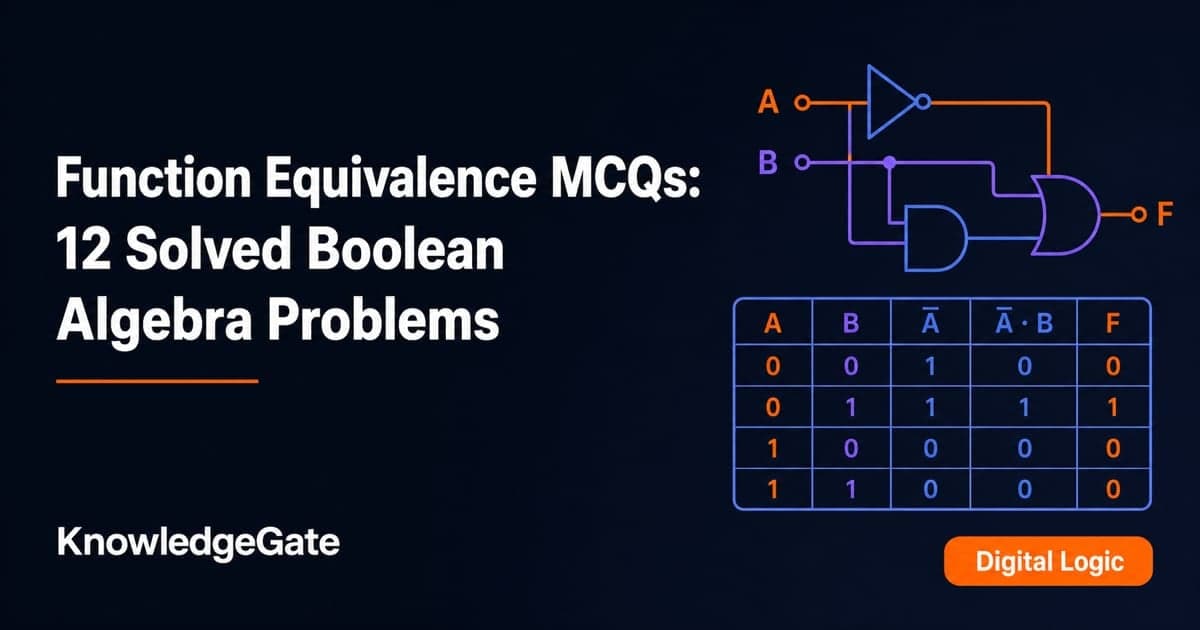
Function Equivalence MCQs: 12 Solved Boolean Algebra Problems
Solve 12 function-equivalence questions step by step, from De Morgan's law and absorption to minterm sets, counterexamples and a four-option MSQ.
Updated 17 Sep 20268 min readDigital Electronics MCQs
CLA & Arithmetic Logic MCQs: 10 Solved Questions with Explanations
Solve ten CLA and arithmetic logic MCQs with compact workings for carry equations, timing paths, hardware sizing and operand-pair counting.
Updated 16 Sep 20267 min readDigital Electronics MCQs
Sync Counter Design MCQs: 11 Solved Questions on Modulus, State Sequences and Excitation Logic
Solve 11 synchronous-counter questions covering modulus boundaries, repeated outputs, common-clock tracing, excitation equations, enables and composite states.
Updated 14 Sep 20267 min readDigital Electronics MCQs